
In the Modern Theological sense, of which Pentecostal theology was both inheritor and co-creator, predestination was a divine choice placed before the individual, not a rigidly pre-cut and defined path to Heaven or Hell. The believer, which is to say the one who recognized their calling as Jimmy had, is continually faced with choices. There is a predetermined outcome in a vague sense, through accrued choices. One is not pre-selected for Heaven because they went to church one, twice, or even three hundred times. Instead, the likelihood of having a Heavenly address in the afterlife is probable because of the character and quality of the individual who is refined by habitual decisions to go to church, who is shaped by being in a community of faith, and who remains open to listening to God and deciding to embody the words of God to them.
An individual is never “chosen” to damnation and eternal torment simply because God made a decision billions of years ago and there is nothing else to be done about the matter. Rather, one builds their own prison cell in Hell by habitual sins, first by choosing wrong, then choosing evil, slowly constructing a lifestyle of evil to then continually, habitually, eternally make wrong decisions. Damnation is, in this sense, the fully anticipated and expected outcome of such an individual. Broadly, God is not surprised by the evil of humanity and is incapable of being surprised. Rather, God is just in declaring humanity evil – even before the individual is born – because, if God knows each individual, God also knows who they are, what they will become, and shows favor or judgement. Further, those bothered by God deciding one’s eternal state millions of years ago or even in the future are pre-supposing that God is restricted by time or part of the linear, sequential movement of time. God, being God, is not bound by time. A decision made by God in the future could also be said to have been made in the past because God is in no way restricted by time, but entirely outside of it. This kind of thinking, when pressed like this, may very well create an existential crisis for any number of us because we, unlike God, are restricted by time and the revealing of information. We are shaped by the past even as we participat in events at present, unaware and lacking insight into how our previous decisions predispose us to make the “choice” we are making at this moment, even as our future self will likely forget the details of the decisions we are making at this moment but will nevertheless be shaped by it, consciously or otherwise.
For Jimmy, and for many Modern Calvinists, the pressing concern of having to make right choices, to overthink every decision, naturally created an anxiety that he mentions (though never explores) continually over the decades through sermons, interviews, tracts, books, in his autobiographies To Cross a River (1977) and Amazing Grace (2018), in magazine articles for The Evangelist, and in conversations on his various programs throughout the years. It caused him to feel unnaturally distracted, bedridden with depression and unable to fly the ministry’s plane whenever it rained for fear, overwhelm, and questioning himself. The anxiety appeared in the next generation with Donnie, and again in Donnie’s son, Gabriel, raising a legitimate question about how much of a role heridity, predisposition, and exposure to incomplete ideas played in the Swaggart family. Donnie’s other children, Matthew and Jennifer, disappeared from the stages of Jimmy’s crusades after all and, in adulthood, only appeared in annual family photos because they were “shy.” It is entirely possible that the choices they made were in the shadow of Jimmy’s teaching that God was both surprised (as Martin Luther might have taught) and not at all surpised (as John Calvin taught) by our actions. Neither strand, however, made an effort to explore the consequences of such teachings. Noting the importance of different views and emphases within theology, Professor of Theology at Wheaton College, Keith L. Johnson, Ph.D., writes in his Theology as Discipleship (2015),
Many people think the formal study of theology produces unnecessary divisions in the church. Even though reading the texts of the great theologians can bring great benefits, it also can produce a sense of disillusionment. Many of the theologians widely considered to be among the best thinkers in church history starkly disagree with one another about core matters of doctrine. Not all of them can be right, and in fact, many of them think the others are gravely wrong. Often, these great theologians have entire schools of thought centered around their views which stand in opposition to other schools of thought based on the work of other theologians. The existence of these divergent schools of thought puts us in a situation where the label “Christian” is not enough. We also have to figure out what kind of Christian we are – whether it is Thomist, Lutheran, Calvinist, Arminian, or so on. While such labels can help us recognize important difference between various approaches to theology, they also can divide Christians from one another and hurt the church’s witness.
“Paul makes this point when he criticizes the Corinthians for engaging in “jealousy and quarreling” between those who held to the teachings of Apollos and those who identified with Paul himself… Paul’s point is clear: our theological distinctions are not irrelevant, but even so, they must be relativized by our common bond in Christ and commitment to the church’s mission. Any theological distinction that unnecessarily causes us to lose sight of this unity and purpose undermines the integrity of the church and the gospel it proclaims.”
Theology as Discipleship by Keith L. Johnson (2015)
Increasingly for Jimmy though, these differences were not merely disagreements. They were aberrations, even perversions of the Gospel message. Johnson continues to point out that Paul’s instructions “have rarely been followed by the church’s theologians” and that even the great theologians have too often fallen into divisions, or emphasized divisions, to the harm of the Church. “In fact, more often than not, theological debates proceed just like contemporary political debates, with each side defending its views at all costs while assuming that their opponents are not only wrong but also morally and intellectual[ly] deficient in some way. This leads to a type of theological partisanship, where adherents of a certain view repeat their party line without charitably considering other arguments or striving for reconciliation with their opponents.” For Jimmy, this was certainly true. Given Frances’ clear alignment with and embodiment of Calvinistic premises contrasted with Jimmy’s of loose Lutheran ideas – empowerment of the individual, rejection of heirarchies, importance of the Bible to correct others (rather than develop oneself), criticism of the Church and its members, folk supernaturalism, crass language – one begins to wonder how much of Jimmy’s stage presence while preaching was a rejection of Frances’ rigid control of him as a musician. Further, there is the natural question of why Jimmy presented such arrogance on stage in contrast to the stories about how kind and generous, how soft-spoken he could be when he was not “performing.” His demeanor and personality were, after all, the direct opposite of Jerry Lee’s bombastic nature. Jimmy suffered from depression and anxiety that, unlike Jerry Lee, were not diminished by alcohol or accelerated by hard drugs.
Crippling anxiety is not unique to the Swaggart family or even Evangelicals. Pentecostals and Pentecostal-adjacent ministries of the 20th and early 21st Century religion seem fixated on “overcoming” anxiety and other various crises of the mind, ranging from Joel Osteen’s cheerful insistence on “overcoming” anxiety, Joyce Meyer’s “battlefield” of the mind, the sermons of Charles Stanley and T.D. Jakes on “winning” the inner life and “conquering” fear. Oral Roberts and his son Richard would shout at their “demons” to shut up. Tammy Faye Baker cried about her “shopping demon” that appeared whenever she and had a disagreement with someone, especially whenever her husband, televangelist Jim Baker, embarked on yet another one of the “stressful” building projects he oversaw at the PTL Network or Heritage USA Theme Park. Derek Prince, a British minister who found more success in America, methodically walked his listeners through steps to “defeat” depression, discouragement, anxiety, stress, and malaise. While Jimmy at times brought such thinking into his sermons, he was not willing to explain away his inner turmoil as demonic oppression or, as became popular during the Eighties, a demon of fear or one of depression. Nor did he, as so many in America who did not hold a mysteical worldview began during this same period, present anxiety and depression through science and rationality. There were such cases, yes, Jimmy believed, but the problem for the majority of people was neither demonic activity or science. Rather, he presented these issues as personal failures. Such a view is consistent with the Protestant Work Ethic of Calvinism as well as Modernity in the Twenthieth Century, which were often synonymous with one another.
By the closing decades of the Twentieth Century, American religion had transformed from a consideration of social responsibility to one of personal crisis, normalizing existential dread as the chief rival to American Christians instead of oppression by the wealthy, systemic racism, food shortages, overpopulation, global warming, or gender inequality. Jimmy did his best to direct the ministry toward other matters, but his own fears and anxieties would often bleed through sermons before undermining him entirely. He would refuse to answer the phone in hotel rooms whenever he traveled, fearful of who might be on the other side of the call and what they might ask him. As he had done with his music career, he often second guessed whether he had “heard” the voice of God to go on the radio and later television, to settle down in Baton Rouge, to travel abroad, to invest in farmland and develop it around the ministry’s headquarters, to build a Bible College, to start a university, to record another album. Anxiety would have undeniably stunted everything he wanted to do for God had it not been for Frances.
There is a direct and unbreakable connection between the predestination of Calvinist thinking and America’s religious experience. One does not even have to be especially religious to feel a looming dread of facing ruin and damnation in America. Calvinism was baked into the culture, government, economic policies, division of labor, food and folkways, architecture, communication, literature, and social structure of America. It is laced through the signage of National Parks and Historical sites, decorating museums of early America if only one knows what to look for.
The first settlements were organized around Calvinism.
- Quakers, seeking to escape persecution in Europe (often from Calvinists), found a new kind of persecution in America whenever they lived among Puritans, the inheritors of Calvinism on the new continent.
- Men who did not have “abundance” on their farms were suspected of idleness, a sin, or may have been under a curse from God for private sins.
- Puritans, with deep superstition and a pressing belief that every malady and disagreement had its source in spiritual darkness, persecuted women and demanded constant productivity from men simply trying to survive. If women were unable to produce children, Puritans claimed she was not “fulfilling” her marital “duties” or “obligations” and, unproductive, would not find salvation. If a woman had children but was unmarried, the “labor” of her survival and that of her child was for naught. After all, without a husband to oversee the fruit of her labor, and complete her, she was either a whore or a witch, both subject to court fines and ultimately death for their “public indencency” of existence.
- Early records of the settlements like John Smith’s “General History of Virginia, New England, and the Summer Isles” (1624), Thomas Morton’s “New English Canaan” (1637), and William Bradford’s “Of Plymouth Plantation” (1651) each depict settlers placed under a divine whip of governors profiting from their labor. Settlers were denied a heavenly reward because they sinned grievously in expressing frustration with an unjust ruler, doubt that a God of mercy supported theft and murder of the Native People, or turned away from their assigned labor in hopelessness.
- As one colony settled and others began to appear, the migration of Europeans across the American continent and their slaughter, displacement, and destruction of the First Peoples was forgiven as part of the Calvinistic teaching of Manifest Destiny, whereby the faithful were destined to take the New World from savages, exploit their resources, murder their warriors, sexually enslave their women, and generously displace those who obeyed.
- Bombarded by relentless sermons denouncing the sinfulness of genocide, Christians turned their wickedness toward legitimizing and enforcing “domestic” and “indentured servitude”, legalizing a new and perfectly legal form of oppression, slavery. Legalizing slavery was even a form of economic expansion, assuring pirates and trading companies that there would be a reciprocal market in the New World built upon the bodies of the enslaved. Good business and focused devotion to building God’s Kingdom was, after all, a form of godliness.
- The enslaved were taught that there salvation would come about not through conditions of the heart, not through prayers or church attendance, but instead through hard work and obedience. Enslavers (sellers) and those who enslaved (buyers) insisted upon their charges scripture out of context. “Slaves, obey your earthly masters with respect and fear, and with sincerity of heart, just as you would obey Christ,” reads Ephesians 6:5 and Colossians 3:22-25 expands upon it, “Slaves, obey your earthly masters in everything; and do it, not only when their eye is on you and to curry their favor, but with sincerity of heart and reverence for the Lord. Whatever you do, work at it with all your heart, as working for the Lord, not for human masters, since you know that you will receive an inheritance from the Lord as a reward. It is the Lord Christ you are serving.” The wise and industrious enslaver had a profit motive to perpetuate such teachings inside the Church, expanding these verses with gentleness and determination to include “workers” instead of “slaves”, creating an entirely new line of psychological and spiritual oppression under the auspice of Biblical obedience.
- Slavery was protected in the South because of Calvinism. Primarily Catholic, at least initially, as the South was explored by Spain and France, Southerners were well acquainted with a looming sense of dread experienced by the poor, people of color, women, immigrants, and the deeply religious who do not subscribe to the teachings of the elect (Calvinists) are, as they have been for centuries, deemed “the damned.” Damnation takes many forms in Calvinist thought, especially poverty – poverty of mind, heart, will, spirit, and yes, finances.
Calavita cuts to the heart of the matter when she writes that there is an “elective affinity,” to use Weber’s term, between Calvinism, capitalism, and rationality. Increasingly in the latter half of the 20th Century, the primary evidence of “God’s blessing” and “God’s favor” was personal wealth. Success in any area, particularly through the “security” of wealth, the amassing of private fortune, or financial privilege, was synonymous with American narratives of manifest destiny, itself a Calvinist teaching regarding one’s salvation which was transformed and repurposes to instead describe the estate one was born into. GOd chose some people to be born into slavery, conveniently they were people of color and conveniently they could be found for purchase at the local dock. God also chose some people to be born outside of slavery, typically Whites but most certainly Whites who had some measure of freedom evidenced by their skin color and, hopefully at least, a small amount of possessions – land, dishes, clothing – as evidence of their divine providence. The wealthiest and most privileged were, by definition in this new exegesis, closest to God, who would not entrust them with wealth and privilege had they not already been destined for it.
This was what was always intended. The universe gifted the fortunate. An individual was meant to be wealthy, it was their destiny and the collision of circumstance through which the stars aligned, providence was revealed, and an individual succeeded. Those who were poor, whether through birth or circumstance, were damned. Gone were sermons about the eternal state of the soul in Heaven or Hell.
When Jonathan Edwards delivered his infamous sermon, ‘Sinners in the Hands of an Angry God’, it was a reaction against rapacious clergy and an apathetic populace.
This is the history that Fundamentalists would continually enshrine, Jimmy Swaggart among them. Sermons, especially throughout the late Eighties, early Nineties, into the Aughts, reflected the American concept of favor not in ways reflected through scripture or tradition but through financial prosperity. While Frances Swaggart took this same approach, she also embodied the Protestant Work Ethic.
The Protestant work ethic, also known as the Calvinist work ethic or the Puritan work ethic, is a work ethic concept in sociology, economics, and history. It emphasizes that a person’s subscription to the values espoused by the Protestant faith, particularly Calvinism, result in diligence, discipline, and frugality. The phrase was initially coined in 1905 by sociologist Max Weber in his book The Protestant Ethic and the Spirit of Capitalism. Weber asserted that Protestant ethics and values, along with the Calvinist doctrines of asceticism and predestination, enabled the rise and spread of capitalism. Just as priests and caring professionals are deemed to have a vocation (or “calling” from God) for their work, according to the Protestant work ethic, the “lowly” workman also has a noble vocation which he can fulfill through dedication to his work.
Weber’s book is one of the most influential and cited in sociology, although the thesis presented has been controversial since its release. In opposition to Weber, historians such as Fernand Braudel and Hugh Trevor-Roper assert that the Protestant work ethic did not create capitalism and that capitalism developed in pre-Reformation Catholic communities. Historian Laurence R. Iannaccone has written that “the most noteworthy feature of the Protestant Ethic thesis is its absence of empirical support.” The concept is often credited with helping to define the self-view of societies of Northern, Central and Northwestern Europe as well as the United States.
Frances would have also been aware of the potential religion had for financial gain. There were all kinds of charlatans crisscrossing the United States who, like the snake oil salesmen before them, made quick profits from the faithful looking for an immediate answer to their desperate prayers. As Proverbs says, to the hunger soul, even the bitter things are sweet. As the Gospels and the Book of Revelation say, there will come a time when people will look for signs and in doing so, will be exploited to their harsh detriment. Frances knew this was not what Jimmy offered. His reluctance was a testment to this. Her husband lived in a perpetual state of fear – of making a mistake, of loosening himself from their straight-laced bootstrap lifestyle, of placing himself before God as Jerry Lee had done. Such a life now affected her, their child, the opportunities she knew they deserved. And so, like Jimmy, she looked to the recent past.
Jimmy familiarized himself with evangelists like Oral Roberts, Asa Alonso Allen, F.F. Bosworth, Jack Coe, and Billy Graham. He lived in their shadow and carefully studied their ministries, deconstructing them with the careful mind of an engineer. Jimmy cataloged and recalled their sermons, musical accompaniments, migration, finances, the way other men might studiously collect data on their favorite baseball team. He knew every detail. One minister he did not seek to emulate was Aimee Semple McPherson, who touched the nation through radio and music without ever needing to leave her base in Los Angeles. Healing evangelists lived a hardscrabble life, ranging from town to town, sleeping in basements or church halls. They often died there too. For all of the great faith they inspired in their audiences, they died for entirely preventable reasons. Jack Coe died from bulbar polio at the end of 1956. He was only 38 years old. F.F. Bosworth suffered from delusions during the last months of his life, probably the result of a series of strokes or respiratory medullary failure, like his brother B.B. who died around the same time. Roberts, having lifted his arms to lay hands of healing on tens of thousands, had to undergo surgery on his shoulders in the sunset of life.
If Frances embodied the capitalist side of the ethic, Jimmy embodied the spiritual. Together, the ministry was destined for success.
In 1960, Jimmy took another step toward his destiny. His records began to air on Christian radio stations. In 1961, he was finally ordained by the Assemblies of God. The following year, 1962, he began to record sermons to officially begin his radio ministry. By the end of the decade, he would take over his father’s church in Baton Rouge to anchor the ministry. By then, Frances had become insistent that she and Donnie have a home. The years were hard on them, and Frances felt that Donnie’s education and social life had suffered tremendously from their itenerant way of life. Instead of living in basements, guests rooms, hotels, and the back of the car, she demanded that they buy a home and settle down. That Donnie be allowed to attend a school. There was only so much she could teach him, and enrolling him at schools for weeks at a time was not a real education. Donnie did suffer, and greatly. He was socially inept, functionally illiterate, and unskilled at basic math. Teased for his limitations, Donnie was also teased – as Jimmy had been – for the strange religious beliefs and behaviors of his parents. This was one of the primary reasons Jimmy and Frances wanted to settle in Baton Rouge, so that Donnie could begin attending school regularly and correct his limitations.
Jimmy’s sermonic records reflect a natural extension of his original claims in Ferriday, emphasizing a coming apocalypse with titles like “Flying Missiles, Atomic Bombs”, “The Plague”, and “What Shall the End Be?” that prevails and at times overwhelms. Apocalyptic preaching, thinking, theology, the recurring fascination with the end of the world and coming judgement, God’s wrath, destruction of the planet, the need for salvation and assurance in the coming horrors, and the constant threat of demonic activity in one’s life. Examined year by year, even decade by decade, Jimmy’s anxieties do not leak or freely bleed, they hemorrhage and stain.
This was not his best work.
- “Religion Without a Reproach” and “A Crown Without a Cross” (1957)
- “The Plague” (1959)
- “What the Bible Says About Drugs”
- “The Ring of Fire” (1969)
- “What Shall the End Be?” and “Is There Really a Curse on the Kennedy Family?” (1969)
- “Flying Missiles, Atomic Bombs” and “The Second Coming of Jesus Christ” (1972)
- “The Gifts of the Holy Spirit” (1973)
- “The Truth About Demon Spirits” (5 LPs)
- “Healing is for You” (5 LPs)
- “Victory Over Fear” (5 LPs)
- “Jesus: A Biography (10 LPs) (1975)
- “House of David Bible News: Abraham” and “House of David Bible News: Jacob” (1977)
His best work, remarkably, was the longer-form series he took on to balance the ministry. In 1975, the ministry put out Jesus: A Biography as a whopping 10 record LP collection, with over 200 actors, musicians, and producers. When technology changed to cassettes, it certainly freed up the cost of production. He taught a series on the Christian Home, the Gospels, the life of Elijah, freely lifting from the notes and commentary of the Scofield, Dakes, and Thompson Chain Reference Bible for a series on the Pre-Adamic world or “anti-diluvian age” and the fall of the heavenly creation – angels, demons, and other spirits. The Pentecostal Message, as he understood it. He preached against alcohol and drugs regularly. Against abortion. Movies. Music. “False religion.”
More and more, he “didn’t mean to be unkind”, but he expressed frustration with politicians, with young people, with the Feminist movement, with “the HO-mo-SEX-uals” and “ungodly filth and pornography” in Hollywood. He preached against Christians who wanted to use the levers of power and politics to accumulate power and prestige. He took aim at other ministers, who had either made a mockery of the simplicity of the Gospel with their advanced degrees or who had no training at all – “poor fella” – and were “stupid, just stupid, absolutely dead-for-brains, flat-out totally stupid without a lick of sense.” He took aim at Catholics, Baptists, Methodists, and increasingly his own denomination, the Assemblies of God.
With each wave of invective, Swaggart continued to alienate himself.
Initially, his ministry expressed gratitude to his audience for allowing him into their homes and lives. He was a friend. Someone who wanted the best for them. He spoke about God’s love, how God had a plan for each person even if they were not saved. He spoke about the gift of salvation God offered to each person, a new life of meaning and purpose and fulfillment. The Spirit of God was not some strange thing, foreign and shameful. The Holy Spirit was a friend, a comforter and counselor who wanted to help each individual find their place in the world and be at peace. It was a compelling invitation, one mixed in with Southern Gospel music and personal anecdotes. It was also more progressive than it is often remembered.

Jimmy was an advocate for racial reconciliation, at least as he understood it. Raised in the South, many things were accepted as conventionally widespread, inevitable, part of the ways in which the world moved. Imbedded, systemic racism was so fundamental to the culture of the American South that to question it, a laughable but forgivable lapse in one’s sense and reason, was like questioning what day of the week it was. To challenge it was something else, an insult to the way the world worked. It was a denigration of the Lost Cause, an insult to the memory of Robert E. Lee and one’s ancestors and neighbors, to the land one lived on. A challenge to the widespread culture of racism was tantamount to a new declaration of war against kith and ken.
Racism was every bit as much a part of the South as widespread poverty. It was God’s divine order. In the first book of the Bible, Noah curses his son Ham after their family survives a great flood. Depressed, Noah gets drunk and his nakedness is “uncovered” by his son. When Noah awakes, he curses Ham to endure servitude or slavery forevermore. What could this be, if not evidence that God had blessed the American nation for enslaving Africans? It is quite the interpretive leap, but entirely logical if one grew up in the American South, where hard work, farming, agrarian life, and (of course) denigration of people of color was the only way forward. As capitalism was allowed to tighten its hold over the life and thinking of America, racism became more pronounced, further entangling one thing with the other.
The Swaggarts were not convinced that Noah’s curse against Ham meant what many Southerners believed. There was nothing in the curse about Ham’s skin color changing, nothing to support his migration to the African continent with a similarly cursed Negress wife to produce Black children who were enslaved. The conventional timeline of Evangelicalism, that the Earth was a mere 6,000 years old also did not support this. Jimmy alone had read enough National Geographics in the Ferriday library to know African culture was far more ancient than Evangelicals wanted to insist. A student of history, Jimmy also recognized that European and Dutch traders invaded and enslaved Africans, turning human life into a saleable good for purchase alongside their spice and furniture trades. He had read about William Wilberforce, whose Christian conviction compelled him to abolish slavery. He and Jerry Lee learned music from Blacks in Ferriday and had gotten to know them, had grown up with them, even admired their intelligence, individually, and culture, generally. Blacks worshipped like their grandmother did, loudly and enthusiastically. Surely, if God had “cursed” Blacks into slavery, the Swaggarts and Lewis and Gilleys were similarly cursed. This was something Jimmy could not accept.
Expanding the scope of the family, there were more intimate reasons to reject the angry racism of the South. The Swaggart, Lewis, and Gilley men, like many men in the South, had second families with Black sexual and emotional partners, they had unacknowledged children with them. They were, again, like many men in the South. Especially those who, like the Swaggarts, Lewises, and Gilleys, who experienced poverty in ways that eroded any class division between the races. A poor White was not the better of a poor Black. Only wealth could correct that.
Of course, Jimmy would deny any of this. His grandfather, the former sheriff turned grocery store owner, was an upright man who would never defile the marriage bed and certainly not step beneath his impoverished station to humiliate the family by sleeping with a colored woman.
Rather than admit the curious history of his family, Jimmy placed emphasis on the Pentecostal message of acceptance and racial reconciliation. It smoothed the narrative for him, allowing him to understand his grandfather as a hero who could overcome racial division rather than impoverished or an adulterer. And American Pentecostals, like Swaggart, preferred their blurry origins. As Pentecostalism was being “founded” on the American continent at the start of the century, Charles Parham’s acceptance, at least initially, of people of color brought together progressive, even liberal ideas that were unconventional in the South.
Typically, the South is depicted as a solid block of racists, incestuous pedophiles, the ignorant. And, of course, Blacks were too poor to move elsewhere. Both stereotypes are false. There were a number of schools built in the Louisiana settlements by the French, including schools for women and people of color. After the Civil War, many Blacks left Louisiana, Alabama, and Mississippi for Los Angeles, where a booming fruit and real estate market allowed many people of color to make a living wage. This is how William Seymour came to travel the South, then Kansas where he was to meet Charles Parham, then Texas, then Los Angeles. Many left for Tulsa, Oklahoma, where there was a promise of Black culture, homesteading, and economic opportunity. The success of Oklahoma City attracted so much attention by neighboring Whites that it ultimately ended with what is commonly known as the “Black Wall Street Massacre” of 1921. Many simply scattered, pulling up stake – like William Seymour – to go anywhere that would have them. The Black Diaspora of America caused many families to lose their cohesive connection to one another, to their community, and to their identity. They sought meaning, purpose, and fulfillment, the readily identifiable pursuits of all humans. They sought connection, especially in the shadow of what was lost when they left to go elsewhere.
Parham’s ministry, dubious as it was, found common cause inside of Black churches. Unlike his contemporaries who may have quietly objected to racism but still lived their lives with segregated churches, groceries, bathrooms, schools, and neighborhoods, Parham crossed these lines to share the Gospel. There was, he said, no difference between the races. God had removed the lines of segregation when Jesus died. As Paul wrote in his letter to the Galatians, there was neither Jew nor Greek. Whiteness and Blackness were entirely arbitrary, Parham pointed out. After all, there were many Whites who had Black children. Thomas Jefferson was one of the more well-known examples of this supposedly rare, but very widespread occurrence. Historically, Whiteness and Blackness were social constructs, less identifiable than geography. Many pre-and-early Americans lived and behaved in ways that showed a tendency toward discrimination against religion, nationality, gender, social responsibility, alcohol consumption, folkways, and class far (far) more frequently than race. Slavery in early America was more often an economic condition, such as indentured servitude. In the first half of the 17th Century though, historians note that racism, at least in America, rapidly became more pronounced because of the institution of slavery and the forced migration of Africans to the New Continent. Racial awareness emerges more or less during this period, the first half of the century, and then slavery began to become primarily defined by race in the mid-17th century, efficiently rewriting history alongside social attitudes. Many laws were passed in the 1660s that explicitly tied enslavement to African descent, solidifying a system where slavery was largely based on race rather than other factors like social status or religion; Virginia is often cited as a key location where this shift occurred.
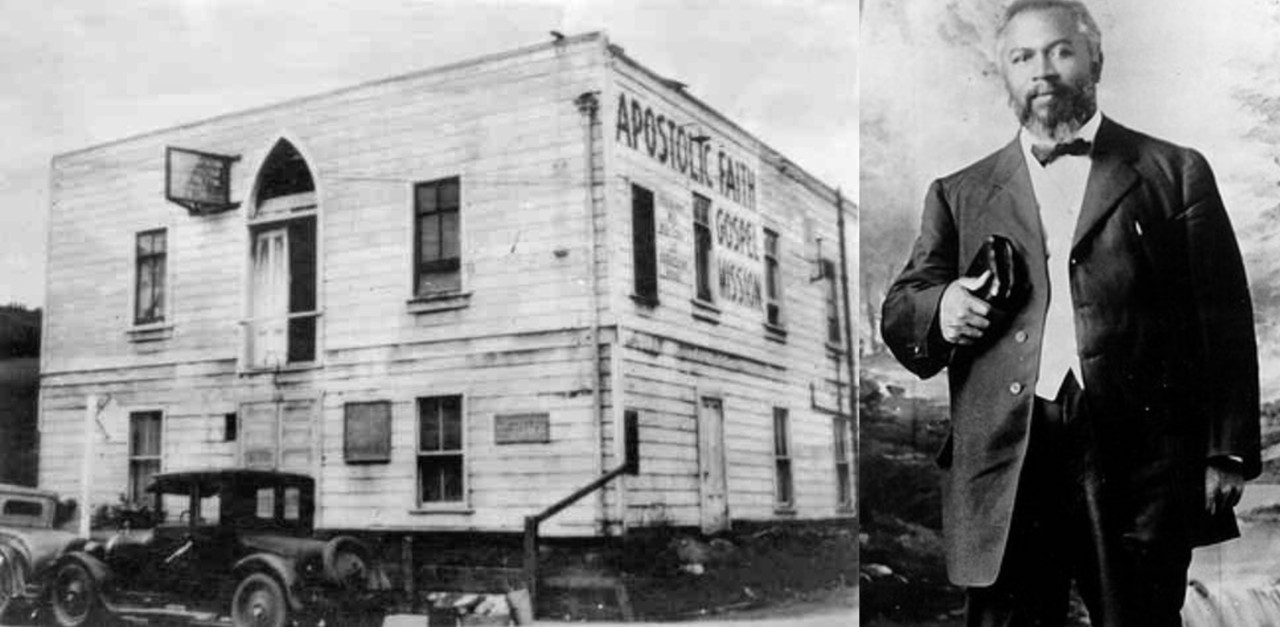
William Seymour, who briefly worked under Parham, came to recognize that scripture was not enough to overcome the racism embedded in the American experience. Kind racists, well-intentioned racists, racists who aspired to a new way of living, were still racists. Seymour, like many Black people, had to recognize the apathy of those who benefitted from systemic racism in actually, materially trying to change it. Seymour broke from Parham in 1906, leaving over “theological differences” for Los Angeles.
Parham’s contributions to Pentecostalism were significant and not to be minimized, particualrly his teachings regarding speaking in tongues as the “initial evidence” of God’s presence in the believer’s life. Perhaps his greatest contribution, without intention, was his emphasis on financial resources as “proof” of God’s blessing. There is a contradictory shift in his ministry after Seymour leaves Parham behind, perhaps indicating their break was not exclusively about the role of racial acceptance inside the Church. Around this same time, Parham became far more comfortable asking for money from his students, fellow ministers, and the congregations he visited. By the end of his life, Parham unapologetically discussed money and material wealth as evidence of God’s favor and, given the importance he played in the “founding” or “recovery” of the Pentecostal experience, this too became part of the Pentecostal message. Along with scandal. The last few years of Parham’s life were chased by one scandal after another, ranging from sexual impropriety, homosexuality, emphasis on money to the neglect of the Gospel, and teachings that were strange even to other Pentecostals who had, until then, readily accepted Parham’s “revelation” that Christians could speak in other languages, could physically heal the sick (even, in some cases, bring the dead back to life), and that God was active and present in the lives of believers. Parham’s emphasis as material wealth should be situated and contextualized as part of a cultural movement during the 1920s or “Roaring Twenties”, a decade of economic prosperity, cultural change, and new technology. However, the Great Depression began shortly after Parham died and with it came the collapse of banks and factory jobs.As well as foreclosures on farms across the Midwest and Great Plains. Compounding financial collapse on Wall Street and the banking industry, Americans experienced widespread drought, those farms that were not dependent on banks experienced blight and their cattle and livestock began to suffer malnutrition and disease. In the South, the Great Mississippi Flood of 1927 brought oil, gas, farming, cotton, and shipping to a standstill for months. Taken together, these circumstances drove many to harden their faith. In larger cities, many turned away from the Social Gospel of interreliance and betterment of society for an internalized piety that denied and rejected others as a means of survival. Many churches, seeking someone to blame, averted their eyes from sins like incest, racist murders, moonshining, and the “disapperance” of bankers and legal officers who tried to seize properties. Some families gave their children away for adoption, unable to feed another hungry mouth in an already strained home. Quietly, some women prostituted themselves. Husbands looked away when their wives and daughters “went for a walk” to visit their “uncles”, as long as they came back with money. Around the country, Americans escaped reality through music and radio programs. There were dance competitions that lasted for days, weeks, even months at a time. Contestants could earn food and cash prizes, a precursor to reality television. In such conditions, and with no job to consume their time, many Americans learned to play the piano, the guitar, perform folk and country music as an outlet for their experiences.
The Roaring Twenties and Terrifying Thirties had not yet come to pass. When Parham and his student William Seymour parted, Parham continued to make distinctive marks upon Pentecostalism, embodying the criticisms and caricatures that would come about and define the movement. Seymour, in juxtapose, went to Los Angeles and would build a similar but tellingly unique alternative to Parham’s framing of the Pentecostal experience. Where Parham believed in the annihilation of the damned after the return of Jesus, Seymour held to a more conventional and traditional belief in eternal damnation. Where Parham held out the possibility that the Pentecostal experience of glossolalia was either a public utterance (prophesying or “speaking” in tongues) and “praying” in tongues (for private spiritual growth) in an angelic or heavenly – and thus unknown, unidentifiable – language, Seymour held to a more identifiable xenoglossy, or a belief that tongues were known and identifiable, though not necessarily by the speaker. Parham’s presentation allowed for the individual (and, presumably, their local church congregation) to simply accept tongues and other features of the Pentecostal experiences uncritically. Seymour may have held to the view of his teacher before leaving him in Houston, Texas, but expanded on it once he was surrounded by so many languages in Los Angeles.
More, Seymour saw tongues as part of a larger and more recognizable phenomenon, xenoglossy, where a person was able to speak, write or understand a foreign language that they could not have acquired by natural means. This may seem an insignificant difference, the proverbial splitting of theological hairs, but as Seymour saw it, “tongues” were far more practical than Parham had taught. As the Christian Scriptures admit, there are different gifts and giftings of the Spirit of God. The Pentecostal experience was not limited to, or restricted by, this singular gift. Instead, Seymour taught that “tongues” as discussed in the Pauline epistles could also encompass any kind of communication. The mute, for instance, could “speak” in tongues through other means than mere verbal speech and did not need to be “healed” of their disability to be used by God or to experience the presence of God. What couple explain the universal acceptance of the ethical and social teachings of Jesus, Paul, James, and Peter except the power of God’s Spirit? One did not have to be fluent in Greek, Hebrew, or Aramaic to feel the power and presence of the divine. Further, Parham was given too much credit. While he billed himself as the one who restored the Pentecostal experience to the church, he was not the one who spoke in tongues first in Topeka, Kansas. That had been Agnes Ozman. Parham’s simplification did not end with theology; it allowed Parham to tell events differently through omission. Taken in case, as Parham taught it, tongues were strange utterances for private communion with God. What of the interpretation of tongues that Paul wrote about 1 Corinthians 14? Wasn’t this also a spiritual gift, or experience, worth asking for from God? According to no less than the Apostle Paul and the Early Church, resoundingly yes. If Parham was short-sighted on this one issue, what else might he be short-sighted on? Race, perhaps. And if Parham was willing to deceive so that he could elevate himself and his own reputation, what else might he be lying about? In depicting himself as the one who recovered and restored the Pentecostal experience, Parham was erasing the experiences of women. Wasn’t racial equality and gender equality something that had led those first students to study with him in Topeka? Yet, in even a short span of half a decade, Parham was rewriting all of this for a conservative message that was no Gospel at all. As for Parham’s self-promotion stood in direct contradiction to the ethos of the Early Church, the one Parham claimed he wanted to restore to the world. It made no sense at the time and, in the decades that followed, continued to undermine Pentecostalism.
Parham died in January of 1929. And those who held to his teachings were left to wonder during the Great Depression about a great many things he taught. If God’s favor was shown by material and financial wealth, then America – Americans – must surely be under a curse of divine judgement. They weren’t “blessed”. They were not “liberated” and set free by the Gospel. They suffered and died. Poverty and hunger did not discriminate on the basis of church attendance, it was obvious. Poverty and hunger did not care whether one spoke, prayed, or prophesied in the tongues of men or of angels.
The differences between these two founders of American Pentecostalism go beyond race and their understandings of the experience and place of tongues in the life of the believer, though both of these are certainly important. Their differences speak to a shift taking place in American religion, one giving token blessing to inclusiveness while suppressing it at every turn, the other welcoming inclusiveness wherever it can be found.
Swaggart’s early ministry reflects this divide. At times, he clearly pulls from Parham’s Pentecostalism, the one that idealizes equality without actually practicing it, the one that views tongues as a cosmological and heavenly language rather than one more recognizable to the inhabitants of Earth. At the periphery, perhaps casting a wider net with the ministry, he is clearly indebted to Black people, Black ministries, Black theologies, which have historically been more inclusive and welcoming to racial reconciliation. White theologies, the kind Swaggart evolves away from, see race as a dividing line not worth questioning and beyond worth challenging. At the core, Pentecostalism has always been anti-clerical, anti-establishment, anti-institutional, and anti-intellectual. It may have been a theological melting pot, but that pot roiled with frustration and anger directed toward fellow Christians. Above all, this comes through in Swaggart’s early ministry and remained a constant throughout his life, occasionally boiling over as it did in the Eighties, Nineties, and Aughts.
In the crosshairs of Pentecostals, more than anything else, have been liberal theologies and the academic institutions that teach them. For the Pentecostal, for all Fundamentalists, institutions like Harvard, Princeton, and Yale with their “so-called” Divinity Schools have always “pushed” a “liberal agenda”, one that actively seeks the “destruction of America” and “Biblical values.” What is forgotten by Pentecostals is that these institutions were founded as theological centers for the American nation. Yale, Harvard, and Princeton were founded as, have remained, and will continue to be leading schools for theological studies. Only, they teach a broader understanding of theology than the uneducated and often illiterate cousins within Pentecostalism. To the Pentecostal, objectionable practices like welcoming ecumenical dialogue, interfaith understanding, multiethnic classes, interracial relationships are equitable to sin and thus, by extension, damnable practices. These schools teach false doctrines and false histories, a history where the Founders and Framers of America were not Christians who sought to establish a theocracy. A well-established fact, like the fact that Thomas Jefferson had slaves and had nonconsensual sex with them, is suspect or (being generous) a misunderstanding. Jefferson was, after all, a product of his time and should be forgiven for the financial exploitation of slaves. All of the enslaved women he slept with were surely mutual and consenting.
Look closer, though. The fact that Thomas Jefferson wrote the Danbury, Connecticut Baptist Convention to declare a “wall of separation between the church and state” is proof to those who are not Fundamentalist that Jefferson was never a Christian.
It’s a one-two step, a sleight of hand that gathers together favorable evidence and vehemently denies anything contradictory. Like a card cheat at the table, whenever Fundamentalists are called out for their deception, they overreact and threaten violence. Swaggart often angrily railed against “Communists” and “Socialists” Americans who did not appreciate America enough, or appreciate America like he did, or did not use certain keywords to evidence their patriotism and theological loyalty to America. He suggested violence against such people to his audience, often mocking supposed liberals” with falsetto voices, denigrating their views as “the stupidest tommyrot that ever was” and in need of “a seeing to.”
After all, what is more American than violence?
Thus, the Christian Thomas Jefferson should be forgiven for having slaves.
Thus, the skeptical Deist Thomas Jefferson, the one who took a razor blade to the New Testament to remove those instances of Jesus performing miracles but appreciated Jesus’ ethics, is damned to Hell.
Thus, the Humanist Thomas Jefferson, the one who clearly defines America as a government ruled by laws and not faith, is overlooked and ignored because he was never a Christian.
The deceptions, outright lies, and preference for “alternative facts” that would come to define Fundamentalists and their inheritors, Evangelicals in terms of race, theology, politics, and society well into the 21st Century and Swaggart frames much of the transitory state of America with questions, tensions, and contradictions that demand attention.
Including Swaggart.
Including Jerry Falwell.
And including another televangelist, Jim Bakker.


One thought on “Biography: Jimmy Swaggart, Chapter 15b”