
Jimmy Swaggart was the inheritor of an entirely different frame of reference than Jerry Falwell. As a Baptist, Falwell upheld a long tradition of individualism. What matters to the Baptist is their own individual salvation experience. As he tried to align with mainline Christians, Falwell vocally supported tenets of Calvinism, particularly predestination. Once Falwell became a political agent purchased by Paul Weyrich, Howard Philips, and Edward McAteer, predestinarian views were crucial to excusing the hostility he weaponized in the name of God. So Falwell began cherry-picking Calvinistic language. And, to many within the Presbyterian and Methodist circles as well as his own Baptist group, it made him sound reasonable.
Arminianism, in contrast to Calvinism, is derivative. It is a theological movement within Protestant Christianity that emerged as a response to Calvinism, particularly its doctrine of predestination. Arminianism emphasizes God’s universal love and the importance of human free will in salvation, rather than predetermined eternal state as in Calvinism. But it remains irretrievably an extension of the thing it rejects. Methodists and their subsequents, like the Assemblies of God, often get grouped in with the Arminians because they emphasize a shared responsibility in the salvation experience, shared between a God who “calls” people to salvation and the individual who responds affirmatively to the call. In the Arminian and Weslyan traditions, an individual may recognize they are “called” to salvation, to ministry, to any part of the human or spiritual experience, and refuse it. God’s will is breakable, it turns out, because God empowers the individual to make a choice.
Baptists continue to remain divided over eternal security because Calvinism is so present in so many other ways that have nothing to do with the eschatological concerns. Inherent to both Calvinism and Arminism, the principle of force majeure prevailed. Might makes right. Both expressions believe that the rich are powerful because God either destined them to be so or allows them to be so. God, in Calvinism and Arminism, often sides with the oppressor and oppressive apparatuses “for His pleasure” and “for His great purpose.” Those in authority are placed there by God, and all of the laws legislated and enacted are – by divine orchestration or permission – the will of God. End of discussion. To question authority or class, gender or sexuality, to question God in scripture or nature is forbidden because this presents a distrust in God or of God. Just like Calvinism.
While R.H. Tawney, author of Religion and the Rise of Capitalism (1922) reasons that “Lutheranism had been socially conservative, deferential to established political authorities, the exponent of a personal, almost a quietistic, piety”, that is not entirely accurate. Martin Luther, as a German priest within the Holy Roman Catholic Church, actively tried to work within the framework of his faith. He did not want to reject Catholicism, but the greedy practices of priests and cardinals, the spiritual corruption of their theology. This does not mean Luther was passive. Compared to John Calvin, Luther was far more emotional and far (far) less revolutionary in that he did not seek the active destruction of the Church. The Church itself, Luther maintained, was a beautiful thing and should be presented as a spotless bride adorned for an eternal marriage at the end of time. Luther was conservative in the sense that he wanted to repair and cleanse, rather than destroy and rebuild something new. John Calvin, by comparison, wanted to destroy the Church entirely and rebuild new churches through the centers of power – state control, yes, together with a shift in the minds and hearts of believers who saw their worth and power as expressions of God.
“Calvinism,” Tawney writes, “was an active and radical force” because it was willing to – literally – burn churches in the name of God. Because Calvin, and his followers, were willing to drown Christians who continued to examine the importance of baptism. Calvinists destroyed works of art, altar pieces, stained glass, anything beautiful and glorious because it was profane and distracted from purity of thought in single-minded devotion to an all-powerful God who “chose” believers to enact furious vengeance. Calvinists, unlike Lutherans, wanted an entirely new economic system that would be identified as capitalism today – but only because it was not feudalism. Only later would Calvin’s teachings be reduced and refocused to emphasize the “safety” of the believer in God’s economy.
Skipping over all of this, modern Calvinism’s emphasis on predestination and eternal security were two specific targets Jimmy regularly aimed at. Forgotten were the other claims of Martin Luther, Menno Simons, John Knox, and the other Reformers. Gone were the actual claims of John Calvin. Gone was the context that mattered and continues to matter so much in framing their actual words. Predestination, as Reformer John Calvin taught it, was meant to assure the believer that God was not capricious like the kings and rulers of Europe. God was not harsh and demanding, like Allah in the Quran. God was also not laissez faire, accepting the intentional evil that humans so frequently endured from harsh, capricious, and negligient rulers. God could be trusted to see the individual’s faithfulness and character, the hope they placed in God.
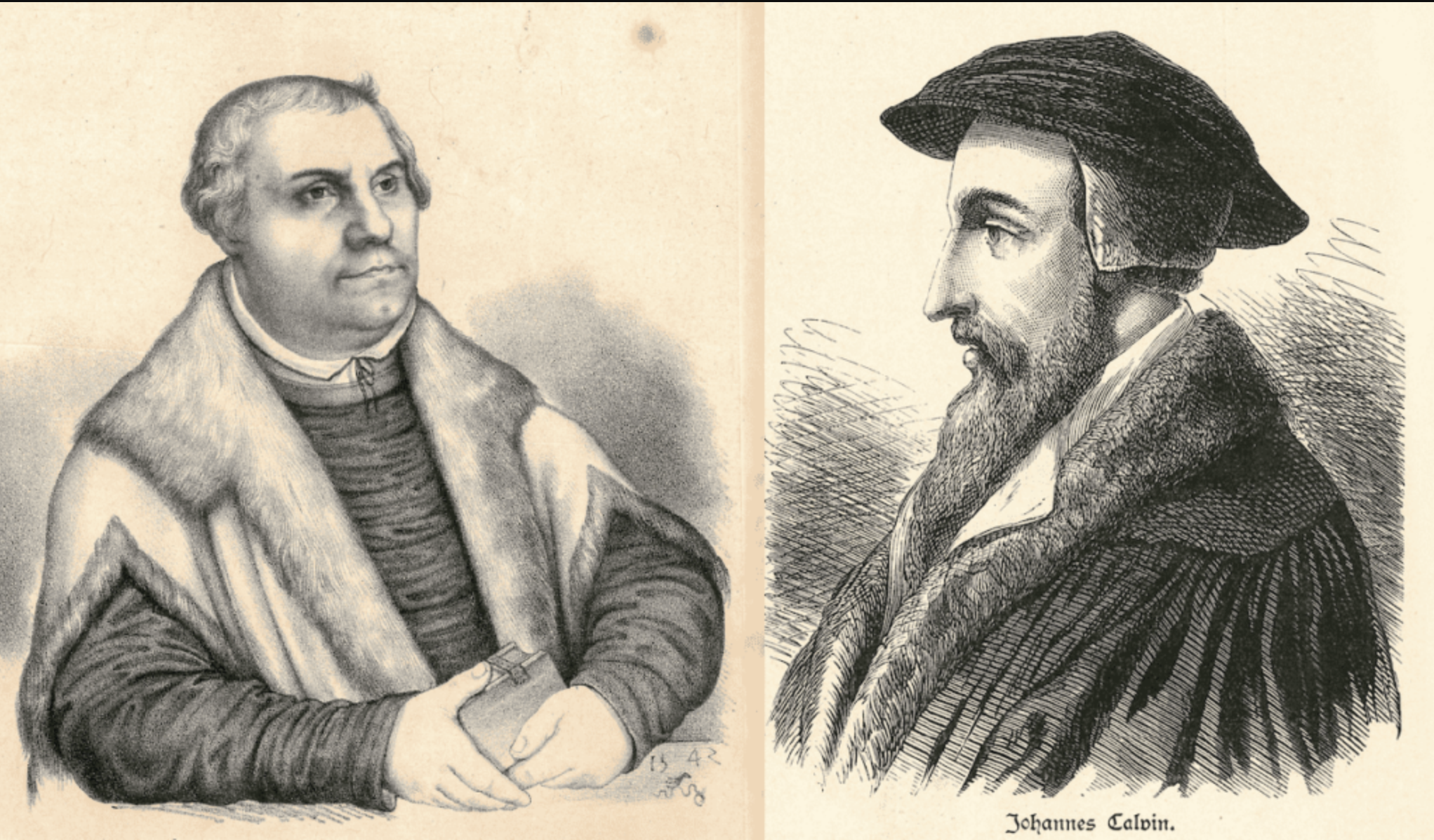
Both Luther and Calvin’s mentalities were subject to their times. There was an assumption of authority. For Luther, the Pope and Cardinals, holy or evil, were placed there by God. God was quiet capable to orchestrate terminal correction, if necessary. Evil (or stupid) though they may be, God was still in control. Believers were not called – by Jesus, the Apostles, God, or any other entity – to overthrow those in power. In Calvin’s writings, kings – just or unjust – were still enthroned by God. If they could be deposed and their power challenged, this was evidence of God’s verdict. Their weakness was proof of God’s will; until such weakness could be exploited, it was best to centralize zealous communities and accumulate power, waiting for an opportune moment to unseat, upend, destroy, and reinstitute a new form of power under the banner of God. For both men, the wealthy were “blessed” by God, whether they were just or unjust.
Reflected upon, the historian would note that both men sought the same ends but had remarkably different methods and means. Luther emphasized the holiness and purity of a supernatural God; Calvin’s emphasis was on the justice of God enacted by purists. What is evident from the philosophoical and theological presumptions and premises of both men is that the believer were endowed with divine power to act on their own behalf. Luther was perhaps more reluctant to do so, seemingly content to name the injustices of the the Holy Roman Catholic Church, to name the evils committed by Cardinals and Bishops, but whether we read his criticisms of the Papal Father as sarcasm, humor, or direct and meaningful statements of intent, he consistently depicts the Pope as merely ridiculously stupid, a puppet easily manipulated by his attendants. Luther is excessively critical, and with cause. He foments truculence toward the Church with one letter and encourages self-reflection in another. Calvin, whose contributions to the Reformation were more practical, encouraged direct action as the right and duty of Christians. Violence will be, at least at times, necessary to bring about the Kingdom of God on Earth, to institute a godly reign. This violence is always directed “down the line” though, never upward to those in actual authority. Violence is allowed toward one’s lesser, so all of his writings assume a heirarchy where God presumably grants the individual power toward those of lesser classes, finances, or spiritual knowledge.
Calvinists, even poor Calvinists, were not shy about claiming their spiritual authority to all people, regardless of social or financial status. Both men separately but especially taken together shifted Europe toward a reconsideration of where the individual belonged, what one’s responsibilities were in the world. John Calvin’s teachings about predestination and eternal security were meant to bolster the believer and give them assurance, confidence, and a sense of optimistic hope.
Shortly after Calvin’s death however, his followers began to place emphasis on economic theories and use Calvin’s works and teachings to construct an eternal class system where the privileged (the elect) could rule over their social and economic inferiors (the damned). The “eternal security” he espoused became a prison from which the damned could never escape, and it was used to justify oppression, baptizing evil in the name of God. The atittude was not symptomatic of the times. As Swaggart saw it, the pernicious bend of Calvinism toward spiritual arrogance only enslaved people to a false sense of importance, either justifying or ignoring the evils such individuals committed across a lifetime. Calvinism made false promises. It was profane to believe God was blind to oppression, sympathetic to it, caused it, “blessed” it. Whenever and wherever one committed evil “in the name of God”, such persons only revealed how truly depraved they were – but what was worse, was they learned it from ministers who taught them such behavior would be pardoned. This was a wicked, terrible heresy. Such pervasive evils must be avoided at all cost in their entirety. Calvinism, as Swaggart spoke of it anyway, was a cancer that needed to be revealed for what it was and removed from the Body of Christ.
The immediately objectionable behavior of Christian leaders like Falwell Sr. and Jr. breeds all kinds of justifications by their followers that find their final form in destructive theology, cultish behavior, and extreme forms of gaslighting necessary to prove their own self-worth. For Swaggart, this meant pathologizing. Normal, nature desires and doubts became evidence of sin in the mind and heart of the believer, especially himself. It also meant repeating claims about the end of the world that he had been taught by functionally illiterate family members like his grandmother and leaders in the Assemblies of God who, Swaggart believed, had it out for him. He leaned into eschatology, one of the Sixteen Fundamental Truths of his denomination, almost to the exclusion of the other Truths. Water Baptism, for instance, was a given. He rarely spoke on it. The Church’s mission, to worship and evangelize and disciple, also received short shrift. But the final four Truths of the Assemblies of God, namely the Blessed Hope (the imminent rapture and resurrection of the Church), the Millennial Reign of Christ (that Jesus will return with His saints to reign on earth for a thousand years), the Final Judgment (all unbelievers face eternal punishment and the wicked dead are judged to damnation), and the New Heavens and New Earth (a promised eternal dwelling for righteous believers with God) were perennial favorites.
Before his own “fall” in 1989, Swaggart’s sermons focused on the sinfulness of humanity much like fellow revivalist and predecessor Jonathan Edwards, whose sermon “Sinners in the Hands of an Angry God” preached almost the entire world into torment, damnation, and eternal punishment in Hell. His emphasis on the Fall of Man, which for the Assemblies of God meant that humanity was created good but chose to sin, bringing physical and spiritual death into the world, appear frequently. After his “fall”, Swaggart would place more emphasis on the Salvation of Man, where redemption is found only through faith in the shed blood of Jesus Christ. So much so that he would develop what he believed to be a “reclaimed” and “renewed” teaching of the Church – salvation.
Like almost every other revivalist, Swaggart’s sermons demanded attention and emotional response to the neglect of mental assent. Mental asset was unwell and even strongly discouraged. After all, God looks at the heart and not the outward appearance according to 1 Samuel 16:17. The Lord searches the heart, according to 1 Chronicles 28:9. The mind does not figure into the activity of God and, according to Swaggart, could be a hinderance. What he and other revivalists failed to acknowledge in placing emphasis on the heart are verses like Jeremiah 17:9, which says “The heart is deceitful above all things, and desperately wicked: who can know it?” Or the teaching of Jesus in Mark 7, where the Christ instructs his followers, “What comes out of a person is what defiles them. For it is from within, out of a person’s heart, that evil thoughts come—sexual immorality, theft, murder, adultery, greed, malice, deceit, lewdness, envy, slander, arrogance and folly. All these evils come from inside and defile a person” (Mark 7: 20 – 23).
Emphasis on the heart fails to integrate other passages in the Bible about the mind. Paul’s teachings about the mind were heavily indebted to Greco-Roman thought, centering the individual’s identity in the mind. Paul encouraged the Roman church to “be transformed by the renewing of your mind” so that the believer would “be able to test and approve what God’s will is – his good, pleasing and perfect will” (Romans 12:2). The Corinthian church, undergoing public sexual immortality, was told to “demolish arguments and every pretension that sets itself up against the knowledge of God, and we take captive every thought to make it obedient to Christ” (2 Corinthians 10:5). To the church in Philippi, Paul claims the peace of God can “guard your hearts and minds in Christ Jesus” and believers should think on “good things” rather than the sinfulness and wickedness of the world around them (Philippians 4:4-9). In a pastoral letter to Timothy, Paul reminds his student that, “God has not given us a spirit of fear, but of power and of love and of a sound mind” (2 Tim. 1:7). Paul may have been a product of his time, centering the core of one’s identity in the mind rather than the heart, as Jewish theology taught. But he did not seem to take issue with the mind as inherently sinful, as Swaggart did.
As for eternal security, Jimmy felt the only people who insisted on this were depraved sinners trying to silence their guilty consciences. Jesus did not die to give people a free pass. If he had, why did Paul spend so much of the New Testament telling churches to correct their behavior? Why did Jesus address himself to the churches of the Asia (modern day Turkey) in the Revelation of John, commanding entire churches to turn away from their sins or risk judgement? Why did Jesus, until his dying breath, preach a message of repentance, even to those who recognized him as Messiah and Savior? Why did James, Jesus’ brother, tell the entire church they must both submit to God and resist from the Evil One? There was no such thing as security in this world; one had only open a newspaper and read the headlines to see the world once more in rapid change just like it had been at the time the Christian Scriptures were written. The promise of eternal security was a false promise. Seen one way, God decided several millenia ago who would go to Heaven and who would go to eternal damnation. This god was a false one, a god not of love and mercy and salvation but instead of cold calculation, a god who did not look at the individual like God had promised, a god whose heart was unmoved but instead a god who needed to meet a quota to justify an eternal prison system, a terrible and terrifying miscalculation.
On the other hand, if God’s providence was so consuming that one was not eternally chosen for Heaven (as some Calvinists believed) but instead such merciful providence offered salvation to all, if this god could then overlook any injustices (or “sins”) committed by the individual who had “opted in” because they merely whispered “yes” inside of a church or on their deathbed, and never revisted the matter with Christian conduct and a changed life, then such a god was not just. Such a god was shockingly, offensively unjust and all of those passages about God being righteous, just, even merciful were a lie, just a bunch of blaster, or as Jimmy would put it, “tommyrot” (really, ‘tummy rot’, meaning it was a bunch of shit that would squirt all over the place, stink, and rightly embarrass the one expressing it). Nothing Calvinsim and, by extension, its author, said or wrote was worth salvaging. It needed to be flushed.
Perhaps, put mildly, Calvin understood that God’s forgiveness required a great deal. Humans were, after all, utterly depraved. God may have created humans in Their image, and may have once called them “good” but time erodes even the best of us. God’s providence was not random so much as far more merciful than we could ever understand. We fail to understand how awful, how intergalatically full of wretchedness we are. Such weighty sin bankrupts humanity.
Wesley and his Methodists agreed that God was sovereign, though Arminians suppose that God’s infinite grace is just that – infinite. The grace of God feels no rivalry with the totality of sin or depravity of humanity. Each individual sin, reckoned together into the utter depravity of Calvin is not insignificant or meaningless. Sin does mean something, after all, and should be taken seriously. But God, as God, is the only One in a position to wipe out the remembrance of sin. Even if that were not the case, if God’s grace were insufficient for the weight of sin, then God would no longer be in control of Their own estimation of what mattered. God, in short, can never go bankrupt.
Yet, Swaggart was selective in the parts of Calvinism that he appreciated and those he attacked. He frequently praised the belief system when it appeared under other names like Puritanism, Evangelicalism, and American Nationalism. He benefitted from Frances’ performative “submissiveness”, the kind emphasized by Calvin’s understanding of gender and that of his followers, who would build out the idea of a “federal marriage” in which men are the “governors” or rulers of their homes. This was all perfectly biblical. In federal marriages, women and children are to follow the commands of their protector, the husband/father, in all things without hesitation or objection. The reasoning here is that women are, at best, the servant of their husband. In the most shocking expression of federal marriages, women are reasoned to be grown children in need of supervision every bit as much as a child. As New Reformer/Calvinist James M. Hamilton writes in Work and Our Labor in the Lord, “[M]an is to lead since he has heard the prohibition in Genesis 2:17 though the woman has not. The man was to provide, protect, and lead. What does the woman’s role of helping entail? Perhaps it would be easier to say what helping does not entail, for helping would seem to involve everything but what the man is to do.” Hamilton argues that women, created after man, are “creatures” over whom the male has authority, just like the animals which were created before humans. It’s a bizarre twisting of logic, sequence, and biblical interpretation to equate half the human population with animals and children, but Calvin’s teachings demanded that women submit to their divinely ordered mandate “below” males. Hamilton’s essay is supposed to be directed to the theological importance of work as purpose and identity, but one symptomatic of Calvinism and Evangelicalism with expectations placed upon the present by early attempts at theology written 500 years ago.
This was not the view of Jimmy Swaggart or most Pentecostals, denigrating women. Far from it. Women had always played an important role in Jimmy’s life and, even at his most offensive, he could not embrace a religious expression which enslaved, oppressed, and denigrated women. Like John Wesley, he celebrated women to the point of placing them in a proverbial gilded cage. It was not the only position on which Swaggart held contradictory, shortsighted, or mercurial views.
As Don Thorsen, professor of Theology and Chair of Theology at Azusa Pacific University writes in his Calvin vs. Wesley: Bringing Belief in Line with Practice (2013),
Wesley better captured the biblically described way that Christians live their lives – clarifying their spiritual challenges, hopes, and successes – than did Calvin. Because Wesley was not a systematically oriented theologian, as was Calvin, his theology has at times been belittled as being inferior to Calvin’s theological logic and comprehensive system of belief. It is not that Wesley did not use logic, critical thinking, and persuasive argumentation; he just did not develop a system of theology per se. But Wesley did have a well-conceived and consistently lived theology.
Calvin’s theological strength was also his greatest weakness. Life, including Christian life, is not necessarily something best described as a system – a logically constructed interconnection of beliefs and values. Such a description may be more applicable to rationalist philosophy of Christian scholasticism than to the Bible and to life. Whereas systematic theology is rationally appealing and culturally respectable, especially in Western society, Wesley’s less systematic, more practically oriented approach to theology is more appropriate. This appropriateness is especially true when it comes to describing the dynamics of biblical Christianity in general, and in particular, of life in the Spirit – the Holy Spirit of God.
According to Wesley, one of the problems with a systematic approach to theology is that it may view Christianity too narrowly in terms of what fits into the system and what does not. For example, throughout his life, Wesley felt that Calvinists wrongly accused him of advocating works righteousness, when consistently Wesley advocated justification by grace through faith. Late in life, Wesley believed the problem was in part because of the narrow categories used in Calvinist’s theological deliberations.
Calvin vs. Wesley: Bringing Belief in Line with Practice (2013) by Don Thorsen
Here, Thorsen points to a sermon of Wesley where he addressed predestination. Wesley, having considered the matter thoroughly, writes,
This is the key: Those that hold, ‘Every one is absolutely predestinated either to salvation or damnation’, see no medium between salvation by works and salvation by absolute decrees. It follows that whosoever denied salvation by absolute decrees, in so doing (according to their apprehension) asserts salvation by works.
Thorsen picks up,
Wesley recognized that those who develop systems of Christian theology are heavily invested in logically rejecting beliefs and values that differ or perhaps challenge their system, even if affirming the system betrays biblical and commonsense evidence. It is not that Wesley was illogical and incoherent in developing his beliefs and values. After all, Wesley was a Fellow at Oxford University, taught logic, and used critical-thinking skills in crafting his writings. But his beliefs and values were not developed into a systematic whole that required apologetics and polemics in order to preserve a systemlike view of Christianity; Wesley’s beliefs and values were more flexible, built upon a dynamic understanding of the ongoing presence of God’s Holy Spirit in the lives of people.
Those who emphasize systematic theology are heavily invested in arguing propositionally that their beliefs and values are right and that other propositional beliefs and values are wrong, or they at least denounce them as slippery-slope arguments that eventually reveal their wrongness. Systematizers do not readily admit that Christian beliefs, values, and practices may vary from person to person and church to church. They focus more on what can be rationally proved to be right or wrong, consistent or inconsistent, regardless of commensurability with real-life circumstances, questions, and concerns. However, from Wesley’s perspective, system-making and proposition-based apologetics and polemics too often fail to capture the Spirit-led vitality of what he called “religion of the heart” – a concept too categorically unsystematic and Spirit-oriented for Calvinists.
Calvin, of course, spoke of the Holy Spirit and of mysteries involved with Christianity. It is not as if he did not account for such paradoxes of faith. Calvin was intellectually aware and astute with regard to historic theological disputation. But for Calvin, the rational unity of his theology superseded the vagaries of individual experiences of faith, hope, love, and other Spirit-led encounters with God and others. To be sure, mysteries and paradoxes existed in Calvin’s theology, but they were considered inconsequential relative to the excellences of the explanatory power of his systematic theology.
Calvin vs. Wesley: Bringing Belief in Line with Practice (2013) by Don Thorsen
Much of Swaggart’s sermonizing and extemporaneous theology has been misclassified and, consequently, misunderstood. Like Wesley, Swaggart had no systematic theology. At least not one recognizable by those who study or even passingly observe such things. What felt right in the moment, always plainspoken and at times crass, was sufficient to build sermons upon. He left details to others to figure out, and it had always been so from the start of his ministry with Frances. He could, for instance, claim that God literally created the world in six days and that the Earth was only six thousand years old if this helped assure his audience that God could do anything – and do it quickly – and subsequently preach that God created the Earth at some point in the distant past, populated it with pre-humans without any effort to distinguish the Cro-magnon from the Neanderthal, the Denisovan from the Pithecanthropus, and through a series of unchronicled but hinted-at events, destroy the world before the Creation account of Genesis. The Antediluvian Age was not the period before Noah’s flood, but the flood before creation. Swaggart elaborated in his 1984 series, The Pre-Adamic Creation & Evolution that God had already judged the world for an unspecified sin. When this happened, how and why, were unknown to him but with absolute certainty Satan (previously named Lucifer) was the chief archangel given dominion over the Earth before his “fall” from the graces of God. The various dents and divots scattered around the world that “stupid” scientists claimed were the result of meteors and asteroids were, in fact, evidence that the angels had been thrown to Earth when they were cast out of Heaven. Dinosaurs, who lived alongside humans in this period, were killed not by asteroids but fallen angels, whose fiery descent from Heaven brought destruction and chaos. This fails to explain how the Earth was flooded before the Creation account of Genesis, but nevertheless Swaggart persisted in both Young Earth and various unscientific explanations, over decades building a theology of contradiction. At the end of the Bible, in John’s Revelation, Swaggart depicts an Earth that will be holocausted and immediately restored to the “original order” without actually identifying, even for himself, whether this is the Garden of Eden, the total destruction by water which opens the book of Genesis on a Sunday in roughly 4,000 B.C.E., the destruction of the Earth by angels that preceded this by fire and falleness on an Earth that did not yet exist(?), another undetailed ancient point where dinosaurs and humans walked the Earth together, or the original formlessness that precedes all of this and which, again, was never chronicled can only be extrapolated (or presumably “revealed” to the believer, like Swaggart). The Pre-Adamic (Antideluvian) Age, at least hypothetically, explains and legitimizes the “idiots” in the scientific community with their unbiblical theories. As a theory, it gives no helpful understanding in the search for closure when a reader reaches the end of the Christian Scriptures. For the Jewish reader, the Pre-Adamic theory is simply one more among thousands, giving a scratch to the curious itch but insufficient to build an entire theology around.
Details, for Swaggart, were never as important as the rollercoaster of emotions, the thrill and spectacle of wild ideas and unbottled rage propelling him across the stage. The showmanship of such wild ideas, the invitation into secret truths, buttressed with piano accompaniment, built his ministry. Because he felt no accountability, to his fellow ministers or denominational leadership or the wider Christian world, his theology could spread out. Unlike rabbinical thought, it made demands. Refusal to believe tangential and loosely-defined theories was a rejection of the eternal truths of scripture. How much more pressing the demands could be when it came to doctrines about salvation, the Pentecostal experience, and eschatology?
He celebrated teachings that depicted him, a Southerner who had always felt like an outsider, as masculine and deserving of adoration even as he denounced the systems of John Calvin, the recklessness of Martin Luther, the reluctance of John Wesley, the harshenss of his father, and the submission of his mother. If there is any throughline here, it is that like many Pentecostals, Swaggart thought that theology and its warping of social roles, gender, economics, and society were a result of excessive philosophizing and conceptualizing without the tangible, without the miraculous, and without hope. A product of his time, Swaggart was selective in the theological insights he embraced and could, like all Evangelicals, be more easily defined by what he was against than what he was for unless that which he was against benefitted him in some way, and then it was permissable. This too defines Swaggart as a product of his time. He was a man born into the Modern Era; he did not fully understand what he embraced or what he was rejecting.
As professor of Theology for Oral Roberts University, Dr. Larry Hart puts it in Truth Aflame: Theology for the Church in Renewal (2005),
“If modernity can no longer swallow supernatural realities such as the verbal inspiration of Scriptures, the virgin birth of Christ, his bodily resurrection, spiritual beings such as angels or demons, miracles, signs, wonders, healings, and the like…”
“And the like” being, of course, the supernatural gifts given to the Christian believer who had been baptized in the Holy Spirit like Jimmy had, visions of the future like Jimmy claimed to possess as a boy, like the gift of tongues given to every believer as the first evidence of God’s blessing and favor.
“… then just jettison these outmoded ideas. Harry Emerson Fosdick (1878 – 1969), a gifted preacher and writer who captured the nation’s ear during the first half of the Twentieth Century, persusaively promulgated this perspective, which became known as modernism. Predictably, there developed a conservative backlash… known as fundamentalism.”
This is what Swaggart was, a fundamentalist. But so was Jerry Falwell, Sr.
“The fundamentalists simply wanted to return to the Bible and hold to its supernaturalism. Unfortunately, this movement became known in many quarters as mean-spirited, obscurantist, and anti-intellectual. Nevertheless, conservative theology continued to hold forth the historic faith, and by mid-century evangelicalism was on the scene.
“Evangelicals have often been facetiously described as ‘fundamentalists with Ph.D.s.’ Many of these new conservative theologians earned their doctorates at the elite liberal schools and armed themselves to address the challenge of modernist theology. At the same time, revivalists – the premier of whom was Billy Graham – proclaimed the evangelical faith far and near…
“Alongside these developments, a movement known as neo-orthodoxy emerged in Europe and spread to America. A more moderate group, they critiqued liberalism [and modernism, as will become obvious] but saw fundamentalism [the elevation of an ancient supernaturalism] as a dead-end street. They called for a return to the orthodoxy [but not orthopraxy] of the Reformation and to the authority of the Bible without compromise of intellectual integrity. In their view, the use of literary and historical methods in the study of the Bible (“higher criticism”) was here to stay, and traditional understandings of the inspiration of Scripture would have to be modified. As the same time, they felt that they could remain faithful to the historic Christian faith. The giant among this group was surely the Swiss theologian Karl Barth (1886 – 1968)… Neo-orthodoxy was launched as journey back to the Bible, so to speak. The trouble was, according to most Evangelical theologians (and non-theological Fundamentalists), the neo-orthodox theologians didn’t make it all the way back” (33 – 34).
Truth Aflame: Theology for the Church in Renewal by Larry Hart (2005)
This was not a passing disinterest on Jimmy’s part. Nor was it a so-called friendly disagreement between different ends of Christianity. In no uncertain terms, Jimmy was expressly against Calvinism as he understood it. Jimmy felt that Calvinism, in fact, ran contrary to the Gospel entirely, again as he understood it. He took issue with tenets of Calvinism, especially the doctrine of eternal security, and went so far as to target Calvinism as a “false doctrine in the Church today.” And the more Falwell aligned with predestination, the more he became a target for Swaggart’s insinuation evil and “false doctrine.”
When it comes to what we refer to as ‘Protestant Christianity’, you have heard a term in your life oftentimes – some of you know what it means and a lot of you don’t – entitled Calvinistic. ‘They’re Calvinistic in thought’, or ‘That’s the Calvinistic way’, and you wonder, ‘Now, what in the world does that mean?’… You’ve heard that statement and the statement refers to more doctrine than is taught in most Protestant churches than any other sphere of belief. That one term, Calvinism, can outline it, describe it, moreso than anything else. John Calvin lived back in the 1500s. He was a dogmatic type of individual. He had a great deal to do with some biblical translations. What is not commonly known is he was also instrumental in putting a lot of people to death. He killed folk that didn’t agree with him. That’s real Christianity in action, now idn’t it? I mean if he didn’t like what you taught and you didn’t agree with him, he’d just have your head chopped off. That got you out of the way. That’s one way of dismissing the opposition… He derived much of his teaching from a great theologian that is called the father of theology, St. Augustine. St. Augustine lived basically in the Third Century – that’s about 1700 years ago. He was a great man of God. But you have to be very careful in – you say, ‘Well that person is a man of God,’ but that doesn’t mean you’re supposed to swallow every thing that is said by that individual. I have taught this church [Family Worship Center] and I am teaching this church, I believe, I am a man of God. I believe the Lord himself would have to determine that factor, of course, but I don’t want you to believe things just because Jimmy Swaggart says them… A church will take on the characteristics of its pastor or sheperd or leader. That’s normal and it should… Augustine greatly influenced Calvin’s teachings… and Calvin enlarged upon Augustine’s teachings into what is known as Calvinism and Calvin said that God’s foreknowledge is based on predestination and that God’s will is the cause of all moral evil. Yet he also held to the blamelessness and purity of God. I want to say that again. Calvin taught that God’s foreknowledge is based on predestination and that God’s will is the cause of all moral evil. From that basic belief, we have what is commonly taught in the tenets of faith of most Protestant churches, even some Pentecostals.
From “Some False Doctrines in the Church Today” by Jimmy Swaggart


One thought on “Biography: Jimmy Swaggart, Chapter 15a”