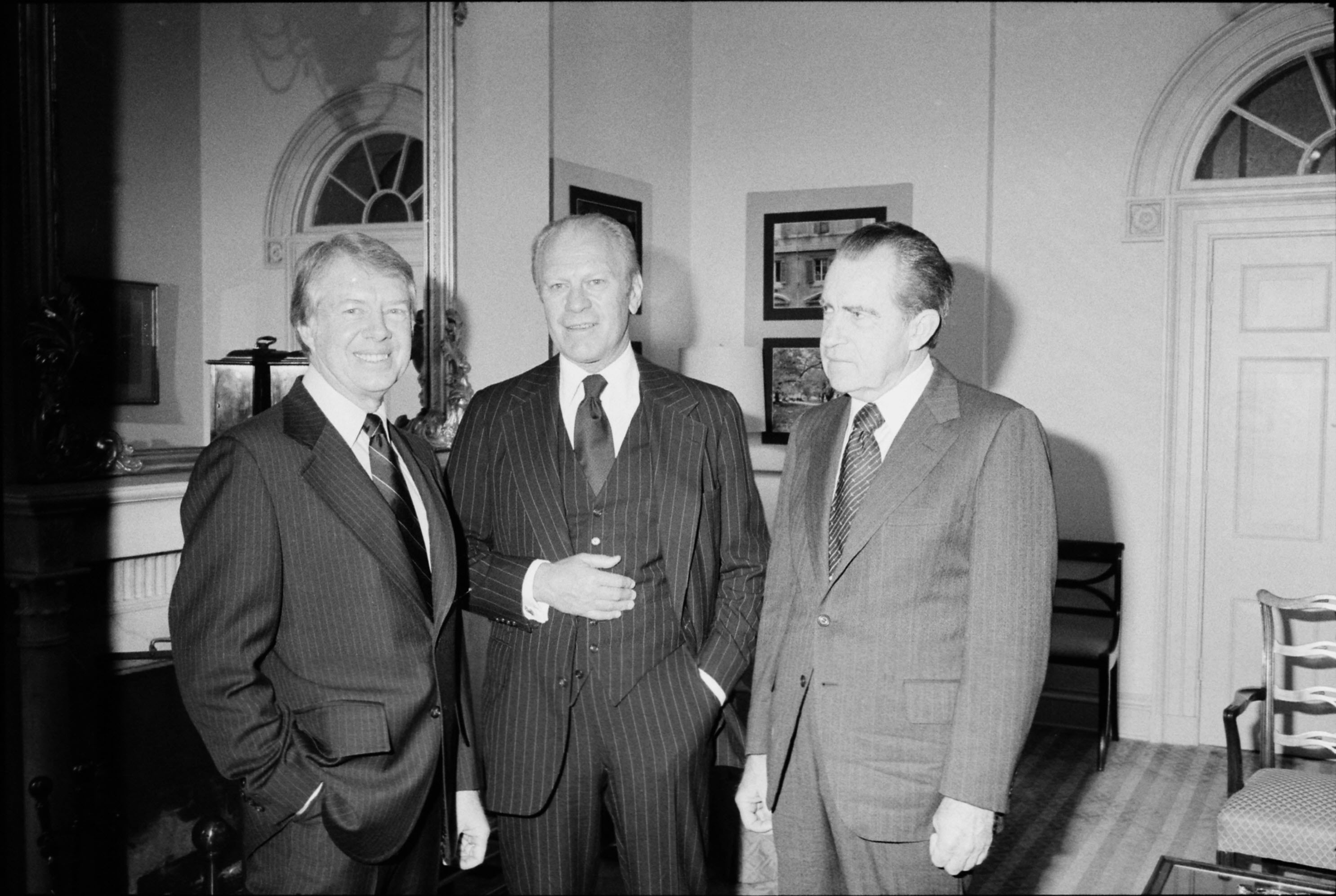
Significant changes were taking place outside the orbit of Evangelicalism. Jimmy’s ministry entered a new decade, but it was a microcosm of the American experience. Richard Nixon was reelected in 1972 in a landslide victory, gaining 520 electoral votes to George McGovern’s 17. It was a staggering, humiliating, and undisputed defeat for the Democratic Party.
One detail of this defeat? McGovern was not the only candidate who lost to Nixon. Benjamin Spock, the famous pediatrician was also a Presidential candidate in the 1972 election and, an underdog, he was a household name trusted by millions of Americans who used his campaign to create reasonable doubt in Nixon and the Republican Party. Dr. Spock’s first book, Baby and Child Care (1946) was one of the best-selling books of the 20th century, selling 500,000 copies in the first six months of initial publication, 50 million by the end of the century, and continued relevance in the 21st Century as new parents look to the wisdom of past decades. After all, two entire generations were raised by, on, and with Dr. Spock’s expertise. New mothers were given a copy of the book at baby showers, studious fathers were expected to read Baby and Child Care, psychologists and psychoanalysts sold the book from their offices, and “Dr. Spock” effectively overhauled conventional parenting. The book’s premise told mothers, “You know more than you think you do” and Spock was widely regarded as a trusted source for parenting advice in his generation. Dr. Spock was one of the first pediatricians to study psychoanalysis in an effort to understand children’s needs and family dynamics. His ideas influenced several generations of parents, encouraging them to be more flexible and affectionate with their children and to treat them as individuals. However, his theories were widely criticized by colleagues for relying heavily on anecdotal evidence rather than serious academic research.
He was also a Socialist.
After undergoing a self-described “conversion” to Socialism, Spock became an activist in the New Left and anti-Vietnam War movements of the 1960s and early 1970s. In 1968, he was convicted of conspiring to aid, abet, and counsel young men to violate the Selective Service Act by resisting the Vietnam War draft. His 1968 conviction, which carried a sentence of two years in prison and a $5,000 fine, was completely overturned on appeal in July 1969. Looking to capitalize on his previous success, the New Left used Dr. Spock to platform their agenda, culminating in Spock’s run for President of the United States as the People’s Party nominee in 1972. His career ruined and trust in him eroded, he campaigned on a platform of maximum wage, legalized abortion, and withdrawing troops from all foreign countries. Predictably, he fell out of favor with traditional households. Despite his success and the trust he had engendered in an entire generation, his books were “debunked” and criticized by conservatives for propagating “permissiveness” and “an expectation of instant gratification,” which Spock vehemently denied until his death.

When Spock lost the Presidential campaign in 1972, it wasn’t even close. The country supported Nixon and an American agenda that broke decades of tension with China, reduced and eventually ended the war in Vietnam, and ended the military draft. Though his resignation in 1974 exposed his unethical behavior, his legacy endured in the minds of Evangelicals.
Nixon had been a champion of Protestant values when he campaigned against John F. Kennedy, a Roman Catholic, in 1960. He was a champion of white traditionalism when he criticized President Lyndon Johnson’s Civil Rights legislation, or American isolationism when he criticized Johnson’s handling of the Vietnam War, both when Johnson tried to reduce tensions and when Johnson escalated the war. He championed conservative values when he ran against Hubert Humphrey, an outspoken advocate of modern liberalism, in 1968. Nixon was even a close, personal friend of Billy Graham, the two infamously recorded tossing around racial epithets regarding Jewish control of the media and pornography. Graham could clearly be heard on the recordings, now in the National Archives and brought to light in 2002, agreeing with then- President Nixon that Jewish control of the media had “got to be broken or the country’s going down the drain.” So, it turned out, Nixon was also a champion of the Ku Klux Klan. Former Grand Wizard of the Ku Klux Klan, David Duke, would later become a state representative in Louisiana and credit Nixon as an inspiration in transitioning from the Klan into American politics.
But Dr. Spock had another critical role in the Twentieth Century. Spock’s permissive approach to parenting would inspire a young psychologist, James Dobson, to devote his career to “reclaiming” psychology, parenting, and family values for Christ. Dobson admitted early in his career that he likely would have followed his father, grandfather, and great-grandfather into itinerant ministry with the Church of the Nazarene had it not been for Spock.

Dr. James Dobson positioned his parenting philosophy as a direct counter-rebuttal to Dr. Benjamin Spock, criticizing Spock for promoting a permissive, laissez-faire approach that Dobson argued weakened parental authority and produced disrespectful children. In 1967, Dobson became an Associate Clinical Professor of Pediatrics at the University of Southern California School of Medicine, where he stayed for 14 years. At USC, he was exposed to troubled youth and the counterculture of the 1960s. He found it “a distressing time to be so young” because society offered him no moral absolutes he felt he could rely upon. Opposition to United States involvement in the Vietnam War was blossoming into a widespread rejection of authority, which Dobson viewed as “a sudden disintegration of moral and ethical principles” among Americans his age and the younger people he saw in clinical practice. This convinced him that “the institution of the family was disintegrating.” Based on these experiences, in 1970 Dobson published Dare to Discipline. The book encouraged parents to assert their authority over their children, particularly by corporal punishment. Dobson saw children as rebellious and inherently sinful, and he believed the rejection of parental authority to be the source of societal problems, asserting that “Respect for leadership is the glue that holds social organization together. Without it there is chaos, violence, and insecurity for everyone.” The collapse of America, as Dobson saw it, was a result of Spock’s permissive approach to parenting. Without dictatorial control over the family, “absentee” fathers (including fathers who were still present in the home, but who had been encouraged by Spock to be “nurturing” and “loving” toward their children) had helped bring about the moral decline of America. Christian fathers, according to Dobson, subjected their children to routine physical punishments. Fathers must force their children to church until church attendance became habitual. They must never be nurturing or loving; to do so would be to abandon their own authority for “the woman’s role.” And they must “break” the child’s spirit, like an animal, to maintain control over their home and family.
Dobson spent 17 years on the staff of the Children’s Hospital of Los Angeles in the Division of Child Development and Medical Genetics. For a time, he worked as an assistant to Paul Popenoe and counselor at Popenoe’s Institute of Family Relations, a marriage-counseling center, in Los Angeles. Popenoe counseled couples on the importance of same-race marriage and adherence to gender norms for the purpose of eugenics. Under Popenoe, Dobson published about male-female differences and the dangers of feminism. When the American Psychological Association de-pathologized homosexuality by removing it from their list of mental disorders in 1973, Dobson resigned from the organization in protest. In 1976, he took a sabbatical from USC and Children’s Hospital. He never returned. With funding from a Christian publisher, he began to broadcast his ideas on the radio and in public lectures. Saying that he feared to repeat the mistakes of his own absentee father by being away on the lecture circuit, Dobson video recorded and distributed his lectures. He sent a representative around the country to solicit funding from evangelical businessmen and distribute the videos. A video about absent fathers titled Where’s Dad? had 100 million views by the early 1980s, but that was just the beginning.
Dobson spoke to a specific type of Evangelical, the kind that wanted absolute control over their family in a time of social instability. Fathers were the de-facto “heads” of their family, the paterfamilias adopted by the Apostle Paul from Rome and replicated without question, change, or challenge in his epistles to the Colossians (3:18–4:1) and. Ephesians (5:21–6:9) as well as the first Petrine epistle (2:13–3:7). Evangelicalism thrived in the middle of the 20th Century on order, structure, defined gender roles, and white nationalism. Unlike the Evangelicalism of the previous generation under Eisenhower though, the Evangelicalism of the Sixties and Seventies did not want a passive social religion. Christianity had to actually mean something, and if it didn’t get you “fired up” then what use was it? This new expression of Evangelicalism was, by all markers of sociology, politics, and religious study, a form of revivalism. The kind that began at the start of the 20th Century and was almost forgotten after World War II. The thing about revivalism is that it always needs an institution to reject and always needs an idealized (though ahistorical) past to “recover” and “restore”, through which those experiencing “revival” can cherry-pick their preferred teachings and claim them as “timeless truths” when, in fact, what they select is often a recent development one generation away, a local development originating in the home country of the new “revival”, and affirms already-held views on race, recreation, gender, and politics.
To be an Evangelical today is, by extension to be a revivalist and restorationist, to know what is worth salvaging from the past so that they can then claim to be the true inheritor of its riches. It is recoverist, revivalist, restorationist, and revisionist because to smooth out any inaccuracies, an Evangelical must also warp history to fit the new narratives they must tell to remain the center of the performance. Evangelicals today are known primarily for their rejection of fact for their preferred misreading of scripture, history, society, and context. In this way, Evangelicals can aggressively condemn Mormons for doctrinal impurity and a history of polygamy without self-reflection. They can – and still do – reject Mormons until it serves a larger purpose, like achieving political power. This is what Franklin Graham did when he embraced Republican candidate for President, Mitt Romney, in 2012. Romney, one of the most well-vested Mormons in America, had previously been rejected by Graham and his fellow Evangelicals when he made a bid for the Presidency in 2008. Yet Graham and his fellow Evangelicals rewrote history, theology, and their previous insults and insinuations when it served them by emphasizing Mormonism’s revivalist nature. Romney was their man. Always had been. Those previous denouncements of him? Misattributed quotes by unprofessional journalists. Fake news. What mattered was smoothing out the differences and rewriting a long, terribly offensive history of animosity to achieve power.
And when Romney failed to become President? Graham once again changed the narrative, insisting he had never fully embraced Romney. In fact, when Romney very publicly called out the lies of then-candidate Donald Trump, Franklin Graham and his fellow Evangelicals turned their full wrath toward Romney, claiming he had been a “Democratic plant” all along, a Manchurian candidate within the Republican Party who sought to destroy the GOP, America, and the holiness of this nation. Just like a Mormon to pull something like that. You never could trust those sneaky bastards. How dare he insult God’s anointed? How dare he bring a charge against the elect? Donald Trump – a convicted felon, rapist, serial bankruptee, who had been divorced after cheating on his wives with his next wife – was the man God had chosen to lead America into a great revival.
When Trump was credibly accused of sexual assault? It was proof that he was just like King David, a man of desire. When Trump was found guilty of assault by the courts, it was absolutely false. When Trump was found guilty of falsifying business records, a felony, and found guilty on all 34 felony counts, it was proof that Satan would use any means necessary to attack a holy man. A holy man who only wanted to bring revival to America.
If it seems like there is a deep and abiding mental health issue taking hold, you would be correct. It is not your imagination. Destabilization is not a flaw in Evangelicalism, it was part of the design going into the 20th Century.
Historically and theologically, revivalist theology centers on the belief that God sovereignly moves to bring spiritual awakening, characterized by intense spiritual fervor, deep conviction of sin, repentance, joyful worship, and mass conversions, often through large meetings led by passionate preachers (evangelists) who call people from nominal faith to a living, experiential Christianity, emphasizing personal conversion and holy living.
That’s a mouthful of an explanation. It means that Swaggart was raised in a culture enamored with revivalists like Martin Luther, Jonathan Edwards, John Wesley, and Dwight L. Moody who were able to excite people into a new way of life. For Luther, this meant educating people to read the Bible for themselves in a language they actually used, to lower all barriers to religious experience. For Wesley, it meant recognizing the soft unction of God’s Spirit. Moody, for his part, used simple, folksy expressions to get across the message of the Gospel. Whatever century the revivalist lived in, a common feature is unhappiness with their present circumstance. Revivalists are continually looking to the past in vague, non-specific, undefined and undefinable ways known “to the heart” more than rationality. Overcoming intellectualism, they can “revive” a crowd, congregation, perhaps even a nation to a previous point in time – explained, understood, and defined by them more than historians, academics, or other experts. Even Luther, who emphasized education and literacy for spiritual as well as practical use, still anchored his work in his own vision of the First Century. For Luther, Jesus’ fluency with storytelling and Paul’s ability to write so many epistles to the scattered churches of the Mediterranean meant that the first Christians were literate. If the Church was to be revived, it must overcome the suppressive illiteracy facilitated by the Roman Catholic church and its agents of evil to become literate again. Noble though this effort and his energy may have been in pulling Europe out of the Medieval Period, it was nevertheless anachronistic. Jesus never wrote a Gospel or epistle of record. Paul’s letters were to be read publicly and circulated by those privileged enough to be able to read. Luther’s efforts, exceptional though they may be, rested on a hopeful reading of history rather than one supported by actual history. For their parts, the Wesley brothers saw themselves as reviving an enthusiasm that is speculative in the history of the Church. There are more records of Christians dying than there are of Christians experiencing a “warming” of the heart. Nevertheless, Wesley persisted to teach and preach that God would intervene in the heart of a believer.
For many American Christians, revivalism means they want to spend the weekend at a church “like the one in the book of Acts” – with supernatural exploits and continual devotion to Jesus. What this claim, when it is made, fails to recognize is that the Book of Acts, following the Gospel accounts in the Christian scriptures, had its own share of problems and is hardly worth “restoring” or reviving. Namely, that they failed to care for widows and orphans and said widows and orphans were pretty upset about that, publicly shaming them for their hypocrisy. Namely, that the first churches, “like the ones in the book of Acts” had differing beliefs that they could not seem to agree on. This led to councils where they disagreed strongly with one another. There was also leadership vacuum. Peter, one of the loudest supporters during Jesus’ life, fades into the oblivion. He reappears in the Christian scriptures long enough for a new believer, Paul, to publicly condemn him for having meals with Jews.
Lest the zealous Christian forget, Joseph Smith founded Mormonism as a revivalist sect meant to “restore” the Church to a successive line of “prophets” who look, act, preach, teach, proclaim, and otherwise administrate in no conceivable or imagined way like the prophets described in the Bible. The two simply share no similarity at all, so what was “restored” or even “revived” shows no resemblance to the origin.
So “revival” or trying to dust off the past with a brush of nostalgia is admirable but often involves overlooking the actual reasons people were happy to move forward in time. It overlooks that, though the first Americans may have been committed patriots with perfectly happy private lives, they still did not have indoor plumbing and the newly sworn-in President, George Washington, had a mouth full of teeth only because he wrenched them from the mouths of enslaved people. Not all progress is “Babylonian” anymore than all regression is “Godly.” In this way, revivalism is “idealistic” in nature not because it seeks to recover the good, but because it rejects reality.
Revivalism is rooted in Protestant traditions like those of the Methodist and Anabaptist traditions as they emphasize a “new birth” and deeper relationship with God, and see revival as God’s renewing work in individuals and communities. Despite the shell game they continue to play trying to change terms and evade intellectual responsibility and cohesiveness, to insist they have more in common than unbelievers might think, Evangelicals are contrarians. Without something to reject – politicians, laws, doctrines, theological insights, educational pedigree, cultural artifacts, ideas and ideologies – they would languish because they offer nothing seminal. To put it plainly, Evangelicals are derivative, and even then, only in their rejection of far more popular (and lucrative) efforts, not in homage.
Whenever Evangelicalism is culturally irrelevant, in disfavor, Evangelicals will disavow the label only to spend tremendous energy “recovering” or “restoring” and then “reclaiming” the title. This is why so many fans of sports in general and wrestling in particular are Evangelical – there is a familiar script of losing a “title match” only to “reclaim” the championship. It is a uniquely American form of entertainment, preying upon intellectual laziness with entirely predictable outcomes. American Evangelicalism offers nothing new. Perhaps this is why it is best known for looking to the future, where facile ideas about the end of the world culminate in a warped eschatology not shared by theological centers outside of their corrupting influence.
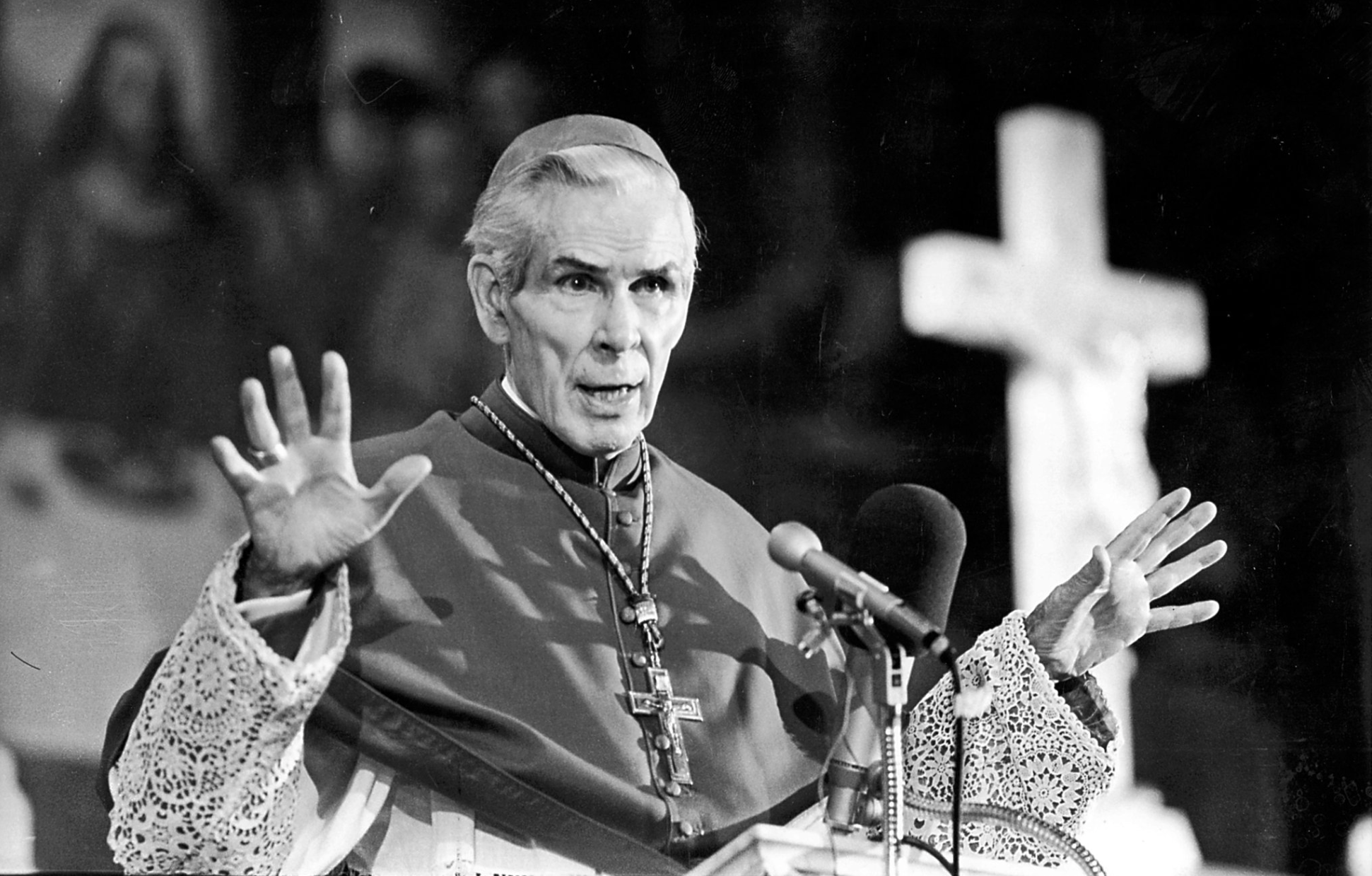
Not all American religious leaders are revivalists like this. Some, like Bishop Fulton Sheen, take exception to the pessimistic approach. As Rachel Lu wrote for America Magazine (“Fulton Sheen Bet on America” August 2026),
Fulton Sheen wanted American Catholics to deepen their faith, infusing more soul into the remarkable infrastructure they had built. If they could do that, he believed, the American Catholic Church could have a transformative impact on both the nation and the global church. It could still happen. We are living in a pivotal moment for American Catholicism. We have the opportunity today to embrace the vision that Sheen saw, in company with men like Archbishop John Ireland and John Courtney Murray, S.J. These men lived in eras when many Catholics, even or perhaps especially in the church’s hierarchy, saw America’s Protestant roots and democratic political structure as an obstacle to forging a healthy Catholic culture. They took a different view. Though the United States has never been a majority-Catholic country, men like Ireland, Murray and Sheen believed that its history and political traditions had created fertile soil for growing an authentically Catholic culture. Catholicism, they argued, did fit harmoniously into the American tradition, and as prejudices against it faded, they felt Catholics would be better positioned to help an already great nation realize its full potential. At the same time, America could provide a model for the rest of the world of a thriving Christian culture not built on an Old World, crown-and-altar foundation. The United States could show people that a modern, free, nation was not in opposition to Christian values. But in a strange irony, some American Catholics have now rejected their own nation’s nonsectarian, pluralist political tradition, even as the wider church has come to welcome it. Roiling with culture war angst, some Catholic Americans are beginning to doubt the value of our constitutional political tradition and a culture that celebrates freedom.”
Evangelicals today, unlike their Catholic neighbors, remain fascinated with the end of the world, the point at which they can abandon the failed project of the created order and burn it all down in an ultimately cathartic proof of their faithfulness. Their theology asserts that Satan, not God, is the “ruler” of this world and has been ever since the first sins was committed by Eve in the Garden of Eden, in time immemorial. By eating the apple, Eve transferred ownership of Earth, all of the created order, nature itself, and her own children – the entire human race yet to be born – to the obedience of Satan, the evil one. For this reason, Evangelicals look forward to the destruction of the world, the assumption of a new body on a new earth, somewhere else in the cosmos.
The only problem with this theology is that it is not grounded in the Bible.
It is entirely made up.
And poorly done, at that.

Since the beginning, God has declared the created order “good” while Evangelicals insist they are “evil.” The Evangelical imagination, by necessity, rewrites scripture to fit their annihiliationist tendencies. Curiously, this is the very thing Satan did in the Garden to tempt Eve.
The good people, according to Evangelicals, see care for the created order as a useless (fruitless) exercise of energy, responsibility for fellow humans and empathy as a weakness, and the human body as inherently degenerate. The Earth is evil and must be destroyed. Whether Satan or Eve or her husband Adam or the lesbians of today are to blame is inconsequential. Their god, the god of death and destruction, inspires them to radical positions of intolerance for the Earth and its inhabitants.
In 1969, a failed minister named Hal Lindsey wrote The Late, Great Planet Earth. By that time, Lindsey had married, gotten divorced, returned from duty in the Korean War, graduated from Dallas Theological Seminary, remarried, and begun working with Bill Bright’s Campus Crusade for Christ until he separated from the college ministry for unspecified reasons. Lindsey never claimed to be a faithful husband or a loving father. Or a good coworker. His entire life story was filled with destruction and mockery for those he once claimed to have loved. He would marry two more times before his death in 2024. In 1970, the book was published by Zondervan, a Christian publishing company who achieved tremendous success with different translations of the Bible, like The Amplified Bible in 1965. At the time, the company was struggling. Many Christians were committed to the familiarity of older, traditional translations. A little over a decade after the Amplified Bible, they would produce the New International Version that secured their fortune for the next half-century. But again, in 1970, Zondervan was struggling to find a foothold in publishing. The company was located in Grand Rapids, Michigan, while major publishers were in New York, Chicago, and Philadelphia.
Lindsey’s book was novel. It was strange. It was radical. And would have probably been seen as fringe material from a maddened mind, penned by a failure at everything he touched, except for the Six Day War in Israel.
Coming on the heels of the war in 1967, the book fueled the popularity of dispensationalism and its support of ethnic Jews as the “chosen people of God.” How else could anyone explain Israel’s surviving the combined might of Egypt, Syria, and Jordan against their people except by God’s divine intervention? The Six Day War, and Lindsey’s Late Great Planet Earth were not the first time dispensationalist teachings had been popular to Evangelicals. Like other revivalists coming out of the 19th Century, Mormons (aka Latter Day Saints) among them, Evangelicals emphasize the coming destruction of the world and its peoples. In fact, more than any other theme in the Bible – salvation, forgiveness, love, social justice, care for fellow humans, care for the Earth – American Evangelicals cling to destruction, violence, and annihilation of the wicked until failure to emphasize violence and God’s wrath is synonymously un-American and un-Christian. Famous theologian Harvey Cox, who served for four and a half decades as Hollis Professor of Divinity at Harvard Divinity School until his retirement in 2009, explains in Fire From Heaven: The Rise of Pentecostal Spirituality and the Reshaping of Religion in the 21st Century (1994),
“Americans have always had a stronger than average dose of millennialism in their veins. From the Puritans who landed in New England and from the revival preachers who traveled the midwest on horseback, they kept hearing that the last act of history was beginning and that their own nation would play a special role in the grand finale. As the Nineteenth turned into the Twentieth Century in America, prophecies and speculations about a new Pentecost and a New Jerusalem were in the air again. The old epoch was ending.
The annihilationism of Evangelicalism then is a product of larger problems, not their cause. Though the United States, America, and the names of all of its states do not appear anywhere in the Bible, many Americans remain insistent through shoehorning and vague assumptions that this nation, above all others, can and will redeem the Earth by destroying it. This is, after all, what Jesus would want us to do. He never said it, but – c’mon! – it’s all there if you’re really paying attention.

Walter Lippman speaks to these delusions in his Public Opinions (1922), where he observes that individual citizens cling to fictional environments so thoroughly that they are truly living in different worlds from those who don’t share them. “More accurately,” he writes, “They live in the same world but they think and feel in different ones… [and] these fictions determine a very great part of [their] political behavior.” People reading newspapers and observing the state of the world, he went on to note, were not offended by stories of unfairness and corruption, they were instead offended by what those stories said about themselves. Taking public events personally proved habit-forming over the 20th Century and into the 21st until it gave rise to fictional tellings of real events – from the Soviet famine to Vietnam, from the Falklands conflcit to the Grenfell Tower fire, a historian will begin to feel the imprint of Lippman’s definitions of enhanced opinion and manipulated fact.
In his introduction to Lippman, Michael Curtis establishes that “people act towards objects on the basis of the meanings that objects have for them.” The same could be said of people and people groups. “These meanings, the products of social interactions” or lack of same “are modified through interpretation by individuals… the responses of people to their environment [are] dependent on the cognitive factor, on mental constructs.” As Puritans, Revivalists, and then Evangelicals continued to reject their predecessors and define themselves in opposition to increasingly minute points of articulation, the predictable inevitability of our current theater was made manifest. Theirs was a warped version of the Gospel. Rejecting everything that had come before but having nothing original to build from, the religious tendency to stand apart from “the world” and one another made for an isolationism that, by rights, should have terminated in self-extinction.
“For example, one of the most debatable issues relating to theological interpretation and theological education in contemporary Evangelicalism in the United States has to do with the place of social justice and Christian activism in society and the public sphere. Many influential Evangelical and Christian theologians have claimed that social justice is a form of cultural Marxism,” writes Celucien L. Joseph, author of Theological Education and Christian Scholarship for Human Flourishing (2022). “Therefore, as they have argued unpersuasively, social justice is incomparable with the message of the Gospel and biblical notion of justice.” As popular Evangelical minister Mark Driscoll puts it, emphasizing the teachings of the New Testament regarding care for others leads to the “pussification” of Christianity. “They have called upon Christian professors not to integrate social justice in their teaching, theological vocabulary, and hermeneutical reasoning… Many of these critics have contended that the idea of ‘social justice’ is not biblical; rather, it is found in the grammar and rhetoric of Marxism. In other words, if a Christian thinker or theology instructor promotes social justice as an integral practice of the Christian faith and theological education, the individual may be labeled a Marxist or Communist.” Or, as many American Evangelicals would put it simply, they would be heretics running contrary to the Gospel. Which is especially strange, given that Jesus’ first sermon insisted on bringing good news to the poor, health to the sick, setting prisoners free, and liberating the oppressed. Not missing the thread, Peter, Paul, and John repeat these teachings in new contexts as Christianity emerges and spreads through the Mediterranean. The author of Hebrews, spiritualizes the message, claiming that when a believer helps those in need, they may very well be ministering to angels in disguise who have come to test the saints. James, the head of the church in Jerusalem, flatly demands that believers recognize “faith without works is dead” and this James, the same head of the church in Jerusalem who is the brother of Jesus and was raised in the same home as Jesus Christ the Savior of All, bluntly says that refusing to help those in need is a rejection of Jesus and his message of salvation.
Swaggart had cause to be furious with his fellow Evangelicals for teaching selfishness, for the ways that they made arrogance into a defining trait of American Christianity. But most of all, Swaggart could become apoplectic with Christians who he felt had twisted scripture to justify their wickedness. He had cause to warn those who listened to his music and radio programs, who attended his Camp Meetings and Crusades, who read his books, who subscribed to his magazine, who watched him daily – more than once – on television that they were being conned. They were. That was one of the primary reasons they listened to Swaggart, because he affirmed their suspicions and told things as he saw them, consequences be damned.
Still, Swaggart was convinced that the end of the world was coming. His first prophecy, after all, was the destruction of Hiroshima and Nagasaki according to the people of Ferriday who were there to witness it. His first sermons were about the coming judgement, the threat of Russia, the war to end all wars, the coming return of Jesus Christ on a white horse. The end of the world was coming, surely enough, but until then it made for a profitable business. The popularity of Hal Lindsay’s Late Great Planet Earth confirmed what Swaggart had been saying all along. With a back catalog of sermons and study notes, Jimmy was ready to hit the circuit even harder and reach new audiences beyond the small town “Penny’cossals”, the annual rotation of conferences and camp meetings, seminars and trainings. His radio program, which had developed into a television ministry, practically exploded in popularity. People ate it up, the destruction and self-righteous assurance that they were going to Heaven while their coworkers and neighbors burned for all eternity in the Lake of Fire without end, tormented with the shame of not listening to that Old Fashioned Gospel.
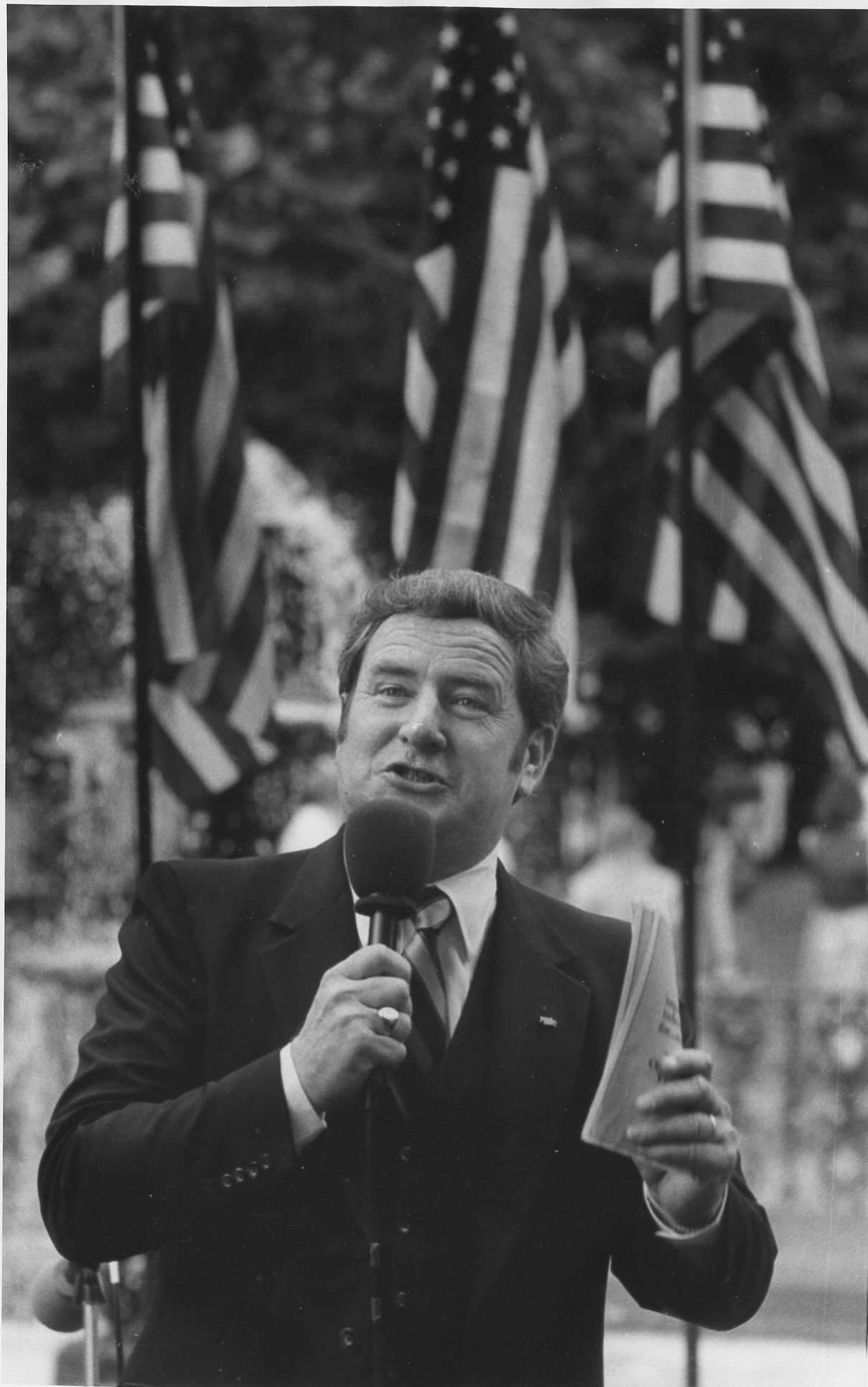
Other ministries were emerging too, though. Lots of ministers, fueled by the fears and anxieties of the Atomic Age turned Nuclear Threat turned “Greed is Good” capitalism understood that television was a golden cash cow worth idolizing. Jerry Falwell, for example, founded Thomas Road Baptist Church (TRBC) in Lynchburg, Virginia, in 1956 with just 35 members. His simple and plain message of salvation didn’t catch on immediately. Falwell avoided any kind of confrontation, like the kind stirred up by the marches, protests, and sit-ins of fellow Baptist Martin Luther King, Jr. Falwell strongly believed that ministers should avoid politics altogether, neither encouraging or discouraging their congregations in social issues or voting. But something changed, making Falwell and a great many Evangelical ministers become aggressively political, weaponizing scripture into something useful.
Writing for Politico, historian Randall Balmer directly confronts the peaceful narrative that Falwell and his fellow Evangelicals hid behind. He speaks to the growing anxiety many Americans were percolating in during the middle of the Twentieth Century. Taking a lesson from Carl Bernstein and Bob Woodward, who exposed the corruption of the Nixon Administration, Randall Balmer suggests all one has to do to expose Evangelical corruption is “follow the money.”
One of the most durable myths in recent history is that the religious right, the coalition of conservative evangelicals and fundamentalists, emerged as a political movement in response to the U.S. Supreme Court’s 1973 Roe v. Wade ruling legalizing abortion. The tale goes something like this: Evangelicals, who had been politically quiescent for decades, were so morally outraged by Roe that they resolved to organize in order to overturn it.
This myth of origins is oft repeated by the movement’s leaders. In his 2005 book, Jerry Falwell, the firebrand fundamentalist preacher, recounts his distress upon reading about the ruling in the Jan. 23, 1973, edition of the Lynchburg News: “I sat there staring at the Roe v. Wade story,” Falwell writes, “growing more and more fearful of the consequences of the Supreme Court’s act and wondering why so few voices had been raised against it.” Evangelicals, he decided, needed to organize.
Some of these anti- Roe crusaders even went so far as to call themselves “new abolitionists,” invoking their antebellum predecessors who had fought to eradicate slavery.
But the abortion myth quickly collapses under historical scrutiny. In fact, it wasn’t until 1979—a full six years after Roe—that evangelical leaders, at the behest of conservative activist Paul Weyrich, seized on abortion not for moral reasons, but as a rallying-cry to deny President Jimmy Carter a second term. Why? Because the anti-abortion crusade was more palatable than the religious right’s real motive: protecting segregated schools. So much for the new abolitionism.
Today, evangelicals make up the backbone of the pro-life movement, but it hasn’t always been so. Both before and for several years after Roe, evangelicals were overwhelmingly indifferent to the subject, which they considered a “Catholic issue.” In 1968, for instance, a symposium sponsored by the Christian Medical Society and Christianity Today, the flagship magazine of evangelicalism, refused to characterize abortion as sinful, citing “individual health, family welfare, and social responsibility” as justifications for ending a pregnancy. In 1971, delegates to the Southern Baptist Convention in St. Louis, Missouri, passed a resolution encouraging “Southern Baptists to work for legislation that will allow the possibility of abortion under such conditions as rape, incest, clear evidence of severe fetal deformity, and carefully ascertained evidence of the likelihood of damage to the emotional, mental, and physical health of the mother.” The convention, hardly a redoubt of liberal values, reaffirmed that position in 1974, one year after Roe, and again in 1976.
When the Roe decision was handed down, W. A. Criswell, the Southern Baptist Convention’s former president and pastor of First Baptist Church in Dallas, Texas—also one of the most famous fundamentalists of the 20th century—was pleased: “I have always felt that it was only after a child was born and had a life separate from its mother that it became an individual person,” he said, “and it has always, therefore, seemed to me that what is best for the mother and for the future should be allowed.”
Although a few evangelical voices, including Christianity Today magazine, mildly criticized the ruling, the overwhelming response was silence, even approval. Baptists, in particular, applauded the decision as an appropriate articulation of the division between church and state, between personal morality and state regulation of individual behavior. “Religious liberty, human equality and justice are advanced by the Supreme Court abortion decision,” wrote W. Barry Garrett of Baptist Press.
So what then were the real origins of the religious right? It turns out that the movement can trace its political roots back to a court ruling, but not Roe v. Wade.
In May 1969, a group of African-American parents in Holmes County, Mississippi, sued the Treasury Department to prevent three new whites-only K-12 private academies from securing full tax-exempt status, arguing that their discriminatory policies prevented them from being considered “charitable” institutions. The schools had been founded in the mid-1960s in response to the desegregation of public schools set in motion by the Brown v. Board of Education decision of 1954. In 1969, the first year of desegregation, the number of white students enrolled in public schools in Holmes County dropped from 771 to 28; the following year, that number fell to zero.
In Green v. Kennedy (David Kennedy was secretary of the treasury at the time), decided in January 1970, the plaintiffs won a preliminary injunction, which denied the “segregation academies” tax-exempt status until further review. In the meantime, the government was solidifying its position on such schools. Later that year, President Richard Nixon ordered the Internal Revenue Service to enact a new policy denying tax exemptions to all segregated schools in the United States. Under the provisions of Title VI of the Civil Rights Act, which forbade racial segregation and discrimination, discriminatory schools were not—by definition—“charitable” educational organizations, and therefore they had no claims to tax-exempt status; similarly, donations to such organizations would no longer qualify as tax-deductible contributions.
On June 30, 1971, the United States District Court for the District of Columbia issued its ruling in the case, now Green v. Connally (John Connally had replaced David Kennedy as secretary of the Treasury). The decision upheld the new IRS policy: “Under the Internal Revenue Code, properly construed, racially discriminatory private schools are not entitled to the Federal tax exemption provided for charitable, educational institutions, and persons making gifts to such schools are not entitled to the deductions provided in case of gifts to charitable, educational institutions.”
Paul Weyrich, the late religious conservative political activist and co-founder of the Heritage Foundation, saw his opening.
In the decades following World War II, evangelicals, especially white evangelicals in the North, had drifted toward the Republican Party—inclined in that direction by general Cold War anxieties, vestigial suspicions of Catholicism and well-known evangelist Billy Graham’s very public friendship with Dwight Eisenhower and Richard Nixon. Despite these predilections, though, evangelicals had largely stayed out of the political arena, at least in any organized way. If he could change that, Weyrich reasoned, their large numbers would constitute a formidable voting bloc—one that he could easily marshal behind conservative causes.
“The new political philosophy must be defined by us [conservatives] in moral terms, packaged in non-religious language, and propagated throughout the country by our new coalition,” Weyrich wrote in the mid-1970s. “When political power is achieved, the moral majority will have the opportunity to re-create this great nation.” Weyrich believed that the political possibilities of such a coalition were unlimited. “The leadership, moral philosophy, and workable vehicle are at hand just waiting to be blended and activated,” he wrote. “If the moral majority acts, results could well exceed our wildest dreams.”
But this hypothetical “moral majority” needed a catalyst—a standard around which to rally. For nearly two decades, Weyrich, by his own account, had been trying out different issues, hoping one might pique evangelical interest: pornography, prayer in schools, the proposed Equal Rights Amendment to the Constitution, even abortion. “I was trying to get these people interested in those issues and I utterly failed,” Weyrich recalled at a conference in 1990.
The Green v. Connally ruling provided a necessary first step: It captured the attention of evangelical leaders , especially as the IRS began sending questionnaires to church-related “segregation academies,” including Falwell’s own Lynchburg Christian School, inquiring about their racial policies. Falwell was furious. “In some states,” he famously complained, “It’s easier to open a massage parlor than a Christian school.”
One such school, Bob Jones University—a fundamentalist college in Greenville, South Carolina—was especially obdurate. The IRS had sent its first letter to Bob Jones University in November 1970 to ascertain whether or not it discriminated on the basis of race. The school responded defiantly: It did not admit African Americans.
Although Bob Jones Jr., the school’s founder, argued that racial segregation was mandated by the Bible, Falwell and Weyrich quickly sought to shift the grounds of the debate, framing their opposition in terms of religious freedom rather than in defense of racial segregation. For decades, evangelical leaders had boasted that because their educational institutions accepted no federal money (except for, of course, not having to pay taxes) the government could not tell them how to run their shops—whom to hire or not, whom to admit or reject. The Civil Rights Act, however, changed that calculus.
Bob Jones University did, in fact, try to placate the IRS—in its own way. Following initial inquiries into the school’s racial policies, Bob Jones admitted one African-American, a worker in its radio station, as a part-time student; he dropped out a month later. In 1975, again in an attempt to forestall IRS action, the school admitted blacks to the student body, but, out of fears of miscegenation, refused to admit unmarried African-Americans. The school also stipulated that any students who engaged in interracial dating, or who were even associated with organizations that advocated interracial dating, would be expelled.
The IRS was not placated. On January 19, 1976, after years of warnings—integrate or pay taxes—the agency rescinded the school’s tax exemption.
For many evangelical leaders, who had been following the issue since Green v. Connally, Bob Jones University was the final straw. As Elmer L. Rumminger, longtime administrator at Bob Jones University, told me in an interview, the IRS actions against his school “alerted the Christian school community about what could happen with government interference” in the affairs of evangelical institutions. “That was really the major issue that got us all involved.”
Randall Balmer, “The Real Origins of the Religious Right” Politico (27 May 2014)
Racism was very much alive and well within the church houses scattered across the continental United States. It was profitable. It was good business. Churches, like Falwell’s Thomas Road Baptist Church, made a good business out of thinly veiled epithets. Balmer, a respected historian, is not alone in his reporting. Kristin Kobes Du Mez’s Jesus and John Wayne: How White Evangelicals Corrupted a Faith and Fractured a Nation (2020) and Frances Fitzgerald’s The Evangelicals: The Struggle to Shape America (2017) offer even more insight in Falwell’s Jekyll and Hyde personalities. Falwell’s public persona was in sharp contrast to his private character. Both historians show a clear timeline of progression that Evangelicalism espoused White Nationalism as much as Christisan Nationalism. Falwell put a civil, rational face on outright racism much in the same way that David Duke did. Duke, an American white supremacist, antisemitic conspiracy theorist, and former grand wizard of the Knights of the Ku Klux Klan brought the Klan forward in the Seventies and Eighties and his recruitment to the Klan expanded under the Presidency of Ronald Reagan, who legitimized fear of the gay community. Duke served as a member of the Louisiana House of Representatives from 1989 to 1992 and has launched multiple unsuccessful campaigns for higher public office, including the U.S. Senate and the presidency. Biographers and political scientists continue to claim that Duke’s ascendancy was only possible because of Reagan and the Moral Majority under Rev. Jerry Falwell. In turn, Falwell’s political and social views were legitimized by his proximity to Reagan, and he was able to capitalize on the success of Duke’s recruitment. Reagan’s political popularity was due, in large part, to Falwell’s ability to convince committed Evangelicals that self-professed Evangelical, Sunday School teacher, father, and business owner Jimmy Carter was not a “real” Christian while Reagan, a divorcee with drug-addled and atheist children who publicly said they hated their father was not only a “real” Christian, but a loving father. Reagan, who had previously served as the Governor of California, had helped blacklist members of Hollywood in anticipation of the McCarthy Hearings. That was his only political preparation for leading the nation.
What many Americans fail to comprehend is the ways in which racism appears. Falwell did not have to speak out about uppity niggers and Jews infiltrating the media to be a racist. He only had to speak about his love for America in a bygone era. Historian Linda Gordon writes in The Second Coming of the KKK: The Ku Klux Klan of the 1920s and the American Political Tradition (2017),
If we are to understand this second coming of the Klan, we must surrender some of our preconceptions about it. Those come mainly from the first Ku Klux Klan, established after the Civil War as a secret fraternity with the aim of reimposing servitude on African Americans after the end of slavery. Its tools were lynchings, torture, and other forms of terrorism designed to inhibit any challenge to white supremacy. It had never entirely disappeared, but faded somewhat after achieving its goal: electoral disfranchisement and economic subjugation of black people.”
Unlike the first Klan, which thrived in the South and began to dissipate as American lurched toward the 20th Century, the second Klan took hold in the North. Gordon continues.
This “second Klan,” as it has been called, took pride in its namesake and its commitment to white supremacy. But it differed significantly from its parent. It was stronger in the North than in the South. It spread across the Mason-Dixon Line by adding Catholics, Jews, immigrants, and bootleggers to its list of enemies and pariahs, in part because African Americans were less numerous in the North. Its leaders tried to prohibit violence, though they could not always enforce the ban. Unlike the first Klan, which operated mainly at night, meeting in hard-to-find locations, the second operated in daylight and organized mass public events. Never a secret organization, it published recruiting ads in newspapers, its members boasted their affiliation, and it elected hundreds of its members to public office. It was vastly bigger than the first Klan… [and] embraced by millions who were not members, possibly even a majority of Americans. Far from appearing disreputable or extreme in its ideology, the [second] Klan seemed ordinary and respectable to its contemporaries. At many of its events, elected officials spoke. Its members included both the well and the poorly educated, professionals, businesspeople, farmers, and wage workers, but lower-middle-class and skilled working-class people formed its core constituency. In addition to providing fraternalism and sisterhood, it conferred prestige on its members and delivered business networking opportunities; for these reasons, many joined in the hopes of raising their social and economic status or identity. Thus membership in the Klan could appear to offer a route into the middle class. Although it claimed to represent the soul of America, its prestige rose from its exclusiveness… its members were proud to belong. The Klan built a politics of resentment, reflecting but also fomenting antipathy toward those who it defined as threatening Americanism.
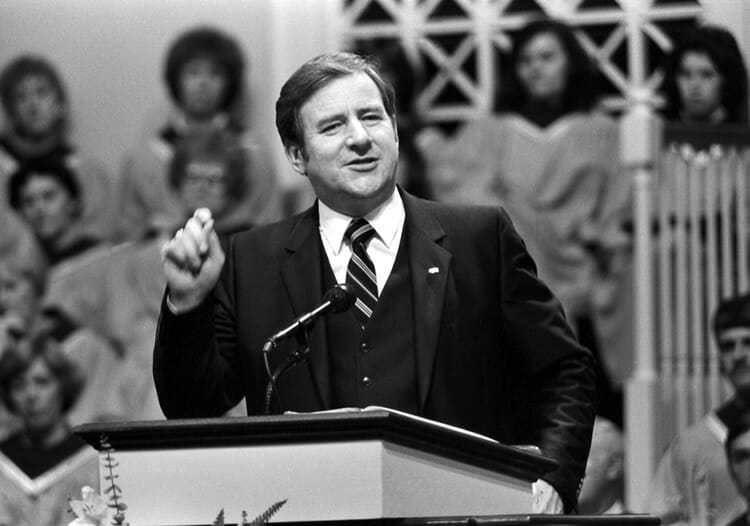
The connection between the Klan and the rise of the Moral Majority within Evangelicalism has been made by the aforementioned historians and biographers, but Richard Flory puts it succinctly in an article for the USC Center for Religion and Civic Culture.
Coinciding with the popularity of Ronald Reagan, Falwell founded the Moral Majority in 1979 as a conservative Christian political lobbying group. Although the founding of the Moral Majority is popularly seen as an anti-abortion and pro-family movement, its real roots were different. Falwell and other evangelical leaders felt the federal government was overreaching with its guidelines into how Christian groups maintained racial restrictions in their schools. The Moral Majority ultimately expanded its platform from segregation in schools to include what is now a familiar agenda: supporting and sponsoring legislation for “traditional” family values and prayer in schools. It also opposed LGBT rights, the Equal Rights Amendment, abortion and other similar social-moral issues. Through his nationally televised church services, Falwell Sr. reached beyond his original followers to other groups that were in agreement with the conservative, pro-family, racial agenda of the Moral Majority.
In other words, Falwell built the Moral Majority on the framework of the Klan, effectively “baptizing” it in Evangelical waters and language, all the time smiling pleasantly and assuring Americans he just wanted a “return” to “tradition.” These became key dogwhistles to rally the base. Emphasizing both “American” and “Christian values”, Falwell found a fellow in Duke and the fractured Klan that Duke left behind when he became a member of the Louisiana House of Representatives.
Falwell was instrumental in minimizing Carter and elevating Reagan. He sanitized Reagan’s image and, in return, was frequently photographed with the President and allowed to refer to himself as an “advisor” to the White House.
But Falwell had bigger aspirations. He didn’t just want to bend America toward his ideology. He wanted to mar future generations, to normalize and institutionalize extremist politics, racism, heteronormativity, and gender discrimination. He wanted to build what both the Klan and National Socialists under Adolf Hitler had enshrined as the ideal government. And so Liberty University was founded in 1971 by Falwell Sr. in Lynchburg, Virginia. It originally opened under the name Lynchburg Baptist College before changing its name to Liberty University later on to further legitimize it as an institution despite not being accredited early on. The colors were changed to red, white, and blue in 1976 and the college finally achieved accreditation with the Southern Association of Colleges and Schools Commission on Colleges in 1980 after almost a decade of repeated failure to meet standards of higher learning. Through those founding years, students and faculty were inspired to influence the moral and ethical course of America as Falwell outlined it. Women were forbidden from walking across campus after sundown and, during daylight hours, had to accompany one another and wear knee-length skirts, long-sleeve blouses. During the investigation in widespread sexual abuse by his son, Jerry Jr. and his wife Becki, several former students came forward to describe how Liberty under both Falwell Sr. and Falwell Jr. helped facilitate a conspiracy of silence about the high incidents of rape, sexual assault, and abuse. Women, under Falwell Sr. and Jr., were second-class citizens. For perspective, in the immediate aftermath of September 11th, Falwell Sr. publicly blamed women who had experienced abortions, feminists, homosexuals with the act of terrorism.
Falwell’s televised sermons increasingly became infomercials for videocassette home study of the Bible and, naturally, Liberty. His church, Thomas Road Baptist Church, continued to grow into a new and emerging category, a megachurch, that was a key part of his religious empire alongside Liberty University. With the passing of the founder in 2007, his son, Jerry Falwell Jr., became chancellor and president of the university. Falwell, Jr. had previously served as legal counsel to the ministry and Liberty University. Over the next decade, under Falwell Jr.’s leadership, the university entered a season of campus expansion. New academic buildings such as the Jerry Falwell Library and the Center for Medical and Health Sciences opened alongside state-of-the art athletic facilities like the Liberty Athletics Center, Natatorium, and Indoor Track & Field Complex. Liberty, desperately trying to find ways to remain solvent, pioneered a distance learning program, launching study-at-home programs before moving their courses online. After Falwell Sr. died in 2007, his son pushed the institution online, claiming his father never understood the money that could be made online from gaming, gambling, and “education” programs. Under Jerry Jr., who pushed “American” and “Christian” education to deployed military, Liberty University Online was a leader in private, nonprofit online education, neck-and-neck with for-profit University of Phoenix.
In 2020, Jerry Falwell Jr. stepped down as president after he solicited another man to have sex with his wife. Allegations persisted for almost five years before credible documents were discovered that Falwell Jr. and his wife, Becki, had used school resources – including a private jet – to fund parties and vacations for their family members. It came to light that Falwell Jr. and his wife met a “pool boy” on vacation, then used personal and funds from Liberty to build a fitness center for him to maintain his secrecy.
In the very public investigation that took place after Liberty’s board dismissed Falwell Jr., a series of auditors, accountants, board members, former students, campus police, faculty members, administrators, even food services all attested that Falwell and his wife were alcoholics and their sexual indiscretions were well known. As they had maintained for years.
Becki Falwell, Jerry Jr.’s wife, had even slept with students and Jerry Jr. had rewarded them by giving positions and promotions at the school despite their inexperience and inability to meet simple objectives.
Falwell Sr.’s rigid fundamentalism and the complete erosion of ethics, values, morals, or simply “Christian” witness that he taught three generations of Evangelicals all speak to the success of revivalism albeit in a different, unexpected form. It was not the kind of revival that Jimmy Swaggart wanted for America, despite the two men having intersecting interests.
To Swaggart, Falwell was a shill, a person who is paid to trick others into buying a product or participating in something. They pretend to be a normal “everyman” or woman to make a product, game, or idea look good. But they are, in the end, a complete con artist. Swaggart saw right through Falwell and did his best to keep a thick layer of insulation between them. Falwell’s rush to embrace the divorced Reagan never sat well with Swaggart. Yes, it was true that Jimmy Carter’s Presidency was frustrating and offensively professiorial. But Carter was also a real Evangelical. Unlike Reagan, he was committed to his marriage and children. Unlike Reagan, he could speak the shibboleths of Christianity without hesitation. And privy to the activities of his fellow televangelists and ministers accumulating land to build their own seminaries and Bible colleges, Swaggart knew that Falwell had been recruited by several conservative and Republican operatives in 1979 to co-found an organization known as the Moral Majority. Falwell said he wanted the Moral Majority to “turn back the flood tide of moral permissiveness, family breakdown and general capitulation to evil and to foreign policies such as Marxism-Leninism” and Swaggart may very well have agreed. But Falwell was a bought man. He was compromised. And this knowledge was made all the more insufferable because he hadn’t even been bought out by fellow Christians. Falwell, like Judas, sold a version of religion that was indebted to outside actors, the unfaithful, the unbelievers.
Leading up to the 1980 presidential election, Falwell barnstormed the country himself in his private jet, giving speeches, appearing at conferences, delivering sermons and overseeing a sprawling media empire; the Moral Majority was widely credited with delivering the White House to Ronald Reagan. But as Swaggart saw it, Reagan was not one of them. He wasn’t a real Christian. As Billy Graham had warned years prior, there was something suspect about those on the Right who wanted to use the Church to accumulate power.
Revivalism and its preceding attitudes, chiefly antidisestablishmentarianism, speak to recurring traits: rejection of hierarchy, rejection of literacy, rejection of learning, and the centralization of the individual and their own individualism. Revivalism, at its worst, is an expression of mental and emotional disturbances, as seen in the character of Falwell Sr. and his son, Jerry Jr. What follows from these disturbances, not surprisingly, are unhealthy expressions of unrest culminating in claims to divine authority.
And, as Swaggart also knew, Falwell was not the only televangelist accumulating power and wealth.


One thought on “Biography: Jimmy Swaggart, Chapter 14”