Evangelicalism, even at its most culturally relevant, has always remained a dim light. It cultivates an inwardly-focused spirituality that resists care for others. Its richest theological insights, like Arminianism’s emphasis on God’s care for the individual, become perverted, emphasizing the individual above all other spiritual insights.
Where many amateur historians lose the thread is making Evangelicalism “another name for” Puritanism. That is not only a misnomer, it is ahistorical. Evangelicalism is the product of many different, competing strands of thought. This is how Evangelicals can claim so many points of origin; once history is blurred, Evangelicalism seems to spring whole cloth from the gauzy mists of time. It is ubiquitous and its always-true-ness validates it.
For the Southern Baptist, this means their actual founding in May 1845 in Augusta, Georgia, when 300 ministers met to break away from their Northern counterpart (now known as the American Baptists) over the issues of slavery, “state’s rights” (slavery), and “theological interpretation” (of slavery, whether as a practice to sustain or a practice to object to like their Northern co-laborers claimed) never happened.
Or maybe it did.
But it probably didn’t.
But okay, it did and they’re sorry but that was so long ago, c’mon, let’s just get over it.
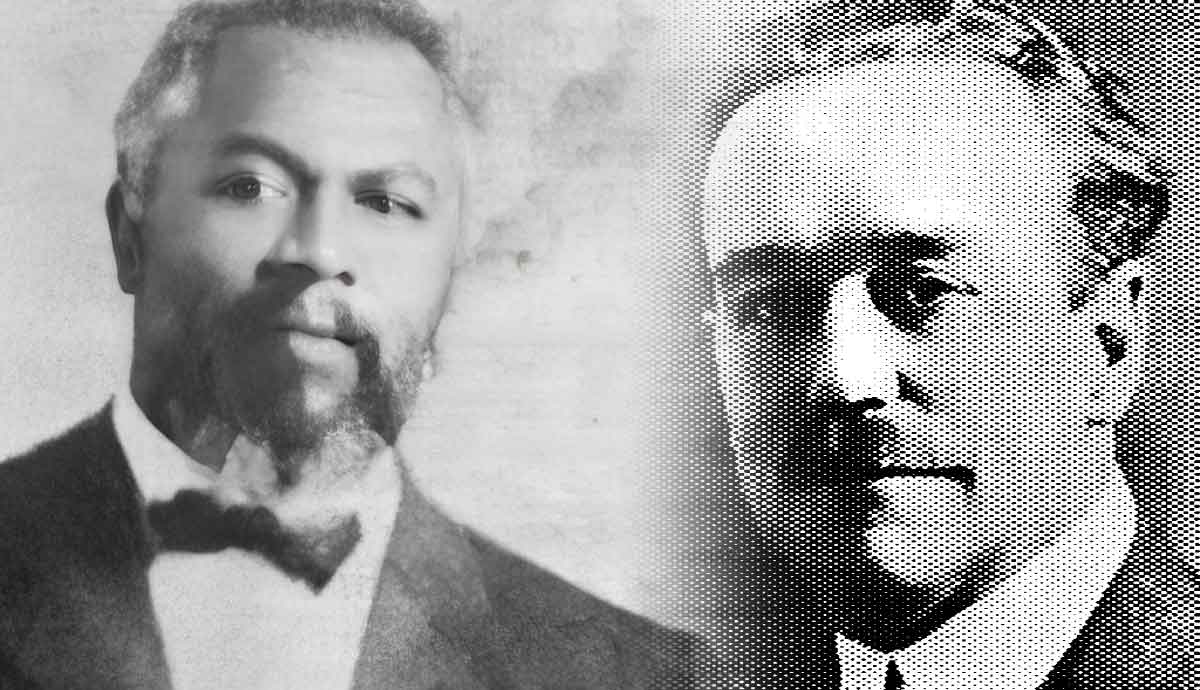
William J. Seymour (left) and Charles Fox Parham (right).
For the Pentecostal, this means two very different origin stories. One taking place in 1901, involving Methodist lay preacher Charles Fox Parham. Parham founded Bethel Bible College in Topeka, Kansas, a year earlier and had been by all accounts trying to understand small “outpourings” of the Spirit of God in Canada and around America. Not only does this fact alone disqualify this as an origin story (what was Parham “investigating” if not various outpourings of the Spirit that predate the one that took place at Bethel Bible College?), but as Parham admits early in the construction of the narrative, he wasn’t even in Topeka when the “outpouring” that allegedly starts the Pentecostal Movement happened. The second “origin” story preferred by Pentecostals took place at 312 Azusa Street, Los Angeles, California in 1906, and was overseen by black minister William J. Seymour. The Azusa Street Revival, even among the non-religious in Los Angeles, was a remarkable but brief period of cultures and classes worshipping together.
For the Methodist, this means claiming John Wesley and his brother Charles rode horseback across all of England, spreading the Gospel. On a high tide of successful revivals, they headed to America in 1736 where – okay, okay, yes, they failed in America and returned to England pretty quickly, they’ll admit that much but, okay, hold on, no, hold on – they had such an impact that they didn’t even need to stay that long! When what actually happened is this: Charles, John’s brother, was a constant voice of anxious criticism. His primary contribution to Methodism was hymn writing, not changed lives. John Wesley, for his part, surrounded himself with enthusiastic friends who took his sometimes perplexing ideas and make sense of them. When John left for America in 1736, he arrived in Savannah, Georgia. By all accounts, including his own, he fell in love with a woman who refused him. He left less than a year later because, jilted and jealous, he denied the sacrament of communion to her and her new suitor. In Savannah, refusing communion was deeply and profoundly offensive. Lovesick and rejected by his object of affection and now his own congregation, John left in disgrace and embarrassment. The founding of Methodism may have started with the Wesleys, but it was really the American revivals of George Whitefield and the administrative decisions by Thomas Coke and Francis Asbury that shaped Methodism into a globally-recognized Christian tradition. The competing origin stories of John Wesley, George Whitefield, and the combined work of Francis Asbury and Thomas Coke are yet another example of revolving acccounts by Christians in America.
Evangelicals, for a number of reasons, approach history like an all-you-can-eat buffet. It’s not healthy. It’s not balanced. It frequently doesn’t make sense and will lead to indigestion. But, like the all-you-can-eat buffet, Evangelicalism is a product of the 20th Century. Unlike Puritanism, where there was at least some semblance of communal responsibility, Evangelicalism is entirely individualistic. This is its defining trait, the emphasis on the individual and the insistence on loneliness in the world, even when sharing space.
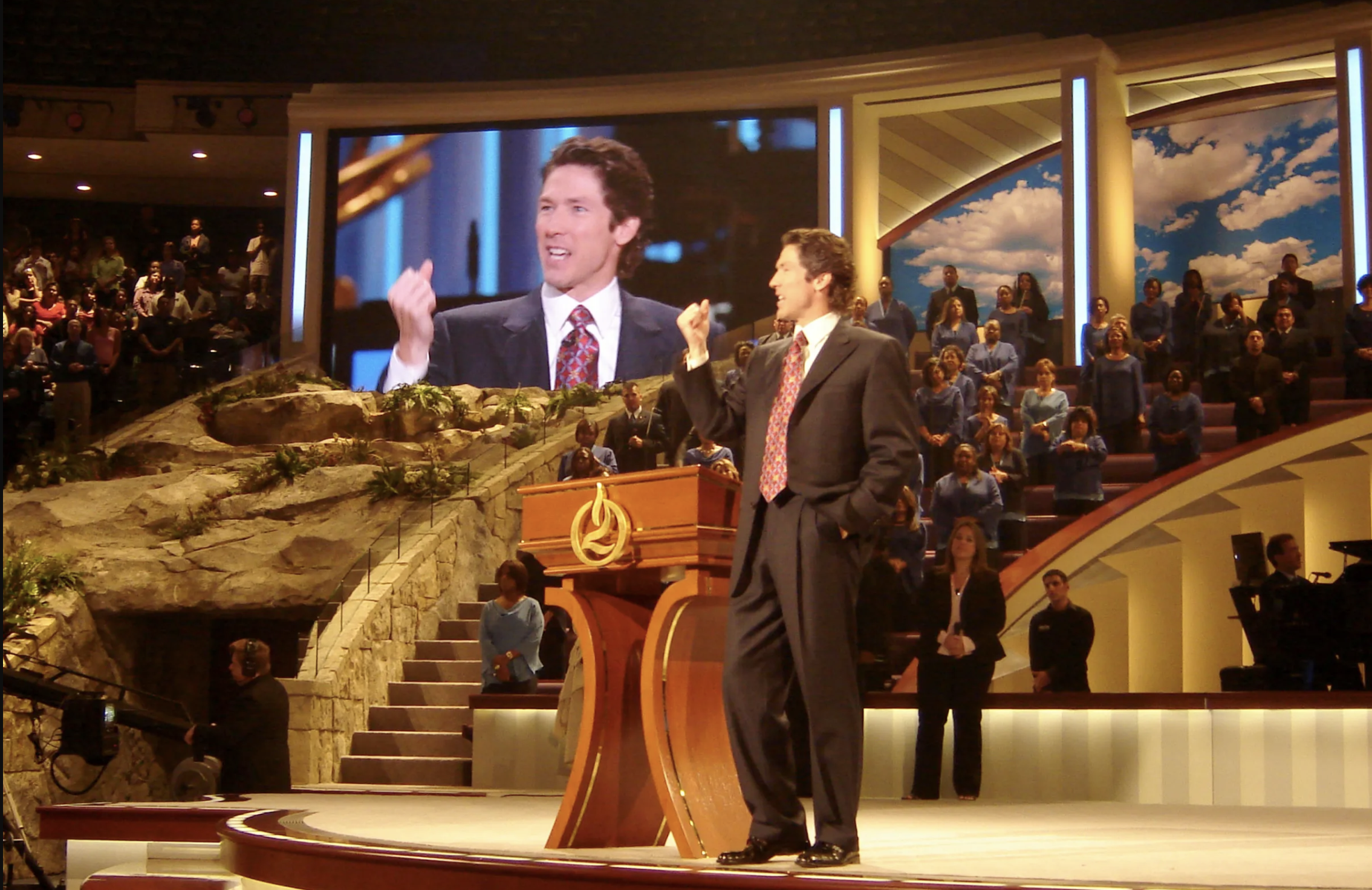
Exhibit A: Megachurches, filled with thousands of believers who don’t even know the name of the person sitting next to them. Even if they have a nametag on.
Exhibit B: The aggrieved anti-cultural Christian who believes themselves to be the victim of a cosmological conspiracy of demonic oppression.
Exhibit C: The insistence on having a “personal relationship” with Jesus to fill the ache of loneliness and the desire for “something more” in this life that will “heal your broken spirit.”
Megachurch pastor Joel Osteen at Lakewood Church in Houston, Texas.
One of the things I tell my American Literature students at the start of every semester is to pay attention to when Americans in the works we survey – letters, essays, fiction – become individuals. “Keep your eyes and ears tuned to this, because it doesn’t happen all at once. But when you see it, you see it.” By the 20th Century, there is a definite shift. The World Wars eradicate hope of collective efforts and Americans go to their siloes or, to use the imagery of the time, they “bunker” into their private nuclear fallout shelter.
In Europe, individualism was an American export. There was disillusionment, to be sure, but shared faith in a monarchy who grew up alongside the Greatest Generation and suffered in similar ways – austerity, reconstruction, rejection of familial nationalistic loyalties – kept things civil and sedated. It was the next generation who began to sound the alarm and ultimately distance themselves from their parents, deconstructing a great many assumptions only to find that, well, after all, we’re all in the same boat after all, aren’t we? Church attendance declined, capitalism prevailed, and individualism was the only inheritance the Greatest Generation left to them. But Americans had been migrating toward individualism since their founding.
Since the first settlements on this continent, the American narrative has been one of defining oneself apart from one another. This is a strange thing, considering how indebted the Founders and Framers were to the Classics – the Bible, Greco-Roman philosophers from Plato and Marcus Aurelius and Seneca, even Shakespeare. Intellectually, as well as culturally, Americans are too often derivative. Even unoriginal. Perhaps this is why Romanticism has always been so popular, because it allows for flights of fantasy and passion, for the unexpected, for breaks from inherited traditions and lore. Romanticism taps into the confusing parts of the human experience and allows the individual, the hero or heroine, to process that confusion in redemptive ways. This is the antithesis of the predictable routines, generational occupations, gender roles, and religious expectations placed upon each successive generation of settlers who begat founders and framers who begat Americans. The “father” of American literature, Nathaniel Hawthorne, gave voice to an emerging attitude, however.
Hawthorne, like many of his fellow Americans, lived in the shadow of previous generations. He became increasingly unsettled with the austere Puritanism of his ancestors. Quite literally, he was a descendent of one of the judges who oversaw the Salem Witch Trials. Hawthorne, seemingly at least, never got over the horror he felt upon learning of his family’s role in persecution of their fellow Americans. As a result, his works gave voice to many Americans who were slowly awakening to a rejection, even repulsion, at the cost of American exceptionalism. What had been brought over from the Old World, it turned out, was a considerable amount of hypocrisy and intolerance masquerading as Christianity.
His contemporary, Ralph Waldo Emerson, outright said as much. Emerson’s essay “Self-Reliance” (1841) begs fellow Americans to begin defining themselves on their own terms without indebtedness to previous generations or even, as he said in his Harvard Divinity Address (1838), “Facts have always suggested to man the sublime creed, that the world is not the product of manifold power, but of one will, of one mind; and that one mind is everywhere active.” For Emerson, the divine individual becomes an all-consuming pursuit. When one arrives at the same conclusion, that they are their own god, one realizes the self-fullling joy that can only be found in self-importance. “The perception of this law of laws awakens in the mind a sentiment which we call the religious sentiment, and which makes our highest happiness.”
Emerson’s student, Henry David Thoreau, will put this idea to the test when he recedes to “nature” (more accurately, a wooden area in Concord, Massachusetts) for two years beginning in 1845. He will recall the experience in his own essay, On Walden Pond, published in 1854. He explained, “I went to the woods because I wished to live deliberately, to front only the essential facts of life, and see if I could not learn what it had to teach, and not, when I came to die, discover that I had not lived. I did not wish to live what was not life, living is so dear; nor did I wish to practice resignation, unless it was quite necessary. I wanted to live deep and suck out all the marrow of life, to live so sturdily and Spartan-like as to put to rout all that was not life, to cut a broad swath and shave close, to drive life into a corner, and reduce it to its lowest terms, and, if it proved to be mean, why then to get the whole and genuine meanness of it, and publish its meanness to the world; or if it were sublime, to know it by experience, and be able to give a true account of it in my next excursion.”
This sentiment will come to be called “rugged individualism” and will later inspire young backpacker Chris McCandless to crisscross the continental United States before traveling to Alaska, where he will die in 1992. Shortly before his death, McCandless would write a much shorter essay, one begging for help. He realized the irrationality of rugged individualism much too late, writing, “I need your help… I am all alone. This is no joke. Please save me.” Sherry Simpson, a writer for the Anchorage Press, summarizes McCandless’ legacy. “Now and then I venture into the ‘what a dumb shit’ territory, tempered by brief alliances with the ‘he was just another romantic boy on an all-American quest’ partisans. Mostly I’m puzzled by the way he’s emerged as a hero.”
But he, like Thoreau, did just that. McCandless was not the first or last young individualist to pursue his “real” self in isolation. President Teddy Roosevelt abandoned his newborn daughter in 1883 to head West and “find” himself, his real and authentic self, after the death of his wife and mother on the same day. It is noteable that Emerson’s premise of individualism is at odds with actual events. He was only able to write his essays because friends paid for him to travel to Europe, where he was exposed to Continental Philosophy and concluded God was dead, we are alone in the universe, and what we call the divine is a collective unconscious, a “lidless eye” that watches over humanity. Quite the oxymoron, that. God is dead and we are alone, except we share a collective mind and experiences that are transcendent. Did I get that right?
Thoreau, similarly, reaches conclusions that are contradicted by established fact. Concord, Massachusetts was hardly a wilderness in isolation. There was a railroad conveniently located a few minutes walk from the cabin where he set up camp. For the two years he lived there, his family brought him meals every week, so all of that “living off the land” stuff conveniently came packaged in a picnic basket delivered each week. Thoreau would later show himself to be a fabulist with his essay “Civil Disobedience” (1849) where he makes a compelling case for not paying taxes to an unjust government. The catch? Thoreau owed a mere $1.50 in unpaid taxes and either a friend or family member, likely his aunt, paid the balance. It is a detail he leaves out of his anthem for challenging the injustices of tyranny. He spent one night in jail.
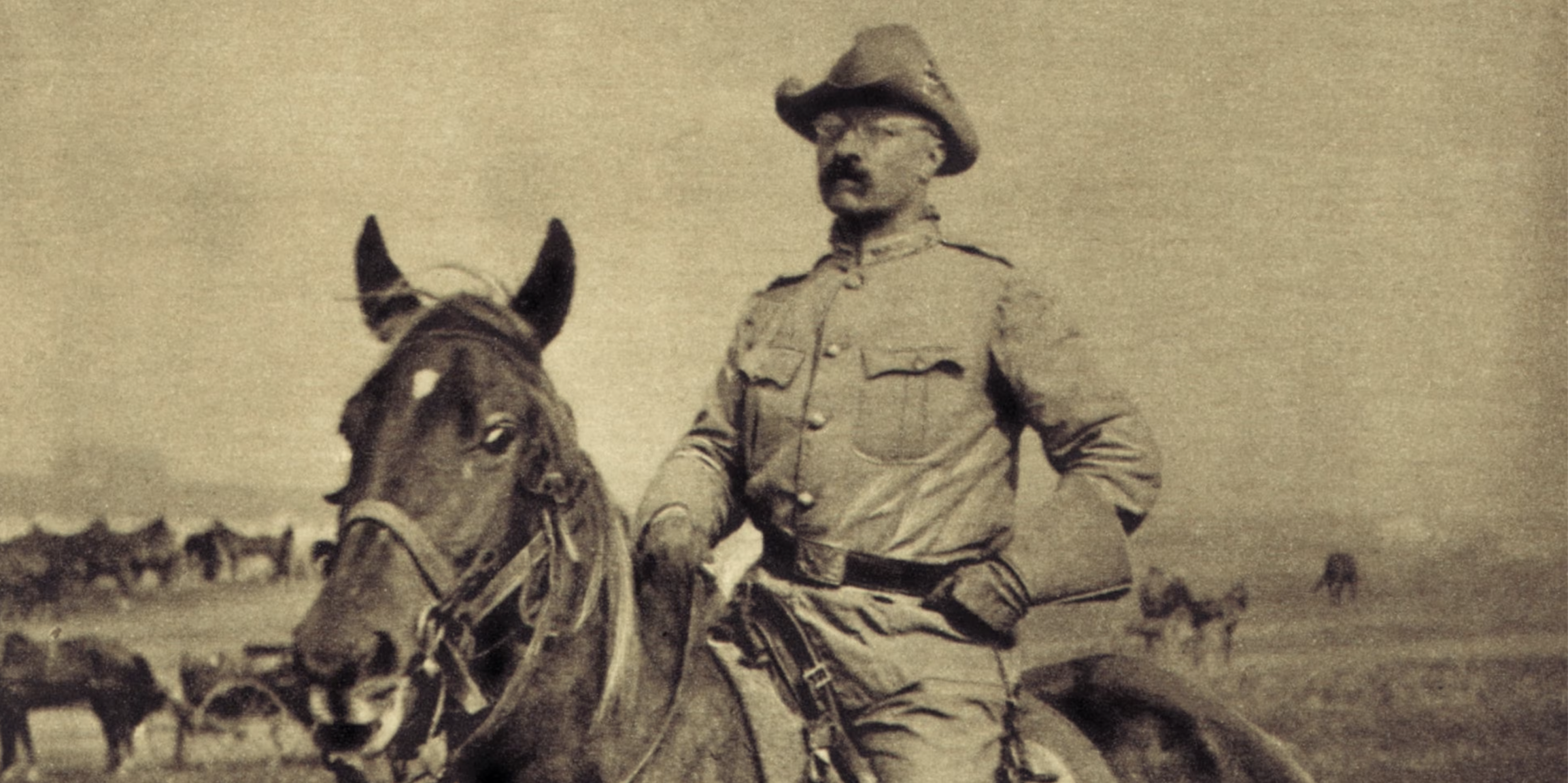
“Rough Rider” Teddy Roosevelt / Getty Images.
And as for Teddy Roosevelt? The generational wealth of the Roosevelt family is so well established – land, trade, imports, manufacturing, banking, railroads, sugar refining, urban real estate – it requires no extended explanation. When Teddy left, he was part of the New York Assembly, a position purchased for him by his family. His mother and wife died on the same day, which was undoubtedly traumatizing, but Teddy did not find himself out West. Instead, he found a great deal of bison to “hunt” whose broad bodies were convenient targets for existential frustration. “Hunting” them must have been especially easy since he joined a ranching party. As someone funding the entire effort, ranchers conveniently rustled the bison in front of Teddy for him to “hunt.” When he returned to New York, he wanted to become the Secretary of Navy and, as had been the practice of his family, it was purchased for him. From death to decoration was a short six year period; his private loss made meaningful through self-actualization. The narrative of individual effort prevailed and became a compelling part of the American narrative that one could simply retreat to nature, slough off the performative self for the real one, and recreate themselves in isolation with no help from anyone.
The back half of the 19th Century, when disillusionment settled into new grievances, forged an isolated America. The old narrative of a United States of America gave way to the United States of America, little islands of culture that continued to fracture and break. With the start of the 20th Century, language becomes granular and specific to differentiate along racial, social, cultural, and class divisions. By the middle of the 20th Century, it feels almost Freudian to speak of an “Atomic Age”, for the world had very much been blasted apart, leaving the individual adrift in the cosmos feeling every bit like a little lost atom among the stars.
Again, Nathaniel Hawthorne’s stories give evidence that when a literate society begins to challenge the narratives they have inherited, narratives where “bad” people are put to death for daring to step outside of collective oppression. Individualism takes shaky, and not entirely honest or thoughtful, first steps shortly before the Civil War, yet Theodore Roosevelt comes to champion individualism as a tool of self-actualization without self-reflection. His mother and wife died, but thank God they did because he would have never become who he was supposed to become without their unknowing sacrifice.
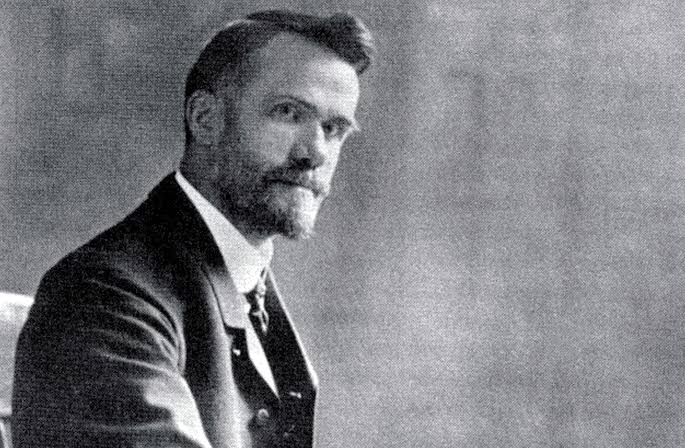
Theologian Walter Rauschenbusch (1861-1918) begins to challenge the swelling individualism within Christianity, what is about to become Evangelicalism. While there were many evangelical movements within Christianity in America and in Europe, Rauschenbusch takes aim at the selfishness pretending to call itself Christian. He articulates, in contrast, a Christianity that uses social tools – like political marches and protests, seats in government, charity services, social action committees to address clean water and sanitation – to make a better world and care for one’s neighbors. Individualism, Rauschenbusch asserts, is a threat to Christianity. Collective effort, he argues, is the authentic form of faith outlined in the Hebrew law and prophets, the teachings of Jesus, and the epistles of the First Christians, and Early Church Fathers.
And here is where Rauschenbusch miscalculates. He adopts the label “social gospel” for his reading of the Christian scriptures and Church history, distinct from the adjectiveless “Gospel.” Consequently, his critics spend the rest of the 20th Century dismantling, criticizing, and cannibalizing his work – as well as those who come after him, like Howard Thurman and Martin Luther King, Jr. – as “another gospel” that the Church was told to reject in Galatians 1:8.
“Even if we, or an angel from heaven, should preach to you a gospel contrary to that which we [originally] preached to you, let him be condemned to destruction!” – Galatians 1:8 (Amplified Bible)
What was it that Rauschenbusch taught? The Christianity he had grown up with. This was his offense. As professor of Sociology, director of the Center for the Study of Religion and Society, and director of the Center for Social Research at the University of Notre Dame Christian Smith writes in his 1998 American Evangelicalism: Embattled and Thriving,
“Through the work of many Christian preachers, writers, and moralists… Christian rhetoric, values, and morals hegemonically permeated public discourse, shaping the focus, content, and limits of imaginable public discourse.
“Given its role as primary moral guardian of the nation, it is not surprising that nineteenth-century evangelicalism exerted much control over the American education system, private and public, at all levels. University college presidents, for example, at even the most prestigious schools, were often not businessmen but well-educated clergymen. University boards of trustees, too, typically contained many Protestant church leaders and clergymen. Furthermore, college and university curriculum typically reflected a Protestant worldview and epistemology, combining classical curriculum with orthodox Protestant theology and piety to train properly the future leaders of America’s Christian civilization. At lower levels, too, education included generous doses of training in Christian beliefs, morals, and virtues. Indeed, public schools were believed to be the primary agency that could unify America under a common Protestant perspective.
“Politically and socially, nineteenth-century evangelical Protestants were extremely active in civic reform. Many of the culture’s public practices – such as Sabbatarianism – were, of course, modeled after Christian standards. But postmillennial evangelical Protestants believed that America fully becoming the kingdom of God would require additional social reform efforts. The abolition of slavery was, at least to Northern evangelicals, viewed as a major advance of the kingdom of God in America. Beyond that, evangelical Protestants organized myriad voluntary societies and poured their energies into causes of hospitals, schools, orphanages, prison reform, temperance laws, peace activism, recreation and leisure organizations, Sunday education for working children, the outlawing of dueling, services to native Americans and the poor, and the reform of prostitutes, drunks, and other dishonorable elements of any Christian civilization. So pervasive and zealous was the activism of Protestant voluntary societies that one Protestant convert to Roman Catholicism, Orestes Brownson, complained that, “a peaceful man can hardly venture to eat and drink, to go to bed or get up, to correct his children or kiss his wife,’ without the guidance and sanction of some voluntary society… Evangelical Protestantism in nineteenth century America appeared to represent the advanced guard of civilization that was leading to the kingdom of God on earth.
“But then all that began to change. During the last quarter of the nineteenth century, a series of profound social, demographic, and intellectual transformations began to challenge evangelical Protestantism’s security, influence, and relevance. Within the churches, liberal theology, biblical , biblical higher criticism, and an increased skepticism about supernaturalism began to question the old orthodox verities. And advocates of the Social Gospel began to devalue, in the eyes of many evangelicals, the importance of individual conversion to Christ in favor of structural reforms.” (American Evangelicalism: Embattled and Thriving, 1998)
Theologian Walter Rauschenbusch (1861-1918)
Rauschenbusch held to a Christian message of social responsibility at a time when Evangelicals were siloing themselves, reading scripture out of context to weaponize the words of Jesus and Paul. To accomplish these new readings, Evangelicals had to strip the Gospels, Epistles, and Prophets of all context. What mattered was the individual. The prophet Jeremiah’s revelation of God’s love with which he introduces his prophecies, “Before I formed you in the womb I knew you, before you were born I set you apart; I appointed you as a prophet to the nations” is no longer about the ancient world, or even specific to Jeremiah himself, but a privileging of American Christians who were known individually by God. The cosmological war of John’s Revelation, where women ride dragons and the buried dead are re-animated to preach against the living church from underneath floorboards somehow becomes a “culture war” in the American imagination, neighbor turned against neighbor, to justify hostility and racism. When pressed to define what the re-animated dead are preaching in testimony against the living, the Evangelical might claim “the importance of traditional gender roles” or “free-market capitalism.” With no social, theological, or narrative context, the Reformation became no longer a movement to place the Bible in the hands of a literate society, but a movement toward the True Gospel of individual authority. After all, God knows each person individually – at least each individual American – and has declared each American to denounce the cultural incursion of a nameless, contextual -free multitude of “the nations.”
Whatever vestiges of social responsibility existed as America slammed into a new century were salvaged by “liberal” churches, primarily (and tellingly) among African Americans. “Liberal” became another way to enshrine racism within American Christianity, a label used by “conservatives” to separate themselves from blacks, communists, Jews, and other degenerates into a separate, lower class, a melting pot of “liberalism” distinct from and disdained by the True Church, Evangelicals, who (rightly!) rejected the “other gospel” of liberalism.
What mattered most to Evangelicals was their own private salvation, the rest of the world be damned. It was quite the reversal, and would require a complete rewriting of the historical witness of the Church. A task that was made easy by the declining number of Christians at the turn of the century.
Since the Civil War, Americans had become more aware of themselves as individuals, in turn untethered from and unwilling to perpetuate whatever expectations had been placed upon them. Out of step with the advances of science, exposed as racists, unwilling to accept immigrants, and once more exposed as illiterate bumpkins with the Scopes “Monkey” Trial (1925), Evangelicals made Christianity-at-large grounds for ridicule. As essayist H.L. Menken would write in 1924, “Christendom may be defined briefly as that part of the world in which, if any man stands up in public and solemnly swears that he is a Christian, all his auditors will laugh.” He wasn’t suggesting that Christianity itself was to be smirked at, but that there was a distinction to be made between the urban, modern Christianity that embraced the context and place of contemporary crises and the anti-modern, anti-black, anti-immigrant, anti-woman, anti-education, anti-science, anti-politics, anti-cultural religion used by the rural Americans who had already enshrined Whiteness as next to godliness. Recognizing the decline was not anti-Christian or anti-Bible. While revivalists continually pointed out wickedness and abomination upon abomination in American society, pastors and denominations and ensconced Ivory Tower theologians very well realized that America was deeply religious going into the Civil War, zealously convinced of the spiritual rightness of their chosen side of the battle. Afterwards, Americans no longer needed God.
Rev. Theodore Woolsey, retired president of Yale University, asked the General Conference of the Evangelical Alliance in 1873, “In what sense can this country [America] be called a Christian country?” The organization had been founded in London in 1846 to coordination humanitarian relief and address social issues like racism, income inequality, labor shortages, malnutrition, pollution caused by factories and corporations, and starvation throughout the world. Evangelical meant something at some point, in other words but even approaching the 20th Century, there was a schism that would cleave and disfigure the very face of Evangelicalism. Woolsey was not lamenting the decline of church attendance. He was lamenting the anti-Christian ideologies of his fellow Evangelicals in America and the growing attitude of selfishness that was taking shape as a result of Evangelicalism’s emphasis on the individual.
“In the worlds of political, religious, and economic man, commitment was outwardly directed to those communal beliefs, practices, and institutions that were bigger than the individual, to the degree that he or she conformed to or cooperated with them, found meaning. The ancient Athenian was committed to the assembly, the medieval Christian to his church, and the twentieth century factory worker to his trade union and working man’s club. All of them found their purpose and well-being by being committed to something outside themselves. In the world of psychological man, however, the commitment is first and foremost to the self and is inwardly directed. Thus, the order is reversed. Outward institutions become in effect the servants of the individual and her sense of inner well-being.
“In fact, I might press this point further: institutions cease to be places for the formation of individuals via their schooling in the various practices and disciplines that allow them to take their place in society. Instead, they become platforms for performance, where individuals are allowed to be their authentic selves precisely because they are able to give expression to who they are ‘inside.’… For such selves in such a world, institutions such as schools and churches are places where one goes to perform, not to be formed – or, perhaps better, where one goes to be formed by performing.” (The Rise and Triumph of the Modern Self: Cultural Amnesia, Expressive Individualism, and the Road to Sexual Revolution, by Carl R. Trueman, 2020)
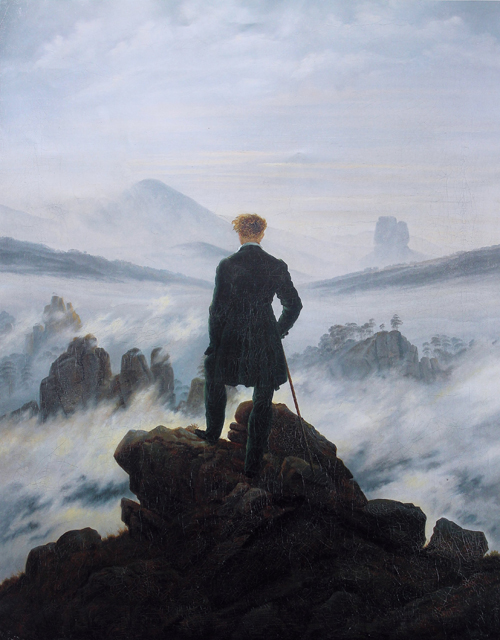
An icon of Romantic individualism, Wanderer Above the Sea of Fog, by Caspar David Friedrich (1818).
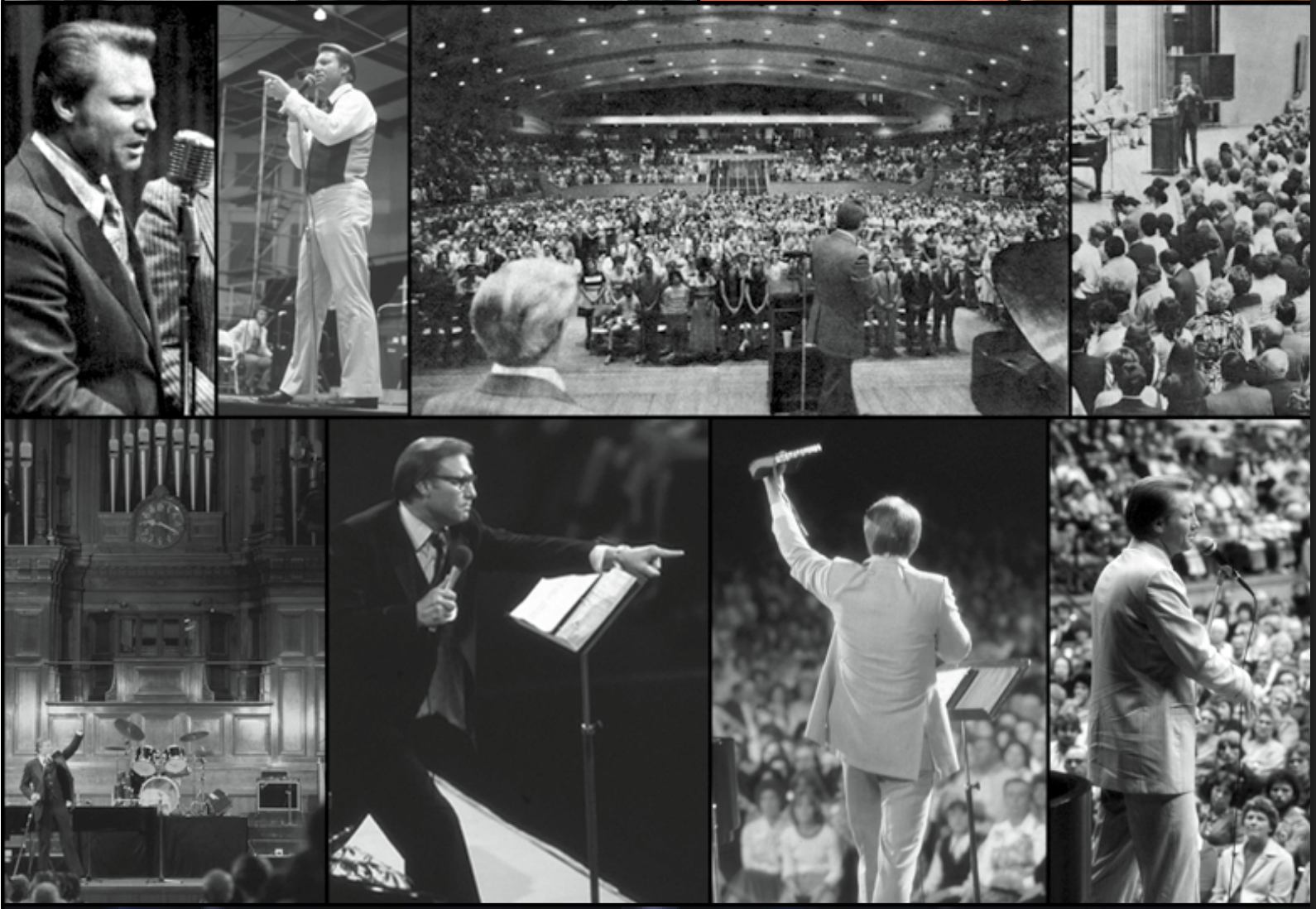
Jimmy Swaggart was a consummate performer. At times, it eroded his sense of identity. He was, like his cousin Jerry Lee, a man who felt most alive on stage and not at all himself when away from attention. In private, Jimmy felt vulnerable and, at least to the armchair psychologist, this explains his desperate need for attention as a means of survival. Languishing in obscurity would have felt like death, but being the most recognized television minister? That felt a lot like living.
Real life, however, proved full of problems. With a radio and television ministry that came to employ hundreds, Jimmy was responsible for budgets and deadlines. He was not built for the structure and civility required for institutional success. It was, as he said frequently, lonely on the road and he wanted desperately to be loved by his fellows within the Assemblies of God, but the rejection he experienced when he sought ordination – because of his relationship to Jerry Lee, not even based on his own individual failures – was a sore spot that never fully healed. Again and again, before it even became relevant, he told audiences about being rejected by the leaders of his denomination. He let the wound fester. And, even as he denounced the individualism he saw in religious expressions within his lifetime, he privileged and maintained his own individualism. Unlike his institutional fellows, he was something else. He was unique. He was special. He did not need to ask permission – or apologize! – for anything. He was a law unto himself. Nothing could be more American or more Christian, after all, than embodying true Evangelicalism.
This is where Jimmy, along with many Methodists, most Baptists, and all Pentecostals reside theologically. As Evangelicals, they adopt a century-long foundation of individualism. When Martin Luther began the Reformation, he did not forsee Christianity as individualistic. Remember, Luther remained convinced that he was a true Catholic until his death. He remained committed to a collective, communal faith despite the revisionist tendencies of Evangelicals to make Luther’s “real” reformation one that centered the individual as the source of their own private revelation. As Carl R. Trueman writes in his The Rise and Triumph of the Modern Self (2020), “one needs to address specific matters of context” instead of the compressed revisionism that Evangelicals use to build false, self-supporting narratives. Trueman continues,
“There is a tendency among social conservatives to blame expressive individualism for the problems that they regard as currently putting strain on the liberal Western order, particularly as it manifests itself in the chaos of identity politics. The difficulty with this claim is that expressive individualism is something that affects us all. It is the very essence of the culture of which we are all a part.” (Trueman)
Including Evangelicals, like Swaggart, who speak to an idealized and distant past where church members “shared all things in common” (Act 2:44; 4:32) even as they promote a “close, personal relationship with Jesus” and maintain loyalty to a denomination only when the denomination serves their own personal interests and motives.
“Just as some choose to identify themselves by their sexual orientation, so the religious person chooses to be a Christian or a Muslim. And this raises the question of why society finds some choices to be legitimate and others to be irrelevant or even unacceptable. The answer to that is to be found not by simply repeating the phrase ‘expressive individualism’ but by looking at the historical development of the relationship between society at large and individual identity. But there is an opposite problem to the temptation presented by overgeneralized explanatory schemes that one must also avoid. That is the tendency to treat symptoms in isolation.” (Trueman)
There is also the tendency among Evangelicals to warp facts and revise history to suit the false narratives they need to perpetuate their ideology. Complementing Trueman’s views on individualism, philosopher Charles Taylor wrote in A Secular Age (2007) about the ways in which individuals arrive at the understanding of the world through “social imaginary” or “that common understanding which makes possible common practices and a widely shared sense of legitimacy.” In Taylor’s reckoning, “the myriad beliefs, practices, normative expectations, and even implicit assumptions that members of a society share and that shape their daily lives” assert themselves at the individual level even as the individual maintains their individuality. This “amorphous concept”, he says, is rightly named “social imagination” because it takes a great deal of imagination to believe one’s identity, sense of self, and individuality spring whole-formed like the mythological goddess Athena from the head of Zeus even as other individuals who share similar political, social, technological, gendered scripts maintain their own private individuality. The individual maintains their individuality even as their ideology is shaped by society at large and their chosen communities – made up of like-minded individuals caught up in the social imagination with them. Personally, this kind of arrogance speaks for itself. They are indebted to no one mentally, emotionally, or spiritually, entirely their own person independent of anyone else despite consistencies in experiences, socio-economic indicators, and personal narratives. Outside of the realm of philosophy, this is often called psychosis at the individual level, delusion at the communal level, and oppression socially. Still, by maintaining their individuality, Evangelicals can maintain their denial that they, like so many of their fellow Evangelicals, have been oppressed by propaganda and the outside forces that have captured their attention and, yes, imagination. As Trueman concludes, “Every historical phenomenon is the result of a wide variety of factors that can vary from the technological to the political to the philosophical.” No one is above this.
David Hempton, former Dean of Harvard Divinity School, explains that “early evangelicals” – by which he means evangelicals who were part of “the global intellectual culture of the late seventeenth and early eighteenth centuries” share nothing in common with the Evangelicalism that emerged from America in the 20th Century. Evangelicals in Europe and Asia, for example, remain consistent with their lower-cased predecessors who, “though sometimes bitterly divided over both belief and practice, nevertheless constructed a global fraternity” that remains today (“The People Called Methodists: Transitions in Britain and North America” The Oxford Handbook of Methodist Studies, 2009).
British historian Reginald Ward, elaborates in his Early Evangelicalism: A Global Intellectual History, 1670 – 1789 (2006), speaking to six themes: “the close association with mysticism, the small-group religion, the deferred eschatology, the experimental approach to conversion, anti-Aristotelianism and hostility to theological system, and the attempt to reinforce religious vitality by setting it in the context of a vitalist understanding of nature.”
The emphasis on individualism, then, becomes a product of the American warping of Evangelicalism in the 20th Century. Jimmy Swaggart, like many Evangelicals, would have believed that he was the inheritor of a long tradition, an individual who like many other individuals, was called and chosen by God to be a true believer in the true religion, uncorrupted by pretenders who attended church, typically mainline denominations with simpering platitudes. Jimmy, like Moses – hell, like Jesus! – was someone who could deliver those poor souls out of bondage to false Christianity and bring them into the Promised Land of the Pentecostal experience. If he collected fellow travellers from the wicked, ungodly society indifferent to what God was doing in Jimmy’s life, all the better.
As the record albums began to sell, this produced a side benefit. More people were attracted to the services. As more people came to the meetings, the length of the revivals grew longer. In the beginning I had been preaching one and two week revivals, now they began to stretch into four and six week meetings. I had prayed and fasted for many hours, hoping to see my revivals stretch into longer and more sustained periods of time… (To Cross a River, 149).
Television and radio allowed him to do just that. Without having to travel. Without the breathtaking humidity of Southern backroads. Without Frances’ constant nagging or Donnie’s teenage funk and moodiness in the backseat. He loved the boy, but Donnie unfortunately favored Frances more than Jimmy would have liked. Donnie was soft-spoken, almost effeminate, and hadn’t had the advantage of cousins like Jerry Lee who could help make a real man out of him. Donnie didn’t have a mentor, like Jimmy’s grandmother, to help guide him; his best friend, sadly, was Frances. Summarizing those years, Jimmy would claim in To Cross a River that, “Somehow God was telling me that every preacher has his own struggles. It might seem like some preachers never face uncertainty and doubt, but they do. The devil is opposed to every work done in Jesus’ name.”
They began building a house, self-funded and debt free, with monies earned from more revivals and the record sales. “We moved ahead to build the house, trusting in the Lord’s personal word for me. Each time we came back to Baton Rouge from a meeting, the house had taken more shape. Even more important, each time we had a bill, the money was in the checking account to pay it. The house was built debt free.” And then he went to Detroit at the start of 1968 to preach at Brightmore Tabernacle. There, Donnie finally “grew up” in Jimmy’s eyes when he “received the Baptism with the Holy Spirit.” At least now, Jimmy felt like Donnie was his son instead of some oddling with his face and Frances’ voice. In Detroit, radio pushed Jimmy’s ministry forward. “It was the longest” and largest “revival I had ever preached up to that time. During the eight weeks,” spanning the start of January to the end of February,
I frequently appeared on WMUZ with Chuck Cossin. At times, he would interview me and play songs from the record albums. On the next occasion, I would answer questions from the listening audience. Because of this exposure to a radio audience, more people came out to the meetings. And I began to hear questions like ‘Why don’t you hve a program?’ ‘You’re a natural for radio,’ others suggested. Something about radio touched me in Detroit. I saw it as a great tool for reaching people with the gospel. The Detroit meetings proved that. At the same time, my records were being played with increasing frequency on many gospel stations. In some locations, I had the number one gospel record. In the fall of 1968, Donnie entered the ninth grade. More than ever before, I felt that Frances needed to stay home with him.
Settling Frances and Donnie into the house, Jimmy began guest preaching and participating in smaller revivals, sleeping in the car, eating less and calling it “fasting” to keep costs down. He withdrew into himself more and more, confident that the stability of moving to Baton Rouge and moving the revivals to radio and television would change things if only he could get through the bone-wearying schedule of the road. Leaving Frances and Donnie behind was a breath of fresh air for Jimmy, his marriage, and his son. Some relationships do better with long stretches of silence and distance. Alone on the road, “God was saying He was more interested in Jimmy Swaggart personally… Knowing God was interested in me didn’t relieve the struggle, but it helped me cope with the situation” (149 – 150). It is telling that with more independence, more freedom, even the hardships of bad food and isolation, allowed Jimmy to become more confident. He had avoided being alone for so long, continually looking to his grandmother, to Jerry Lee, to Frances, for validation, only to find that when Jimmy was alone, he felt like God loved him more.
In 1969, at the insistence of his wife, Jimmy began The Camp Meeting Hour, a half-hour show featuring gospel music and preaching.
After the first month, he was ready to shut it down.
It was the refrain of his ministry; what he wanted to do was not what “the Lord” or his wife told him to do. He bucked. He balked. He prayed through. Eventually, he would come around, but unhappily. He was constantly looking for a way out, a way to show God and Frances that he could be his own person and still come out on top. He didn’t like to be handled and managed, his day scheduled and systematized. He was a free mind and spirit who wanted to experience each day, not tick boxes.
He was restless.
Stuck behind a microphone, he wanted to return to the familiar rhythm of being on the road. No one called in, donations were nonexistent. He needed people. Unable to work a room, to feel the energy of a crowd, with only his own voice to listen to felt like a complete waste of time, if not terrifying.
Jimmy was no Billy Graham or Oral Roberts, that was for sure. Graham yelled because there were thousands of people in packed stadiums, the technology still new, and he wanted to be heard. What he had to say was important, after all, a matter of life and death, eternal fate, national interest. Roberts was far more comfortable behind a microphone; he had used them under the tents of his camp meetings to call people forward, to bring them into the experience, to connect with them and have “a point of contact” for their miracle. But Swaggart withered. It was a completely different experience facing the tiny audience of a single microphone. With The Camp Meeting Hour, he had to learn a completely different presentation style. He had to restrain himself. He had to be focused and controlled. He had to follow a script. He couldn’t shout. And if he waved his arms around, that was fine, but no one would be there to see it, to do the same, to give him the instantaneous feedback he had grown accustomed to having. His thunderous voice, belting songs and sermons to the back of auditoriums and theaters had to be suppressed in a soundbooth. There was no crowd to feel, to ride, to laugh with. No one gave him the immediate feedback he needed, the assurance that he was saying the right thing. There was no stage, no performing here. He was alone for the first time.
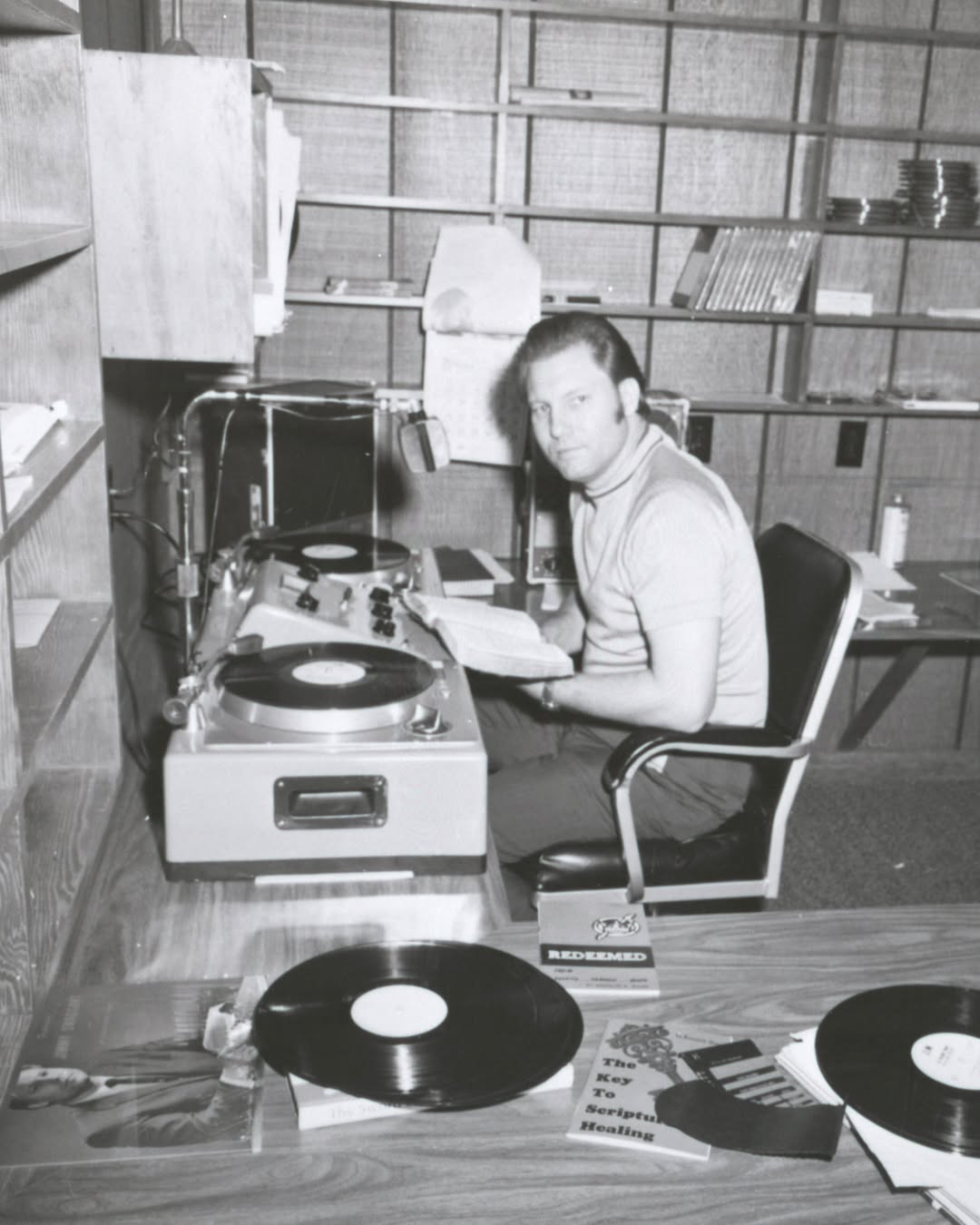
Jimmy Swaggart records The Camp Meeting Hour in 1969.
Desperate for any kind of feedback, Frances urged him to ask listeners outright whether they wanted him to continue or pack it in at the end of that first month. If it wasn’t profitable, if the donations weren’t going to come in, then they needed to hit the road again. As it was, she felt deep in her spirit that if Jimmy could remain patient, an impossible task she admitted, they could have a little more stability. They could reach an even larger audience. Radio opened up new audiences with new potential for new revenue streams. For Frances, it was always about what would be most profitable. Centralizing their ministry and having access to a single studio would help make their expenses more predictable, making it easier to forecast what would come next. Radio seemed like the answer, but not if it proved yet another unnecessary expense. Jimmy could sing, he could preach, he could be everything she knew he could be. And they could sleep in their own beds. He just needed to be patient.
To their mutual surprise, people called the station. Honest in his solicitations, they sent money to keep him on the air. They sent letters to the stations, asking station managers to keep the young preacher on the air. They ordered records and promised to keep listening. A few years later in 1975, Jimmy and Frances would expand to a weekly television program. A decade later, his weekly telecasts reached approximately two million households in the United States, making him the most popular and successful televangelists of the era, even bigger than Billy Graham and Oral Roberts. There was no time left to think and feel things fully anymore, things were moving so quickly.
No, the situation would not get any better. The difficulties would remain. But you see, God saw something that Jimmy Swaggart could not see. In that day so long ago, I could not even begin to remotely see a radio ministry that would touch the hearts and lives of hundreds of thousands of people. I could not even begin to see the millions that would be touched by the television programming that would girdle the globe. I suppose if God had shown it to me in a vision, it would have scared me so badly that possibly it would have hindered my progress with Him, because then those types of things seemed impossible. But of course, with God nothing is impossible.
I think I paid my dues the hard way. My love for the church goes back to nearly twelve years spent in crusades in local churches. I remember the countless nights we would witness the Holy Spirit moving and touching the hearts and lives of so many, as they would come down those aisles and kneel at an altar to find the Lord Jesus Christ as their precious Savior.
I remember the first real breakthrough we had (which was in Alton, Illinois). The meeting lasted some six weeks. Several hundreds of people were saved and filled with the Holy Spirit. I think that one meeting changed my life. It increased my faith, enabling me to believe God for great things. And from then on, the meetings seemed to take on a completely different complexion. Whereas previously they had lasted from one to two weeks in length, suddenly they were going from four—up to nine—weeks in duration. Now I know that sounds almost unheard of nowadays, for a revival meeting to last that long in one church, but the crowds kept coming—the buildings oftentimes packed to capacity—people getting saved, lives being changed. And I think all of this was preparing me for the work God was then calling us to do.
And then the Lord opened up radio. This was in 1969, January 1st. Our first station was in Atlanta, Georgia. If it had not been for the people of the Assembly Tabernacle where Jimmy Mayo pastored, possibly this ministry would not have survived in the way it did. They stood with us in those struggling first days. And then there was Houston, and Hardy Brundage helped us to stay on the air. Then there was Minneapolis, Minnesota. These were the first struggling stations. And then God started to bless it—a moving of the Holy Spirit that swept over my soul that resulted in the program going on over six hundred stations and developing one of the largest radio audiences in the world.
It was during the beginning of the radio ministry (after we had been on the air for possibly two or three years) that the crowds became so large in the churches we could no longer stay there. Then very reluctantly I started renting large auditoriums and we went into the citywide meetings. I really didn’t want to do this. I was comfortable in the churches; I wanted to stay there. And I didn’t leave until we just had no choice. People were driving sometimes hundreds of miles, only to arrive and there would be no room to seat them. And of course this was creating such problems we felt we had no alternative.
I remember that last revival service I conducted in a church. It was a Sunday morning. (Actually it was not the last service, but it was the last Sunday morning we were in a service.) The service was bound up. It would not function or move. It seemed to be so dead—I had no liberty whatsoever. Right in the middle of the message, while I was preaching, I was subconsciously wondering what in the world was wrong. And God was speaking to my heart and said, “Son, I’ve told you to go into the citywide auditoriums. I have more things that I want you to do, and you are not obeying Me. Until you do, My Spirit will not move.” I’ll never forget that moment.
And if I remember correctly, that was basically the last meeting that we conducted in a church. And, of course, I say that simply because the Lord instructed me to do otherwise, certainly not meaning that it’s wrong to conduct meetings in churches. It isn’t. But God was leading us into a different ministry, and I actually did not want to launch out into the unknown. But then we did, and the crowds started coming. Lives started to be changed. Souls started to be saved—in a magnitude that I had never dreamed possible.
And, of course, I cannot talk about the media without remembering our humble start into publications. In 1970, we began to publish a little four page flyer to list our revival schedules and to advertise our records and tapes. It was just black and white and was printed on inexpensive, uncoated paper. But the blessing of God was on this little publication too. We called it The Evangelist, and we began improving it by adding pages and color. We found this to be an excellent teaching tool to feed the people each month, so we began adding teaching articles and other helps for God’s people… Today, publications of all kinds that we have written can be found in the homes of multiplied thousands of people, bringing instruction and blessing to hungry hearts. In fact, through the media of publications, radio, and records and tapes, God has poured out His blessings on this ministry far more than we could have visualized, and we are grateful to Him. (“Twenty-five Years of Mighty Miracles: A Quarter Century of God’s Goodness”)
Originally, Jimmy recorded a half hour show with marked time for advertisements. Once he developed an audience, he realized he could break a teaching apart. Ten to fifteen minute stretches allowed him to elaborate on a few points before asking listeners to return the next day, the next week. In this way, he broke from other radio ministers with their constant calls for salvation and incessant requests for donations, charity, love offerings, or – simply – money. It was a format he learned from comic books and serialized movies as a boy, you had to keep people coming back for more. Everything was “to be continued” and when he ran out of material, he would preview the next series. He continually promised he would talk about something “next week or the week after” to keep his audience invested, searching, wanting him to answer their questions on the air and bridge the parasocial relationship. He was, after all, one of them – just a country boy from the end of a dirt road who loved Jesus and wanted God to move in his life, their lives, the world entire. He wanted so badly to keep that connection to who he had been and how he grew up, but personal anecdotes had to serve the script. As Frances would remind him, he could actually say something substantial if he stayed focused. No more flowing in the Holy Spirit, no more seeing where things went. Consistency and the development of an audience were tools for filling in auditoriums the next time he was in the area of his audience. Consistency would keep people coming back. Jimmy wanted to keep the Spirit flowing, but Frances wanted to keep the money flowing. Frances would win.
As the years went on, especially once Jimmy and Frances moved into television, Jimmy’s tell became more apparent. He would interrupt and speak over pastors he had invited onto the show. He would jerk his head, crane his neck up and away from his collar, pull at his lapel. His eyes would get wide and wild, darting up or outside the camera frame for a moment. That caged animal was still there, looking for the doors, looking for a way out, looking for prey, doing everything he knew to do to keep from gnawing his own hands off.
The Campmeeting Hour, the program’s name, came from the camp meetings of the Second Great Awakening, when ministers were innovating a new form of Christianity outside of traditional methods. In England, Dissenters were forbidden from preaching five miles outside of a town, and began to field preach on agreeable farms or in open fields. They were finding new preaching styles as well outside of the brick-and-mortar cathedrals and houses of worship. Families would travel out for the weekend and camp, meeting other families and sharing news.
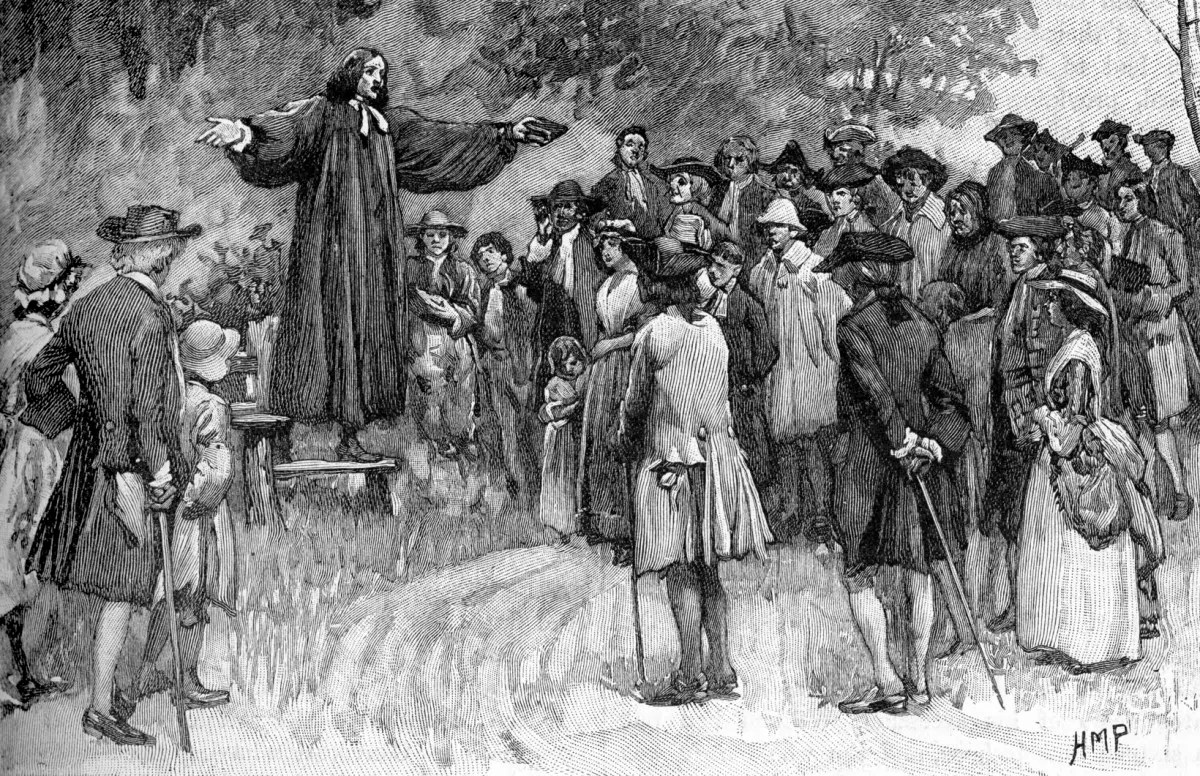
By the middle of the 18th Century, the Christianity of America had begun to slumber. John Wesley had tried to convert Americans to his religion of the heart, Methodism, when he came to the New World in 1736. He failed miserably and returned to England the following year, believing America an inhospitable land. His emphasis on the heart, rather the mind, continued to germinate but much of the original enthusiasm in America had given way to Calvinism, scientific rationalism, or anti-imperialist politics. Religion just wasn’t meeting people where they were anymore, especially when it supported tyranny in the name of the crown. The disaffected saw church attendance as a social club and noticed that the privileged would attend on Sundays only to trade goods, even slaves. Surely, this was not what the Lord intended for the Sabbath. Churches upheld a form of religion that spoke about obedience to the British crown before loyalty to scripture. And of course zealous Calvinists, inheriting counterculturalism and iconoclasm from their Puritanical ancestors, were quick to believe everyone (except them) would going to Hell for every imaginable reason. As Jonathan Williams declared in his sermon, “Sinners in the Hands of an Anrgy God” (1741),
Artist’s depiction of Jonathan Edwards delivering his sermon, “Sinners in the Hands of an Angry God” on July 8th, 1741.
Yea, God is a great deal more angry with great numbers that are now on earth – yea, doubtless, with many that are now in this congregation, who it may be are at ease – than He is with many of those who are now in the flames of hell.
It is not because God is unmindful of their wickedness, and does not resent it, that He does not let loose His hand and cut them off. God is not altogether such an one as themselves, though they may imagine Him to be so. The wrath of God burns against them, their damnation does not slumber; the pit is prepared, the fire is made ready, the furnace is now hot, ready to receive them; the flames do now rage and glow. The glittering sword is whet, and held over them, and the pit hath opened its mouth under them. The devil stands ready to fall upon them, and seize them as his own, at what moment God shall permit him. They belong to him; he has their souls in his possession, and under his dominion. The scripture represents them as his goods. The devils watch them; they are ever by them at their right hand; they stand waiting for them, like greedy hungry lions that see their prey, and expect to have it… The old serpent is gaping for them; hell opens its mouth wide to receive them.
After the American Revolution had concluded in 1783, a jaw-dropping nine out of ten Southerners were not affiliated with any church at all. In the North, where Christianity had been more of a civil religion, church leaders carried the stain of treason either for their support of the Revolution or, worse, their support of the monarchy. There, the Church of England rebranded itself as the Anglican Church in a desperate hope that Americans would come to forget their loyalty to the crown. Thomas Jefferson famously took a knife to a copy of the Bible, finding accounts of miracles and the rejection of science to be contemptible. A month before his death in 1790, Benjamin Franklin wrote about his indifference toward Christianity to Ezra Stiles.
Portrait of Ezra Stiles (1770-71) by Samuel King.
As to Jesus of Nazareth, my opinion of whom you particularly desire, I think his system of morals and his religion, as he left them to us, the best the world ever saw or is like to see; but I apprehend it has received various corrupting changes, and I have, with most of the present Dissenters in England, some doubts as to his Divinity; though it is a question I do not dogmatize upon, having never studied it, and think it needless to busy myself with it now, when I expect soon an opportunity of knowing the truth with less trouble. I see no harm, however, in its being believed, if that belief has the good consequence.
Americans had won their freedom but were spiritually demoralized. Stiles was, at the time of Franklin’s letter, president of Yale University where he had distinguished himself as a professor of Semitics. Notably, Stiles was also a leader in ecumenical dialogue and showed reluctance of his own to see Jesus apart from a Jewish context. The anti-intellectualism of Puritans, arrogance of Calvinists, isolationism of his fellow theologians, and disarray of civil religion had worn the new nation thin, in the halls of academia as well as the public square and farmer’s fields.
Expanding westward across the Appalachian, Americans found a primitive existence like that of their ancestors. Revolutions felt terribly far away, left behind beyond the mountains. The struggle for life in the midst of uncertainty, where the only certainty was death, compelled many to abandon their morals and virtues. There was no time or energy to work out eternal fate or one’s destiny. Whether an individual was a member of the Elect or the Damned seemed unimportant. People on the frontier drank heavily, domestic violence was to be expected, and by some estimates one in every three brides were pregnant at the time of their wedding. The evil of each day was sufficient to break the strongest of wills. Justice caused a neighbor to disappear here, injustice caused the next to disappear there. Directionless, paranoid, and in need of relief, Americans found comfort in a new wave of revivalism.
The Second Great Awakening, stretching from 1795 to 1835, placed tremendous emphasis on salvation as had the First Great Awakening. It also emphasized social reform, Christian character, temperance, and domestic tranquility – or at least a decline in violence, at minimum. Unlike the First, however, the Second Awakening did not care much for civility or the advance of science. In most respects, it came to see science, politics, rationalism, even religious certainty as indicators of sinfulness. These were the very things that had shackled the nation, rather than liberating. Rationalism failed to speak to the lived experience of Americans who had come to feel that life simply did not make sense. You could apply yourself and still fail. You could do everything in your power to claw out of the morass only to meet with fate or God’s will and either die or see everything you had worked for disappear. Scientific thinking failed to recognize the traditions that people held on to for meaning as they expanded Westward, that they brought with them from Palestine, Germany, Italy, and Ireland. Science could not explain the terrors of the human condition, could not deliver on many of its promises to an impatient population. And politics? Politics had turned neighbor against neighbor, as it would once again a century later.
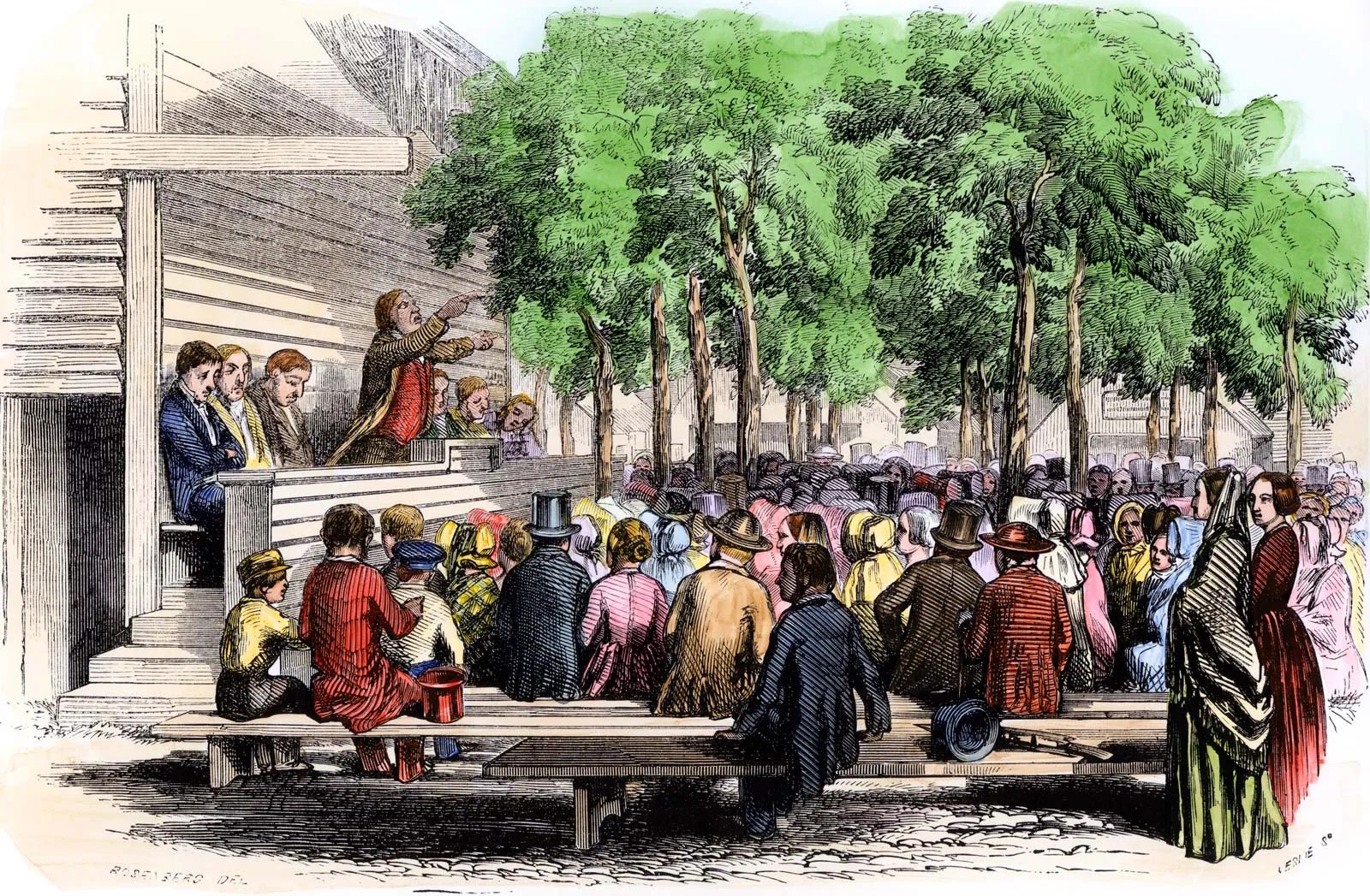
An aspect of the Second Great Awakening that often gets downplayed is how camp meetings provided a place for Americans to find common cause with one another. These meetings, outside of towns and institutional structures and expectations, allowed Americans to talk with one another, meet new people, and discover shared experiences.
The concept of large-scale communal worship through “camp meetings” had roots in ancient Israel’s Feast of Tabernacles. On the American frontier, they provided a vital religious and social outlet in sparsely populated regions where permanent churches and ordained ministers were scarce. Unlike traditional church services, camp meetings could last several days, drawing thousands from miles around. Simply, people would set up tents or campers in a large clearing. These social gatherings reunited families and friends; beyond this, people engaged in various recreational and cultural activities. They talked about politics and found they were more alike than not, then joined with those already attending the communal worship sessions of preaching, prayer, and hymn singing. Some meetings featured “wild enthusiasm and hysteria,” with experiences like sudden conversion and calls to the “anxious bench” to seek Christ’s cause until the late 19th century, when mainstream Protestant denominations like the Methodists, Baptists, and Presbyterians could no longer tolerate excessive (or, as many came to believe, performative) displays of emotionalism and behaviors associated with traditional camp meetings. By 1890, their decline in popularity was met with a matching rise in permanent churches, camp meetings continued and were adapted by various denominations, including Methodists, Baptists, and later, Seventh-day Adventists and Pentecostals. Entering a new century, some of these groups recast these events – within the hierarchical church structure, where emotionalism could be “disciplined” – as seasonal Bible Conferences or revivals but many Christian denominations, especially “Mainline” churches, discarded, recast, or tried to forget them and their tradition’s revivalist history while the less-respected Wesleyan-Holiness and Pentecostal groups unapologetically embraced the spirit of the frontier camp meeting, and particularly emotional displays, as a testament to their faithfulness.
Oral Roberts (l) and Billy Graham (r). Graham spoke at the dedication ceremony for Oral Roberts Unversity in 1967.
When Jimmy named his program The Camp Meeting Hour, it was a clarion call to the disaffected and forgotten. Like Oral Roberts before him, Jimmy wasn’t shy about his belief in the miraculous and supernatural. He wasn’t shy about his emotionalism either, which was very different from his predecessor. In 1963, Roberts founded a school, a private, nonsectarian, liberal arts institution in the State of Oklahoma bearing his name. Two years later, in 1965, Oral Roberts University (ORU) held their first classes with an enrollment of 303 students. At the time of its dedication on April 2, 1967, the university had eight completed buildings situated on a 420-acre campus. Billy Graham was even on hand and was the chief speaker at the dedication ceremony for ORU, and appeared together with the healing minister on a primetime television special to dedicate the university’s new Mabee Center five years later. Graham’s participation was significant as it helped legitimize Roberts’ ministry within the broader evangelical world, bridging the gap between the Charismatic and mainstream Evangelical movements.
But Jimmy Swaggart wasn’t either of those things. The camp meetings he held at his church in Baton Rouge, the ones he spoke at in arenas around the United States, and the kind he presented on his radio program were not for shoulder-rubbing, schmoozing, or photo opportunities. His meetings, he was famous for saying, were “old fashioned, heartfelt, Holy Ghost, devil chasin’, sin killin’, true blue, red hot, blood bought, God given, Jesus lovin’, indoor camp meeting!” and he brought that same energy and enthusiasm to The Camp Meeting Hour.
No. Jimmy Swaggart was many things, but he wasn’t a Charismatic.
In the coming decade, he wouldn’t care much for Evangelicalism either.