By Mark Strauss

This article was originally published in The IVP Introduction to the Bible (2006).
///
A. Diversity and unity
Though `Bible’ (from Greek biblos, `scroll’ or `book’) is a singular term, the Bible is not one book but a library, a collection of diverse writings concerning God and his relationship to the world. Perhaps the best way to begin an orientation to the Bible is with the terms unity and diversity.
Diversity means that the Bible is a diverse collection of books written over a period of some 1,500 years by many authors from a wide range of experiences and walks of life. The Bible arose in a variety of historical and cultural contexts and contains an array of literary forms: prose, poetry, genealogies, laws, psalms, proverbs, history, philosophy, prophecy, letters, etc. This diversity may be described as the human side of the Bible, since it encompasses a vast range of human experiences and perspectives.
Side by side with the Bible’s diversity is its unity, the claim that despite its many differences, the Bible represents one grand story or meta-narrative. This story may be summed up as the actions of God in redeeming the world. This unity was achieved because the Bible is more than a human book. It is the inspired and authoritative Word of God.
B. Inspiration and authority
Inspiration means that the Bible is not just a record of religious reflections or human experiences of God, but is God’s self-revelation, his meaningful communication to human beings. Scripture claims this inspiration for itself, both implicitly and explicitly. The prophetic literature of the OT carries the sense of `Thus says the LORD…’ and NT writers frequently cite the OT by stating, `God said…’ or `the Holy Spirit said…’ A good example appears in Acts 4:25, where an OT citation from Ps. 2:1-2 is introduced, `You [the Lord] spoke by the Holy Spirit through the mouth of your servant, our father David’. Here we see the convergence of the human and divine in the inspiration of Scripture. The Lord spoke by means of the Holy Spirit through David, his human instrument.
Inspiration is claimed explicitly in 2 Tim. 3:16, traditionally translated: `All scripture is given by inspiration of God (Greek: theopneustos), and is profitable for doctrine, for reproof, for correction, for instruction in righteousness’ (AV). The term theopneustos was apparently coined by Paul and means `God-breathed’ (as in TNIV). Inspiration means that the Holy Spirit influenced the human writers in such a way that they recorded not just their own words, but God’s Word – his divine message. 2 Pet. 1:21 similarly says that `prophecy never had its origin in the human will, but prophets, though human, spoke from God as they were carried along by the Holy Spirit’.
How this inspiration took place in the minds and hearts of human authors remains a mystery, but certain qualifications can be made:
- (1) Inspiration does not mean dictation. While in some cases God may have spoken directly to authors, as in prophetic utterances (‘the LORD says…’), in most cases inspiration means that God worked through the author’s own circumstances, thoughts, and intentions to communicate his divine message. This is evident from the unique human styles and personalities which emerge in these writings. Mark, for example, writes in a rather rough Semitic style, while Luke and the author of Hebrews have more polished literary styles.
- (2) Nor does inspiration deny the use of written or oral sources. The author of Chronicles drew from passages in Samuel and Kings, as well as non-canonical sources. Luke explicitly refers to written and oral accounts from which he probably borrowed (Luke 1:1-4). Paul at times quotes from pagan poets and philosophers (1 Cor. 15:33; Titus 1:12; cf. Acts 17:28) and the letter of Jude cites the apocryphal work known as 1 Enoch (Jude 14-15).
- (3) It follows that inspiration lies not with the sources or traditions behind the text, but with the author and the text produced. The inspired author’s selection, editing, and composition were guided and `carried along by the Holy Spirit’ (1 Pet. 1:21), so that the result was authoritative Scripture – God’s Word.
The terms plenary and verbal are often used to qualify inspiration. Plenary means `full’ and refers to the fact that all Scripture is equally inspired. Verbal means that the words themselves, not just the ideas, are inspired by God. Here we must be cautious, however, since words are arbitrary signs which indicate conceptual content. It is the meaning of these words – the message which they convey – which is ultimately inspired by God. In this way, a translation of Scripture which accurately represents the meaning of the text remains God’s Word. Another necessary qualification for verbal inspiration is that all language carries a measure of ambiguity and imprecision. Though the Holy Spirit who inspired Scripture may be perfect and precise, the vehicle of transmission (human language) is subject to ambiguity and imprecision. Our comprehension of divine revelation is therefore always partial and incomplete (1 Cor. 13:12).
If the Bible is the inspired Word of God, then it naturally follows that it is authoritative for all who worship and serve God. Its theological tenets are to be believed and its commands are to be obeyed. For more specifics on how theology may be gleaned from the text of Scripture and how its truths are to be applied, see the sections `OT Interpretation’ and `NT Interpretation’.
C. Biblical criticism
The term `criticism’ is not meant to be negative, but refers to a variety of methodologies developed to analyse and interpret the biblical text. In one sense, Jews and Christians have always engaged in biblical criticism, since there has always been a need to identify and interpret the sacred text. Modern biblical criticism arose during the period of the Enlightenment in the eighteenth and nineteenth centuries, when the Bible was placed under the same historical and scientific scrutiny as other works of literature. Though biblical criticism is sometimes viewed as a negative discipline which undermines the authority of Scripture, this is not a necessary conclusion. The human side of this divine-human book makes careful analytic study a necessity. The Bible did not fall from the sky, but arose in the crucible of the challenges and trials of the people of God. The more we understand the settings and situations in which its various books arose, the better we will understand God’s revelation to us today.
Biblical criticism can be divided into two broad areas. Historical criticism refers to a variety of methods developed to analyse the history of the text – how it came to be through various compositional phases. Literary criticism refers to the analysis of literary features of the text, apart from its composition history.
1. Historical criticism
Form criticism is the identification and analysis of oral (spoken) traditions which lie behind written documents. Form critics recognize that religious tradition is generally passed down by word of mouth before being codified in written form, and that these `forms’ (or mini-genres) of oral tradition have various functions in religious communities. Forms such as miracle stories, pronouncement stories and parables were analysed to determine their formative context (or Sitz im Leben, literally `setting in life’) in the early church. The term tradition criticism is sometimes used for the analysis of how these oral traditions changed and developed as they were passed down.
Source criticism seeks to identify the written sources which lay behind biblical texts. NT source criticism has primarily focused on the `synoptic problem’, the literary relationship between the first three Gospels. The most widely held solution is the two-source theory: Mark wrote first; Matthew and Luke (independently) used Mark and another common source (‘Q’). The primary competitor to Markan priority is the two-Gospel hypothesis. This is the view that Matthew wrote first, Luke used Matthew as a source, and Mark combined and abridged their two accounts.
Redaction criticism arose in the mid-twentieth century as a reaction against the tendency of form criticism to treat the gospel writers and others as mere compilers, stringing together bits of oral tradition. Building on the results of form and source criticism, redaction critics seek to analyse how the gospel writers edited, arranged and altered their sources to achieve a particular theological purpose (a `redactor’ is an editor).
2. Literary criticism
The term `literary criticism’ has sometimes been used of all methods employed to analyse the biblical text, including those discussed above. More recently, the term is used specifically of methods which examine the biblical documents in their final form, without reference to sources or composition history.
Narrative criticism arose as a correction to the tendency of form and redaction critics to focus on the component parts of the gospels at the expense of their narrative unity. While redaction criticism studies the history of composition of a text, narrative criticism analyses its literary nature, seeking to determine how plot, characters and settings function to produce the desired effect on the reader. Narrative criticism has been particularly helpful in analysing OT narratives, the gospels and the book of Acts.
Rhetorical criticism analyses how authors use literary devices to persuade or influence readers. Rhetoric is an ancient art which became the foundation of the educational system of the Greco-Roman world, and treatises on rhetoric were composed by Aristotle, Cicero and others. Modern rhetorical critics utilize these ancient (and some modern) categories to determine the literary strategies of the biblical writers. Rhetorical criticism has proved especially useful in the study of epistolary literature like the letters of Paul, and discourses found in narrative, like the sermons of Jesus and the speeches in Acts.
Canonical criticism, like narrative and rhetorical criticism, focuses on the biblical writings in their final form. Yet it goes beyond these by examining the role these books have played as an authoritative canon in the life of the church (see discussion of the canon below). Some canon critics focus on the history of interpretation, while others on the hermeneutics of canon, that is, how various faith communities read and interpret the Bible as authoritative Scripture.
Structuralism combines insights from linguistics and anthropology, claiming that literature, like language, functions at the level of conventional patterns and rules. Just as there are rules of grammar which govern the way we speak, so there is a `grammar’ of literature which determines how stories operate. While on the surface, stories may have different plots, settings and characters, below this is a `deep structure’ – subconscious for both author or reader – which follows certain universal patterns. By identifying and categorizing these structures (plot movements, character types, kinds of action, etc.), stories can be objectively analysed according to their essential meaning. According to structuralists, meaning does not reside in the author’s intention or in a reader’s response, but in this deep structure intrinsically encoded in the text.
Reader-response criticism claims that meaning is determined by the reader, not structure of the text or the intention of the author. Readercentred approaches are diverse, with some claiming there is no `correct’ meaning in the text since each reader creates meaning. Others speak of right or wrong meanings as determined by particular reading communities; still others treat a text’s meaning as a dynamic interplay between text and reader. Some reader response approaches are historically focused, examining how the original readers would have responded to the text. This approach is sometimes called audience criticism.
Liberationist and feminist approaches to biblical criticism are closely related to reader-response criticism since they seek to read the text from a particular viewpoint, whether that of women, ethnic minorities, the poor or the oppressed. In general, feminist readings of Scripture assert that the patriarchal character of the Bible is culturally determined rather than divinely sanctioned, and argue for an egalitarian reading which affirms the value, dignity and historical contribution of women.
D. Text and canon
How did we get the Bible we have today? This is the question of text and canon. Textual criticism concerns the preservation of the biblical text. The study of the canon refers to how these particular books came to be viewed as inspired Scripture.
1. Textual criticism
The necessity and goal of textual criticism. How did the books of the Bible come down to us? Before the invention of the printing press, all literature was copied by hand by scribes or copyists. The books of the Bible were copied again and again to disseminate them among God’s people and to pass them down to future generations. Of course, when a document is hand-copied, errors inevitably result. Of the thousands of biblical manuscripts, no two are exactly alike. How can we be sure that we have an accurate Bible? The science and art of textual criticism has been developed to reconstruct as accurately as possible the original text of Scripture.
An autograph refers to the original document penned by the author. Not surprisingly, considering the ravages of time, no autograph of a biblical book has survived. The goal of textual criticism is to work backwards from the many surviving manuscripts, reconstructing the autograph as closely as possible. This is accomplished by judging where scribes made unintentional errors or intentional changes. Textual criticism is a science, in that there are rules and principles which govern the procedure. It is also an art, in that nuanced decisions must be made from the best available evidence. While one hundred per cent reliability is never possible, there is widespread agreement among scholars today that the text of the Bible has been preserved and restored with a very high degree of reliability.
Old Testament textual evidence. The standard Hebrew text of the OT is called the Masoretic text (MT) because it is based on the textual tradition of the Jewish scholars known as the Masoretes, who meticulously standardized and copied the text from the sixth to tenth centuries AD. The Masoretes treated the sacred Scriptures with the highest regard, revering and protecting them. This had a positive and a negative consequence. On the positive side, they did their work with precision and accuracy, thus maintaining a high level of consistency. On the negative side, they tended to destroy old scrolls to protect them from defilement. For this reason our oldest copies of the MT come from the tenth and eleventh centuries, over a thousand years after the last books were written.
Supplementing the MT are both recent finds and ancient translations. The Dead Sea Scrolls (DSS) were discovered from 1947 onwards in caves near the ancient settlement of Qumran on the shores of the Dead Sea. They are important because of the insight they give us into the Jewish community which produced them in the first century BC, and because they contain a
wealth of information on the text of the OT. Fragments from almost every book in the OT were discovered. The DSS have pushed back the textual history of the OT almost a thousand years. The greatest find was a magnificent scroll containing almost the entire text of Isaiah.
Another witness to the text of the OT is the Samaritan Pentateuch. When the Samaritans separated from the Jews in the post-exilic period, they came to accept only the Pentateuch, the first five books of the OT, as authoritative Scripture. The value of the Samaritan Pentateuch is disputed among scholars. Some view it as a late revision of the Masoretic text. Others consider it an independent and valuable pre-Masoretic tradition.
Other important witnesses for the OT text are the early translations or `versions’ made from the Hebrew text. The most important of these is the Septuagint, produced by Jews in Egypt beginning in the midthird century BC. The name comes from the Latin word for `seventy’ (septuaginta), a roundedoff reference to the seventy-two scholars who – according to an ancient legend – completed the work in seventy-two days. The Roman numeral LXX is used as an abbreviation. The Septuagint is a valuable witness to the OT, since it represents pre-Masoretic traditions. Other ancient versions utilized by textual critics include the Aramaic Targums (translations with some additions), the Syriac `Peshitta’, Old Latin, the Vulgate and Arabic.
New Testament textual evidence. The manuscript evidence for the NT is much greater than for the OT, including over five thousand manuscripts in Greek. Most of these are fragmentary, containing portions of the NT (e.g. Gospels or epistles). The oldest manuscripts (second to seventh centuries AD) are made of papyri, a paper-like material made from a reed grown in Egypt. There are approximately 100 extant papyri. The majority of manuscripts are made of parchment, or animal skins. These come in two writing styles. The older uncials, similar to capital letters, date from the fourth to the ninth centuries. The later miniscules, cursive letters similar to lower case, date from the ninth century onward. There are approximately 300 uncial and 3,000 miniscule manuscripts. In addition to these, there are over 2,000 lectionaries, church reading books containing selected liturgical readings for the church calendar. These date from the ninth to the fourteenth centuries.
As with the OT, translations of the NT into other languages provide another important textual source, including versions in Latin, Syriac, Coptic, Ethiopic, Armenian, Georgian and Slavonic. Prepared by missionaries to aid in evangelism, these originated in the second and third centuries. Finally, citations of Scripture found in church fathers provide a fourth important source for NT textual critics. These citations, which are many and varied, give insight into the ancient texts available to church leaders at various places and times. The method of textual criticism. Textual criticism of the OT and NT have tended to be quite different enterprises. For the OT, the standard Masoretic text is widely accepted. Most English versions have tended to follow the MT closely, occasionally introducing variant readings from the LXX or the DSS. NT textual criticism is a more developed discipline because of the wealth of early manuscript evidence and the greater variation among manuscripts.
Contemporary NT textual criticism focuses on two kinds of evidence, external and internal. External evidence relates to the date and value of manuscripts. Based on a comparison of their readings, manuscripts have been grouped into four `families’: Alexandrian, Caesarean, Western and Byzantine. These families are named for the geographical regions in which scholars
believe each family arose. The great majority of manuscripts are Byzantine. These are also the latest manuscripts, most from the ninth century onward. The external evidence tends to favour the Alexandrian family, since these are the earliest manuscripts. The two most important Alexandrian manuscripts are Codex Vaticanus and Codex Sinaiticus.
Internal textual evidence refers to the tendencies of copyists and authors. Textual critics have derived certain principles or `rules’ from the kinds of mistakes copyists tended to make. The most basic rule is to choose the reading that best explains how the other readings might have been made. Another common rule is that the shorter reading is usually original, since a copyist was more likely to add a clarifying phrase than to drop one. A third is that the `harder reading’ is usually the original, since a scribe was more likely to smooth over a difficulty than to create one.
Applying these rules of internal evidence to the manuscript evidence results in a text closest to the Alexandrian family. This is not to say that Alexandrian readings are always the best, but in general this family seems to represent the earliest text. Since both the external evidence and the internal evidence favours the Alexandrian family, almost all textual critics consider this to be the earliest and most reliable family.
Textual criticism and modern English versions. The Greek text derived by following the principles of textual criticism is known as the `critical text’. There are two standard editions, Nestle-Aland (NA, 27th edn) and the United Bible Societies (UBS, 4th edn). Almost all modern English versions utilize the critical text. The exception is the Revised Authorized Version, which uses the so-called Textus Receptus, the Greek text which lies behind the Authorized Version of 1611. The Textus Receptus was based on a very limited number of late Byzantine manuscripts available in the sixteenth century.
There are thousands of variant readings throughout the OT and NT, but most are very minor (many in the OT involve spelling), and no doctrine of the Christian faith rests on any of these divergences. Furthermore, the wealth of manuscript evidence and the strong consensus among scholars concerning the practice of textual criticism, together confirm the accuracy and reliability of the text of Scripture.
2. The canon of Scripture
The word canon comes from a Greek word meaning `measuring rod’, and hence a `rule’ or `standard’. The canon of Scripture are those books recognized by the church as the authoritative Word of God. When did a book become part of the canon? The ultimate answer is when that book was completed by a Spirit-inspired author or authors (2 Tim. 3:16-17; 2 Pet. 1:21). No council or committee made a book part of the canon. Rather, through the centuries the people of God – filled and guided by the Holy Spirit have recognized those writings which exhibit the power and presence of the Spirit (1 John 2:20, 27).
Nor did formal recognition of the canon occur through a single council or decree. The canon was rather the result of a gradual process of collection, recognition and confirmation. Local canons and collections gradually grew into the widespread affirmation by the church.
The Old Testament canon.
The Jewish Scriptures, sometimes called the Tanak, contain the same books as the Christian OT, but ordered differently. TaNaK is an acronym of the Hebrew words Torah (Law), Nevi’im (Prophets), and Kethuvim (Writings). Torah means the five books of Moses (Genesis to Deuteronomy); Nevi’im are the four `former prophets’ (Joshua, Judges, Samuel and Kings) and the four `latter prophets’ (Isaiah, Jeremiah, Ezekiel and the Book of the Twelve, meaning the minor prophets); Kethuvim are the three main books of poetry (Psalms, Proverbs, Job), the five `scrolls’ (Ruth, Song of Songs, Ecclesiastes, Lamentations and Esther), and three other writings (Daniel, Ezra-Nehemiah and Chronicles). Hence there are twenty four books in the Jewish canon, which are identical to the thirty-nine books in the Christian OT (see chart).
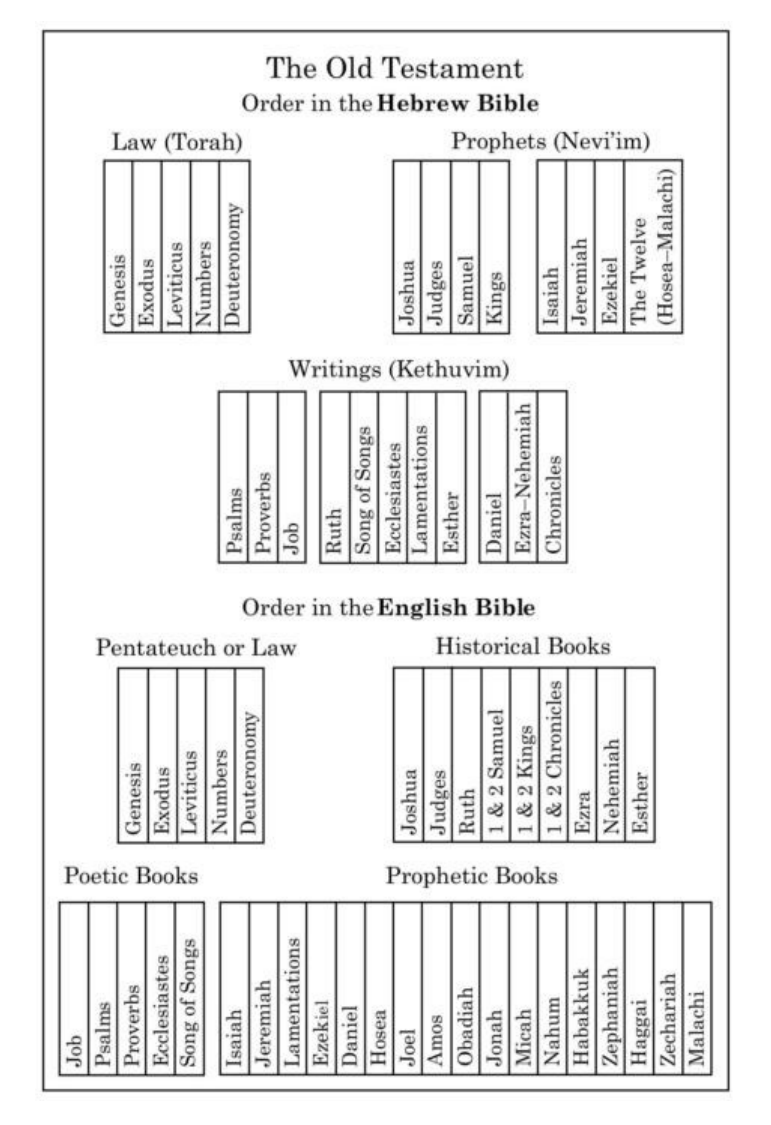
While one cannot speak definitively of a time or event when the OT canon was `closed’, it seems clear that by the NT period this tripartite division had achieved authoritative status. For instance, Jesus refers once to the `Law of Moses, the Prophets and the Psalms’ (Luke 24:44). Psalms is the first and main book of the Writings, so indicates the whole section. There was also a widespread tradition in Judaism that the prophetic voice of God had ceased after the post-exilic prophets: `With the death of Haggai, Zechariah and Malachi, the latter prophets, the Holy Spirit ceased out of Israel’ (Tosefta Sotah 13:2, from the mid-third century AD; cf. Talmud b. Sanh. 11a). The so-called `council’ of Jamnia in the decades after the destruction of Jerusalem in AD 70 debated the authority of various books among the Writings, but ultimately affirmed them all. Melito of Sardis writing around AD 170 produced the first known list of all OT books (except Esther).
The New Testament canon.
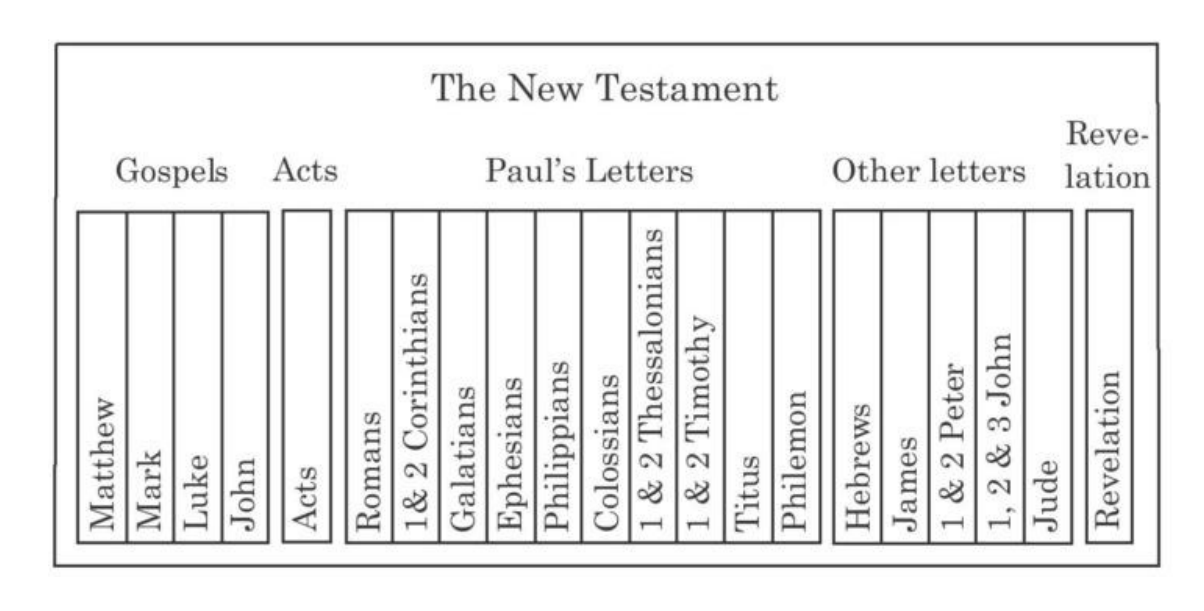
As with the OT, there is no definitive point at which the NT books received canonical recognition. 2 Pet. 3:1516 suggests that even in the first century AD Paul’s writings were being preserved and read as authoritative Scripture. The early church fathers frequently quote from the NT writings and attribute authoritative status to them. Impetus for formal recognition of the canon arose especially from external challenges, such as when the second-century Gnostic heretic Marcion established his own truncated canon made up of portions of Luke’s Gospel and ten letters of Paul (c. AD 140). The church responded with discussions and lists of its own. The Muratorian fragment, dated about AD 170, contains a list which contains our NT with some minor variations. In the fourth century Eusebius categorized books under four headings: accepted, disputed, rejected and heretical. Those `accepted’ contain all our NT books except James, Jude, 2 Peter and 2 and 3 John, which are identified as disputed. Eusebius also identifies Revelation as accepted by some but rejected by others. The first list which is identical to the twenty-seven NT books was produced by Athanasius of Alexandria in his Easter letter of AD 367.
The Apocrypha.
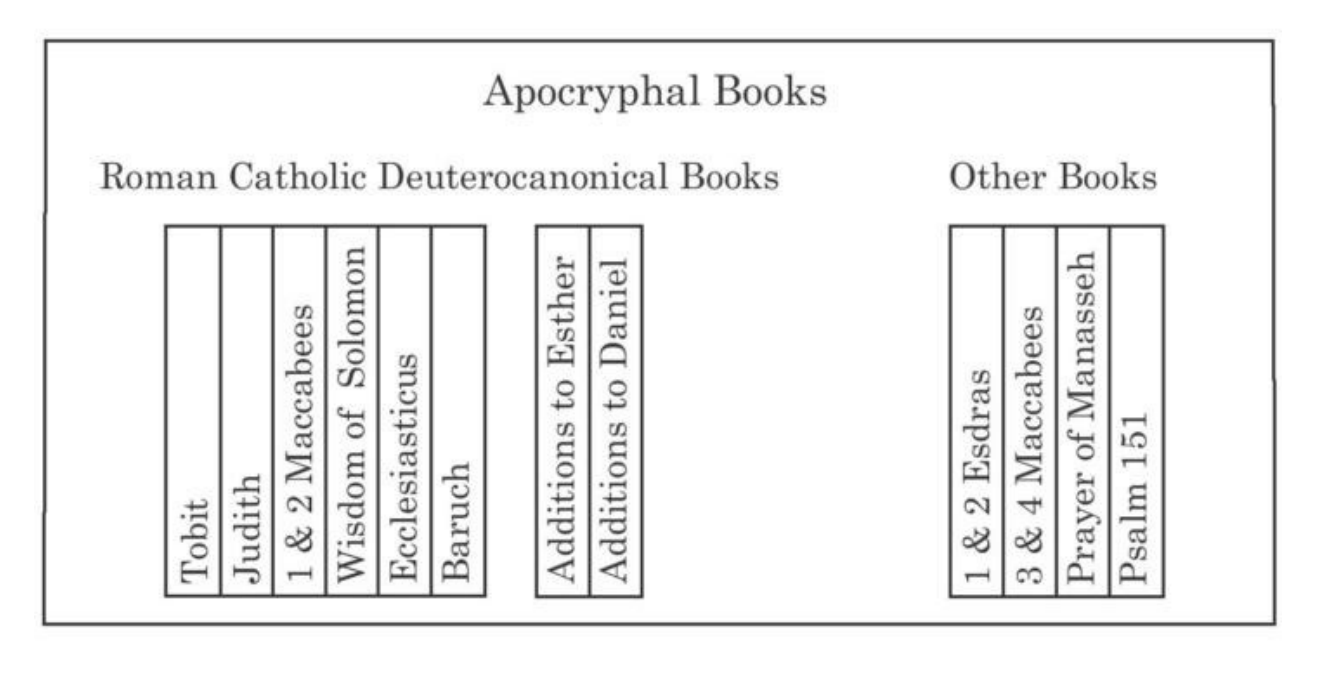
The most significant canonical debate among Christians concerns the books of the Apocrypha, a group of Jewish works mostly written between the times of the OT and the NT. These are included in our earliest complete copies of the LXX (fourth century AD), produced by Christians, but we do not know when they were first included with the OT. The canonicity of the Apocrypha was rejected by Martin Luther and the Protestant Reformers, following the tradition of Jerome (translator of the Vulgate). Roman Catholics accept the Apocrypha as `deuterocanonical’. This does not mean it is less inspired than the protocanonical books, but rather a `second canon’ beside the first. Catholics claim that the Apocrypha has been read and cherished by Jews and Christians from antiquity, and was included in the Septuagint. Protestants counter that these books were not part of the Hebrew Scriptures as recognized by Jesus, that they contain historical and doctrinal errors, and that they lack the prophetic power of inspired Scripture.
Historical tests of canonicity. For the OT, its acceptance as Scripture by Jesus and his apostles has been sufficient authority for Christians. For the NT, we can discern certain tests which the people of God applied to writings to test their authority and canonicity.
- (1) Apostolic origin. Does the book show evidence of divine authority? Jesus commissioned his apostles to pass down the authoritative message. When judging books for canonicity, the early church placed great emphasis on apostolic authority. Even those books that were not written directly by an apostle (e.g. Mark, Luke) bore the stamp of apostolic authority because their authors were closely associated with the apostles.
- (2) Theological consistency with the rest of Scripture: the rule of faith. Since God is a god of truth, new revelation will not contradict earlier revelation, but will conform to the body of tradition passed down by the authentic community of faith.
- (3) Recognition by the Spirit-filled community. Although this test does not reject differences of opinion or debates about canonicity, in time the church has recognized the presence of the Spirit in truly inspired writings.
- (4) Transforming power. Has the work demonstrated the power of God to change lives? God’s Word is recognizable by its living and dynamic capacity to renew and restore people’s lives (Heb. 4:12).
Is the canon of Scripture closed? There is no explicit evidence for this in the Bible, but that is not surprising, since no NT author wrote with the intention of establishing the NT canon. Yet two thousand years of church history have confirmed that God’s people have all they need in these sixty-six books to know God’s nature, purpose and plan for the world.
E. Translating the Bible
Most people in the world do not read the Bible in its original languages, but in translation. The history of Bible translation begins in the third century BC and continues today, as scholars and linguists around the world labour to make God’s Word understandable to people everywhere.
1. The languages of the Bible
The Bible was originally written in three languages: Hebrew, Aramaic and Greek. Most of the OT was written in Hebrew, the ancient language of the Jews. A few passages were written in Aramaic, a related Semitic language which served as the trade language for the ancient Near East. By the first century, most Jews in Israel spoke Aramaic as their native tongue. Hebrew was restricted to religious contexts (rather like Latin in the Middle Ages). Since the conquests of Alexander the Great in the third century BC, Greek had replaced Aramaic as the common trade language of the eastern Mediterranean. Jews engaged in commerce and administration with non-Jews (Gentiles) needed to speak Greek. Jesus was probably trilingual, speaking and teaching primarily in Aramaic, reading Hebrew in the synagogue and conversing with non-Jews in Greek. As Christians began proclaiming the gospel outside Palestine, they spoke and wrote mainly in Greek. The whole NT was written in Greek, except for a few of Jesus’ words recorded in Aramaic (e.g. Mark 5:41; 7:34; 14:36).
2. The history of Bible translation Ancient versions.
By the third century BC, the Jews of Egypt were speaking Greek instead of Hebrew and the need arose for a Greek version of the Hebrew Scriptures. The result was the Septuagint (Lxx; discussed above). By the first century the Septuagint was the primary Bible for Jews of the diaspora (or ‘dispersion’), i.e. those living outside of Israel. A similar need arose in Israel since most Jews now spoke Aramaic rather than Hebrew. After the Hebrew text was read in a synagogue service, an Aramaic paraphrase or explanation, called Targum, would be given so the people could understand. These Targums were eventually put down in written form.
The need for translation also arose in the early church, as Christian missionaries began spreading the gospel beyond Greek-speaking regions. Versions in Latin and Syriac were produced in the second century, and many more followed: Coptic (the language of Egypt), Armenian, Georgian, Slavic, Ethiopic and others. The most enduring of ancient versions was the Latin Vulgate, produced by the early church father Jerome in the late fourth century. Commissioned by Pope Damasus I, the Vulgate was intended to replace the Old Latin version. Jerome’s magnificent translation became the standard Bible of the Catholic church for over a thousand years. `Vulgate’ comes from the Latin word for `common’ and refers to the vernacular, the everyday language of the people.
Early English versions. Although the Vulgate was intended to be a common language translation, by the Middle Ages its Latin was understood only by the elite. Fearing the potential for heresy if everyone interpreted the Bible for themselves, the church placed strict limits on the production of vernacular versions. Yet people like Oxford theologian John Wycliffe believed that God’s Word was meant for everyone. In 1382 Wycliffe and his associates produced the first English translation of the entire Bible.
With the invention of the printing press by Johannes Gutenberg in 1450, and the Protestant Reformation in the early sixteenth century, Bible publication flourished. In 1526 William Tyndale produced the first printed version of the NT in English. Tyndale’s excellent translation, the first English version rendered directly from the Greek, set the standard for accuracy and style and became the model for all subsequent English versions. Yet vernacular translations were still illegal in England, and Tyndale was forced to flee to continental Europe to finish his work. He was eventually kidnapped, imprisoned and executed. Tyndale’s legacy lives on today as international Bible translators suffer hardship and even martyrdom to take God’s Word to the remotest parts of the world.
The Authorized or King James Version. The changing political climate of Britain as well as the popularity of Tyndale’s work resulted in an easing of restrictions and the proliferation of English versions. The Authorized Version, known in North America as the King James Version (KJV), was commissioned by James I of England in 1604 as a compromise between two competing versions, the Bishop’s Bible (1568), the official Bible of the Church of England, and the Geneva Bible (1560) favoured by the Puritans. The translation work was completed in seven years by fortyseven of the leading biblical scholars in Britain and published in 1611. Though – like all new versions – the AV was initially rejected by some, it quickly became the most widely used English version of its day and, eventually, the most popular English Bible of all time.
Revisions of the Authorized Version. Though the AV remained the preeminent English Bible for over 300 years, changes in the English language, advances in biblical scholarship, and the discovery of older and more reliable manuscripts resulted in the need for revision. In 1870 the Church of England commissioned the Revised Version (RV, 1881-85). A separate revision, the American Standard Version (ASV) was published in 1901 to reflect the preferences of North American scholars. Though neither of these versions challenged the popular dominance of the AV, they launched an era of translation and revision which continued throughout the twentieth and into the twenty-first centuries.
3. Contemporary versions and modern translation principles
English Bible versions today can be categorized in a variety of ways. One distinction is between those versions which are in a direct line of revision from the AV and its predecessors, and those which are `new’ versions translated directly from the Hebrew and Greek. Some of those in the AV tradition include the Revised Standard Version (RSV, 1952), the New American Standard Bible (NASB, 1971), the Revised Authorized Version (RAV, 1982), the New Revised Standard Version (NRSV, 1990), and the English Standard Version (ESV, 2001). New versions without direct link to the AV include the New English Bible (NEB, 1970), Good News Bible (GNB, 1976), New International Version (NIV, 1978), New Century Version (NCV, 1986), Revised English Bible (REB, 1989), Contemporary English Version (CEV, 1995), New Living Translation (NLT, 1996), and Today’s New International Version (TNIV, 2005). Most of these would be categorized as `Protestant’ versions, since their translation teams were primarily Protestant. Recent versions which are predominantly Roman Catholic include the Jerusalem Bible (JB, 1966), the New American Bible (NAB, 1970), and the New Jerusalem Bible (NJB, 1985). In 1985 the Jewish Publication Society released the Tanakh, a modern Jewish translation of the Hebrew Scriptures.
Another more significant distinction between modern Bible versions is their translation philosophy. Formal equivalent versions, also called `literal’ or `word-for-word’ versions, seek as much as possible to follow the lexical and grammatical form of the original Hebrew or Greek. Functional equivalent versions, also known as dynamic equivalent or idiomatic versions, seek first to translate according to the meaning of the text, regardless of the form. For example, the RSv renders Acts 11:22 quite literally: `News of this reached the ears of the church at Jerusalem…’ Recognizing that `the ears of the church’ is a Greek idiom rather than an English one, the GNB translates `The news about this reached the church in Jerusalem’. While the RSV reproduces more closely the form of the Greek, the GNB captures the meaning in natural, idiomatic English.
There are no pure versions of either translation philosophy. Since no two languages are the same, all versions must frequently introduce idiomatic renderings in order to make sense. The difference is how much freedom translators take to alter the form in order to produce naturalsounding English. All Bible versions lie on a spectrum between form and meaning. Some recent versions which are generally formal equivalent include RSV, NASB, RAV, NRSV and ESV. Functional equivalent versions include GNB, CEV, NCV and NLT. Versions somewhere in between are the NIV, REB, NAB, NJB and TNIV, and many Christians use one of these as their `all-purpose’ Bible. (Most quotations in this IVP Introduction are taken from the TNIV.)
There are strengths and weaknesses of both formal and functional translations, and students of the Word should be encouraged to use a variety of versions from across the translation spectrum. Both kinds of translations have an important place in Bible study. Formal equivalent versions are helpful for examining the formal structure of the original text, identifying Hebrew or Greek idioms, locating ambiguities in the text, and tracing formal verbal allusions and recurrent words. Functional equivalent versions are more helpful for communicating accurately the meaning of the text, and for providing clarity, readability, and natural-sounding language. The weakness of functional equivalence is the danger of misinterpreting the original and so misleading the reader. The weakness of formal equivalence is producing obscure and awkward English when the text was clear and natural to its original readers.
Bible translation continues to be a critical concern of the church. God’s Word was meant to be for all people everywhere, yet there are ethnic groups around the world which do not yet have Scripture in their native tongue. There is also the continual need for updating existing versions. Language changes over time, requiring periodic revision to keep up with contemporary idiom and to eliminate archaic language (e.g. the AV’s archaic use of `pitiful’ in the sense of `compassionate’ in Jas 5:11). Advances in biblical scholarship and archaeological discoveries also create the need for ongoing assessment and improvement of existing versions. While no Bile version is perfect, the steadfast goal remains to communicate the meaning of the sacred text with accuracy and clarity.
Further reading
On inspiration and authority:
- Howard Marshall, Biblical Inspiration (Paternoster, 1995) – well-written standard summary.
- Howard Marshall, Beyond the Bible: Moving from Scripture to Theology (Baker, 2004) – helpful reflections in accessible lectures.
- Richard Bauckham, Scripture and Authority Today (Grove, 1999) – thoughtful, booklet response to postmodernism.
- Tom [N. T.] Wright, Scripture and the Authority of God (SPCK, 2005) – very readable, with helpful application to church life. Published in the USA as The Last Word (HarperCollins, 2006).
On text, canon, and translations:
- F. F. Bruce, The Books and the Parchments (Zondervan, 1991) – very readable survey of all the issues.
- David Dewey, Which Bible? A Guide to English Translations (IVP, 2004) – now the best straightforward introduction available.
- Dick [R. T.] France, Translating the Bible: Choosing and Using an English Version (Grove, 1997) – excellent booklet introduction, though it predates the TNIV.
- Bruce Metzger, The Bible in Translation: Ancient and English Versions (Baker, 2001) – another good survey, with more detail on the ancient versions.
///
Mark Lehman Strauss is an American biblical scholar and professor of the New Testament at Bethel Seminary San Diego, which is part of Bethel University, Minnesota. His areas of expertise include New Testament Gospels and Bible translation.

