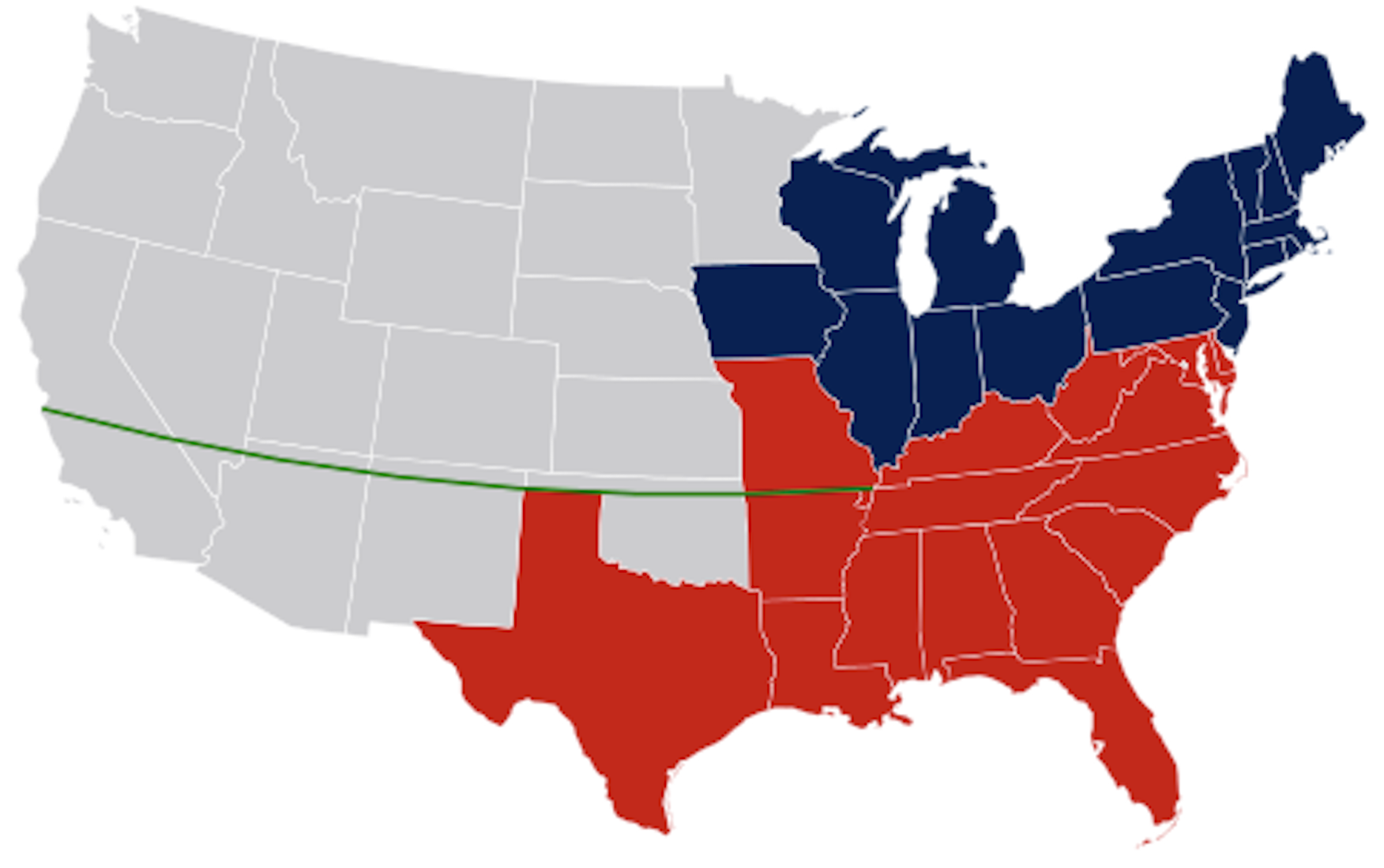
1820 – The Missouri Compromise was a legislative agreement that admitted Missouri as a slave state and Maine as a free state, preserving the Senate balance of 12 states each. It prohibited slavery in the Louisiana Territory north of the 36^30′ latitude line, temporarily easing sectional tensions over slavery’s expansion. The Missouri Compromise was controversial and many worried that the country had become lawfully divided along regional and sectarian lines. The Supreme Court declared it unconstitutional in Dred Scott v. Sandford (1857), both of which increased tensions over slavery and contributed to the American Civil War. The compromise both delayed the Civil War and sowed its seeds; in April 1820, Thomas Jefferson predicted the line as drawn would someday tear the Union apart. Forty years later, the North and South would split closely along the 36°30′ parallel and launch the Civil War.
1857 – Dred Scott v. Sanford. In this ruling, the U.S. Supreme Court stated that enslaved people were not citizens of the United States and, therefore, could not expect any protection from the federal government or the courts. The opinion also stated that Congress had no authority to ban slavery from a Federal territory.
1861-1865 – American Civil War. Both sides of the war document an exceptionally high literacy with the Bible; evidence of literacy comes through personal accounts, letters, and journals.
1906 – Azusa Street Revival. Led by Black minister William J. Seymour in Los Angeles, this revival is considered the catalyst for the modern Pentecostal movement, emphasizing speaking in tongues and gifts of the Holy Spirit.
1907 – Christianity and the Social Crisis. Authored by Walter Rauschenbusch, an American theologian and Baptist pastor who taught at Rochester Theological Seminary. Rauschenbusch was a key figure in the Social Gospel and single tax movements that flourished in the United States during the late 19th and early 20th centuries.
1908 – Methodist Social Creed is adopted on 4 Dec. 1908. Entering the 20th century, the Methodists began to embrace a more liberal theology, one that was concerned with social ills, like poverty and worker exploitation. Congregationalists, Presbyterians, and Episcopalians also began emphasizing a “social” gospel, not just an individual gospel. To begin addressing social problems, the Methodist Episcopal Church (MEC) organized the Methodist Federation for Social Services in late 1907. During the 1908 General Conference, leaders of this federation created a statement known as “The Church and Social Problems.” Feeling the statement was too long, Chicago pastor Harry Ward helped summarize the lengthy report into a short creed detailing social reforms the church should promote, including the abolition of child labor and support for worker rights. This became known as the “Social Creed” of the Methodist Church, which was adopted in 1908 and expanded over time. It reads as follows:
The Social Creed of the Churches (Adopted Dec. 4, 1908)
The Federal Council of the Churches of Christ in America stands:
For equal rights and complete justice for all men in all stations of life.
For the abolition of child-labor.
For such regulation of the conditions of toil for women as shall safeguard the physical and moral health of the community.
For the suppression of the “Sweating System.”
For the gradual and reasonable reduction of the hours of labor to the lowest practicable point, and for that degree of leisure for all which is the condition of the highest human life.
For a release from employment one day in seven.
For the right of all men to the opportunity for self-maintenance, a right ever to be wisely and strongly safeguarded against encroachments of every kind.
For the right of workers to some protection against the hardships often resulting from the swift crises of industrial change.
For a living wage as a minimum in every industry, and for the highest wage that each industry can afford.
For the protection of the worker from dangerous machinery, occupational disease, injuries, and mortality.
For suitable provision for the old age of the workers and for those incapacitated by injury.
For the principle of conciliation and arbitration in industrial dissensions.
For the abatement of poverty.
For the most equitable division of the products of industry that can ultimately be devised.
1910-1915 – The Fundamentals, a 12-volume set of 90 essays published to defend conservative, literalist theology against liberal, modern theology. According to its foreword, the publication was designed to be “a new statement of the fundamentals of Christianity.” However, its contents reflect a concern with certain theological innovations related to liberal Christianity, especially biblical higher criticism. It is widely considered to be the foundation of modern Christian fundamentalism. The project was conceived in 1909 by California businessman Lyman Stewart, the founder of Union Oil and a devout Presbyterian and dispensationalist. He and his brother Milton anonymously provided funds for composing, printing, and distributing the publication. The project had three successive editors: A. C. Dixon, Louis Meyer, and Reuben Archer Torrey. The essays were written by sixty-four different authors, representing most of the major Protestant Christian denominations. It was mailed free of charge to ministers, missionaries, professors of theology, YMCA and YWCA secretaries, Sunday school superintendents, and other Protestant religious workers in the United States and other English-speaking countries. Over three million volumes (250,000 sets) were sent out. The volumes defended classical Protestant doctrines and attacked the Roman Catholic Church (“Romanism”), higher criticism, liberal theology, socialism, modernism, atheism, Christian Science, Mormonism, Millennial Dawn (whose members were sometimes known as Russellites, but which later split into another group, adopting the name Jehovah’s Witnesses), spiritualism, and what it called evolutionism.
1925 – Scopes Monkey Trial, regarding the teaching of evolution in schools. Symbolized the deep divide between traditional Christianity and modern secular science.
1962 -1965 – The Second Vatican Council was a global modernizing of Catholicism (no longer “Roman Catholicism”) convened by Pope John XXIII. Vatican II dramatically modernized the Roman Catholic Church, replacing the Latin Mass with vernacular languages, increasing the role of laypeople, and initiating dialogue with other Christian denominations and religions. It also emphasized, encouraged, and funded ecumenical dialogue and fostered efforts towards Christian unity, including a 1965 joint declaration with Orthodox leaders to revoke the mutual excommunications of 1054. Pope John XXIII was known for saying, “Consult not your fears but your hopes and your dreams,” “Think not about your frustrations, but about your unfulfilled potential,” and “Concern yourself not with what you tried and failed in, but with what it is still possible for you to do.” Echoes of Pope John XXIII could be heard in President John Kennedy’s call to “Ask not what your country can do for you, but what you can do for your country” and general optimism in space exploration. His encyclicals, such as Pacem in Terris, addressed issues of peace and human rights, which were essential reading at a time when the United Nations and post-war world order were grappling with the threat of nuclear arms and Cold War proxy wars.
1968 – On April 4th, Civil Rights leader Martin Luther King, Jr. is assassinated. King was indebted to Rausenbach as well as Howard Thurman for his (slow and reluctant?) commitment to civil rights. According to biographer Jonathan Eig, King’s initial reluctance to embrace civil rights (ex: the Montgomery Bus Boycott of 1955) was because he knew he would be killed. King’s letters, essays, journals, and recalled conversations all point to the recognition of failure inside of the Church (ex: Walter Rausenbach, The Fundamentals, etc.) and the tendency to “baptize” violence.
1970 – Hal Lindsay authors The Late Great Planet Earth, the bestselling nonfiction book of the 1970s. Over 28 million copies have been sold and the book has been translated into 54 languages. Religion historian Crawford Gribben states that The Late Great Planet Earth “set a pattern for the shape of the political re-engagement of American evangelicals in the final third of the twentieth century” and “exercised enormous influence” in US President Ronald Reagan’s administration. The Late Great Planet Earth is a treatment of dispensational premillennialism. As such, it compared end-time prophecies in the Bible with then-current events in an attempt to predict future scenarios resulting in the rapture of believers before the Great Tribulation and Second Coming of Jesus to establish his thousand-year (i.e. millennial) kingdom on Earth. Emphasizing various passages in the books of Daniel, Ezekiel and Revelation, Lindsey originally suggested the possibility that these climactic events might occur during the 1980s, which he interpreted as one generation from the foundation of modern Israel during 1948, a major event according to some dispensationalist evangelical schools of eschatological thought. Cover art of the Bantam edition suggested that the 1970s were the “era of the Antichrist as foretold by Moses and Jesus,” and termed the book “a penetrating look at incredible ancient prophecies involving this generation.” Descriptions of alleged “fulfilled” prophecy were offered as proof of the infallibility of God’s word, and evidence that “unfulfilled” prophecies would soon find their denouement in God’s plan for the planet. He cited an increase in the frequency of famines, wars and earthquakes, as major events just prior to the end of the world. He also foretold a Soviet invasion of Israel (War of Gog and Magog). Lindsey also predicted that the European Economic Community, which preceded the European Union, was destined (according to Biblical prophecy) to become a “United States of Europe”, which in turn he says is destined to become a “Revived Roman Empire” ruled by the Antichrist. Lindsey wrote that he had concluded, since there was no apparent mention of America in the books of Daniel or Revelation, that America would not be a major geopolitical power by the time the tribulations of the end times arrived. He found little in the Bible that could represent the U.S., but he suggested that Ezekiel 38:13 could be speaking of the U.S. in part. Although Lindsey did not claim to know the dates of future events with any certainty, he suggested that Matthew 24:32-34 indicated that Jesus’ return might be within “one generation” of the rebirth of the state of Israel, and the rebuilding of the Jewish Temple, and Lindsey asserted that “in the Bible” one generation is forty years. Some readers accepted this as an indication that the Tribulation or the Rapture would occur no later than 1988. In his 1980 work The 1980s: Countdown to Armageddon, Lindsey predicted that “the decade of the 1980s could very well be the last decade of history as we know it.”
1973 – Paul Weyrich founds the Heritage Foundation.
1976-1980 – Georgia Governor Jimmy Carter wins the Presidency. Subsequently loses to Ronald Reagan, primarily because of the Moral Majority.
1979 – Baptist minister (and radio preacher / televangelist) Jerry Falwell founds the Moral Majority to mobilize conservative Christians into a political force. It played a key role in the 1980s GOP rise by pushing “pro-life, pro-family, pro-morals, and pro-American” agendas, helping elect Ronald Reagan. What is remarkable is that Falwell very publicly said he was against the “social gospel” of Martin Luther King Jr., where ministers used their platform to discuss politics. The Gospel, according to Falwell, was above human politics and ministers needed to speak to the concerns of salvation. Falwell claimed that he reversed course on 23 Jan. 1973 with the Supreme Court’s ruling in Roe v. Wade. It is more likely that Falwell’s turn took place on 30 June 1971, when the United States District Court for the District of Columbia issued its ruling in the case in Green v. Connally. The decision upheld the new IRS policy: “Under the Internal Revenue Code, properly construed, racially discriminatory private schools are not entitled to the Federal tax exemption provided for charitable, educational institutions, and persons making gifts to such schools are not entitled to the deductions provided in case of gifts to charitable, educational institutions.” This stripped tax-exempt status from nonprofit organizations (like churches and private schools) when they segregated. After the IRS began sending Christian schools questionnaires about the racial makeup of their student body—a consequence of the Court’s ruling in Green v. Connally (1971), which stripped so-called segregation academies of their nonprofit tax exemptions—an irate Falwell publicly denounced the immorality of the government, fulminating that “in some states, it’s easier to open a massage parlor than a Christian school.” The free market ideas of “school choice,” charter schools and vouchers, first proposed by Milton Friedman in Capitalism and Freedom and a post-Brown article, became a cause célèbre for the Christian right. It was Brown, in other words, that first turned the Christian right against government intervention. Furthermore, Falwell did not coin the term “moral majority.” That was Paul Weyrich, founder of the Heritage Foundation. Weyrich would pen several essays in the 1970s, expressing “The new political philosophy must be defined by us [conservatives] in moral terms, packaged in non-religious language, and propagated throughout the country by our new coalition… When political power is achieved, the moral majority will have the opportunity to re-create this great nation.” Weyrich believed that the political possibilities of such a coalition were unlimited. “The leadership, moral philosophy, and workable vehicle are at hand just waiting to be blended and activated,” he wrote. “If the moral majority acts, results could well exceed our wildest dreams.”
1995 – Tim LaHaye publishes the first Left Behind novel. LaHaye’s writings are so heavily predicated on the work of Hal Lindsay that to differentiate is harder than to consider them the same. Over 65 million copies sold worldwide by 2016. Critically, the series has been both influential and controversial, reflecting shifts in American evangelicalism, particularly a move toward political and social activism and a more divisive view of non-Christians. Scholars and critics have noted its triumphalist theology, perceived anti-Catholicism, sensational depictions of violence, and alignment with conspiratorial fears of globalism and one-world government, themes that some link to later movements, including QAnon. While praised by figures such as Jerry Falwell for its religious impact, others have criticized its theology, political messaging, and literary quality, with some viewing it as representative of American exceptionalism and neoliberal values.
8 November 2016 – Donald Trump elected to become the 45th President with Evangelical support.
- 10 August 2019 – Jeffrey Epstein dies. Epstein, a convicted sex trafficker, will celebrate Trump as well as call him “the most evil person I have ever met.”
- 6 January 2021 – Trump incites insurrection in Washington, D.C.
- 30 May 2024 – Trump convicted of 34 felony counts of falsifying business records by a jury in New York State Supreme Court. This makes him a convicted felon.
8 November 2024 – Convicted Felon re-elected as 47th President with Evangelical support.
- 5 April 2026 – “Open the Fuckin’ Strait, you crazy bastards, or you’ll be living in Hell – JUST WATCH! Praise be to Allah.” (Note: 5 April 2026 was Easter Sunday.)
- 7 April 2026 – “A whole civilization will die tonight, never to be brought back again.”
Donald J. Trump, a convicted felon, has surrounded himself with spiritual advisers to sustain his legitimacy among Evangelicals. These advisors are telling him the Iran war is the beginning of the End Times and mean that as encouragement. This is not a fringe internet conspiracy. This is not some corner of Reddit. This is happening inside the White House, inside the Pentagon, inside the chain of command of the most powerful military on earth.
Donald J. Trump, a convicted felon, convened nearly two dozen evangelical leaders after launching strikes on Iran. They stood around him, laid hands on him, and prayed for his military campaign. At the center of that circle is Paula White-Cain, head of the White House Faith Office, who once asked Benjamin Netanyahu on camera whether the world was ready to kick off Armageddon. She has said publicly: “To say no to President Trump would be to say no to God.” She’s not alone. Pastor Greg Laurie, a regular in Trump’s inner circle, posted a video after the assassination of Iran’s ayatollah linking it directly to end times prophecy. “As far as I can see the next event on the prophetic calendar would be the rapture,” he told his followers. “Then of course the great tribulation period, culminating in the Battle of Armageddon.” These are not metaphors to these people. They read Iran as biblical Persia from the Book of Ezekiel. They see this war as a necessary step toward the return of Christ. Suffering, in this theology, is not tragic. It is required. Meanwhile, Defense Secretary Pete Hegseth, an alcoholic and alleged domestic abuser, has tattoos of Crusader iconography and the phrase Deus Vult, meaning “God wills it.” He prayed at the Pentagon last week asking God to pour down “overwhelming violence of action against those who deserve no mercy.” He has reshaped the chaplain corps, elevated hardline evangelical figures throughout the military, and pushed an overtly religious tone across the force. Lawmakers have formally called for an investigation into whether extreme religious rhetoric is seeping into how the war is being prosecuted. Even some conservatives are alarmed. One right-wing commentator called Paula White-Cain a “psychopathic doomsday cultist.” And then there’s Josh McPherson, a rising voice in Christian nationalist circles who preaches in camouflage and combat boots and advocates for “godly righteous men and women submitted to the Heavenly Father” to run the military. He describes Islam as “demonic” and a “scourge” and calls for mass deportations. This is not faith guiding policy. This is prophecy replacing strategy. This is a group of people who believe the world is supposed to end, and they are in the room when the president decides where to send the bombs. A soldier should not be asked to die for a religion he does not serve. A war should not be fought to fulfill a prophecy. No American president should be taking military counsel from people who think Armageddon is the goal, not the risk.
 Theology & the City