
Senator Joseph McCarthy died in 1957, having failed to reveal Jewish overlords. Father Charles Coughlin continued the fight for another twelve years, dying in 1979, having failed numerous times in civil and federal court to show any proof of Jewish manipulation in the American government.
No one wanted to acknowledge their failures. There had been enough fighting, enough wars at home and abroad to admit the humiliating and disgusting failures of these supposed champions of White Christian Nationalism. America, at least White America, preferred a false but unifying narrative that could paper over all of this.
American religion, under the Presidency of Gen. Dwight Eisenhower, settled into a civil religion.
Gone with the lingering questions of how to help others. That was Socialism.
Gone were the utopian visions of a coming kingdom where people held all things in common. That was Communism.
Gone was the idealism of the Roaring Twenties, when Americans could dance the night away, women could wear pants, and the only way forward was up, up, up to the top.
Civil religion, the kind put forward by Evangelist Billy Graham and President Eisenhower made for a convincing alternative to disillusion. Civil religion was democracy in its purest, holiest form. It allowed a new generation to simply ignore and delay addressing any of the lingering issues in America after the War, paper over it with a common thread of nationalism that refused to discuss and name the inequities Americans felt going into the War. Racism no longer existed. Inequity no longer existed. Corporate control of America, the kind John Steinbeck only partially fictionalized in The Grapes of Wrath, was hushed and eventually denied entirely. Anger, frustration, denied opportunities, gender and race and financial divide were left to sour.
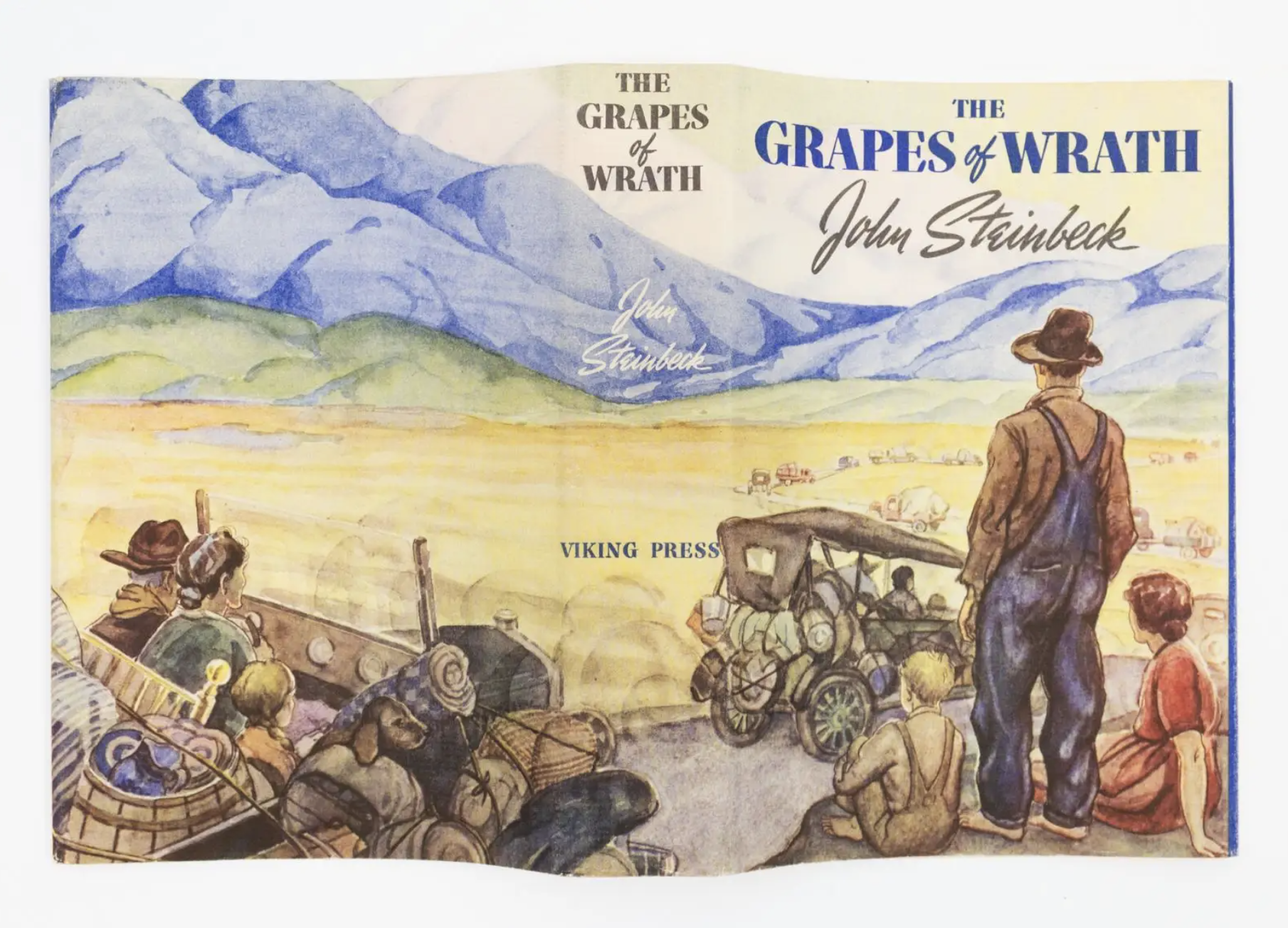
The works of the roots of the vines, of the trees, must be destroyed to keep up the price, and this is the saddest, bitterest thing of all. Carloads of oranges dumped on the ground. The people came for miles to take the fruit, but this could not be. How would they buy oranges at twenty cents a dozen if they could drive out and pick them up? And men with hoses squirt kerosene on the oranges, and they are angry at the crime, angry at the people who have come to take the fruit. A million people hungry, needing the fruit- and kerosene sprayed over the golden mountains. And the smell of rot fills the country. Burn coffee for fuel in the ships. Burn corn to keep warm, it makes a hot fire. Dump potatoes in the rivers and place guards along the banks to keep the hungry people from fishing them out. Slaughter the pigs and bury them, and let the putrescence drip down into the earth.
There is a crime here that goes beyond denunciation. There is a sorrow here that weeping cannot symbolize. There is a failure here that topples all our success. The fertile earth, the straight tree rows, the sturdy trunks, and the ripe fruit. And children dying of pellagra must die because a profit cannot be taken from an orange. And coroners must fill in the certificate- died of malnutrition- because the food must rot, must be forced to rot. The people come with nets to fish for potatoes in the river, and the guards hold them back; they come in rattling cars to get the dumped oranges, but the kerosene is sprayed. And they stand still and watch the potatoes float by, listen to the screaming pigs being killed in a ditch and covered with quick-lime, watch the mountains of oranges slop down to a putrefying ooze; and in the eyes of the people there is the failure; and in the eyes of the hungry there is a growing wrath. In the souls of the people the grapes of wrath are filling and growing heavy, growing heavy for the vintage.” – John Steinbeck, The Grapes of Wrath (1939)
The entire matter was closed, stonewalled, to be forgotten with time and distance. Unity required confessions of faith in the American government, so children were taught to pledge allegiance to the flag of the United States of America. That was enough. People were left to their own private affairs. Religion was no exception. But many inside as well as outside the churches of America with their patriotic flags and pledges to national allegiance began to peek through, often denounced – by the now perverted Gospel of America – as an ism. Socialism. Communism. Blackism. Womanism. Each ism was an invective, an accusation of disloyalty to God, to America, to Americans. Each accusation was a testament to the forgetting, for America had seen each of these isms addressed by American ministers shortly before the First World War, part of the Social Gospel Movement in urban areas. Evangelicalism capitalized on the new Civil Religion because it served a political function. It was an easy compromise for power. One only had to suppress the teachings of Jesus, Paul, Mary, James, John, and Peter by exercising aggressive illiteracy in promotion of one’s own interests, to effectively ignore the obvious by focusing on the self.

“It has been my conviction ever since reading [Walter] Rauschenbusch that any religion that professes concern for the souls of men and is not equally concerned about the slums that damn them, the economic conditions that strangle them, and the social conditions that cripple them is a spiritually moribund religion only waiting for the day to be buried.” – Martin Luther King Jr., from The Autobiography of Martin Luther King Jr. (1998, pg. 18)
It would be fair to say that Christianity was in crisis following World War II. So much had been left unresolved, doctrinally and socially, that the opportunity existed to redefine what it meant to be Christian as much as what it meant to be American. In a very real way, the existential concerns of most Americans were less important than survival at home and abroad. In the cities, social concerns like race and gender were every bit as important as the conservationist attitudes in the American West, the financial concerns in the South where banks had collapsed during the Depression and been replaced by exploitation and, in turn, tremendous frustration in search of a cause. Pentecostalism was only one theological debate among the many taking place inside of the American Church. But in the decade that followed World War II, what emerged was a renewed interest in evangelism. The language of the time reflects a deep and pressing need to tell one’s story – of sin and deliverance as much as the inner peace and security of salvation and sanctification.
Church historian Roger Olson, reflecting on the period, points out that Pentecostalism flourished at the start of the Twentieth Century because it was reacting to the perceived excesses of American religion with an insular, self-contained spiritual experience that was “intensely experiential and emotional.” He also notes that Pentecostalism drew from anti-intellectual sentiments widespread across America at the time, cutting through interdenominational debates.
It tended to downplay theological correctness and doctrinal precision, as well as intellectual inquiry in general. Some scholars have argued that it was and remains severely anti-intellectual and otherworldly in ethos, even though in the later part of the twentieth century some genuine biblical and theological scholarship has arisen from within its ranks. Its emphasis on emotional experiences, miracles, rejection of “worldliness” in appearance and amusement, and imminent return of Christ gained it the pejorative descriptor “Holy Rollers” and caused even many evangelical Christians to reject it as fanatical… Throughout the first half of the twentieth century, Pentecostalism especially languished in a limbo state in relation to the rest of conservative, evangelical Protestant Christianity. It was harshly comdemned by nearly everyone, including its own Holiness and higher-life cousins (History of Evangelical Theology 80-81).
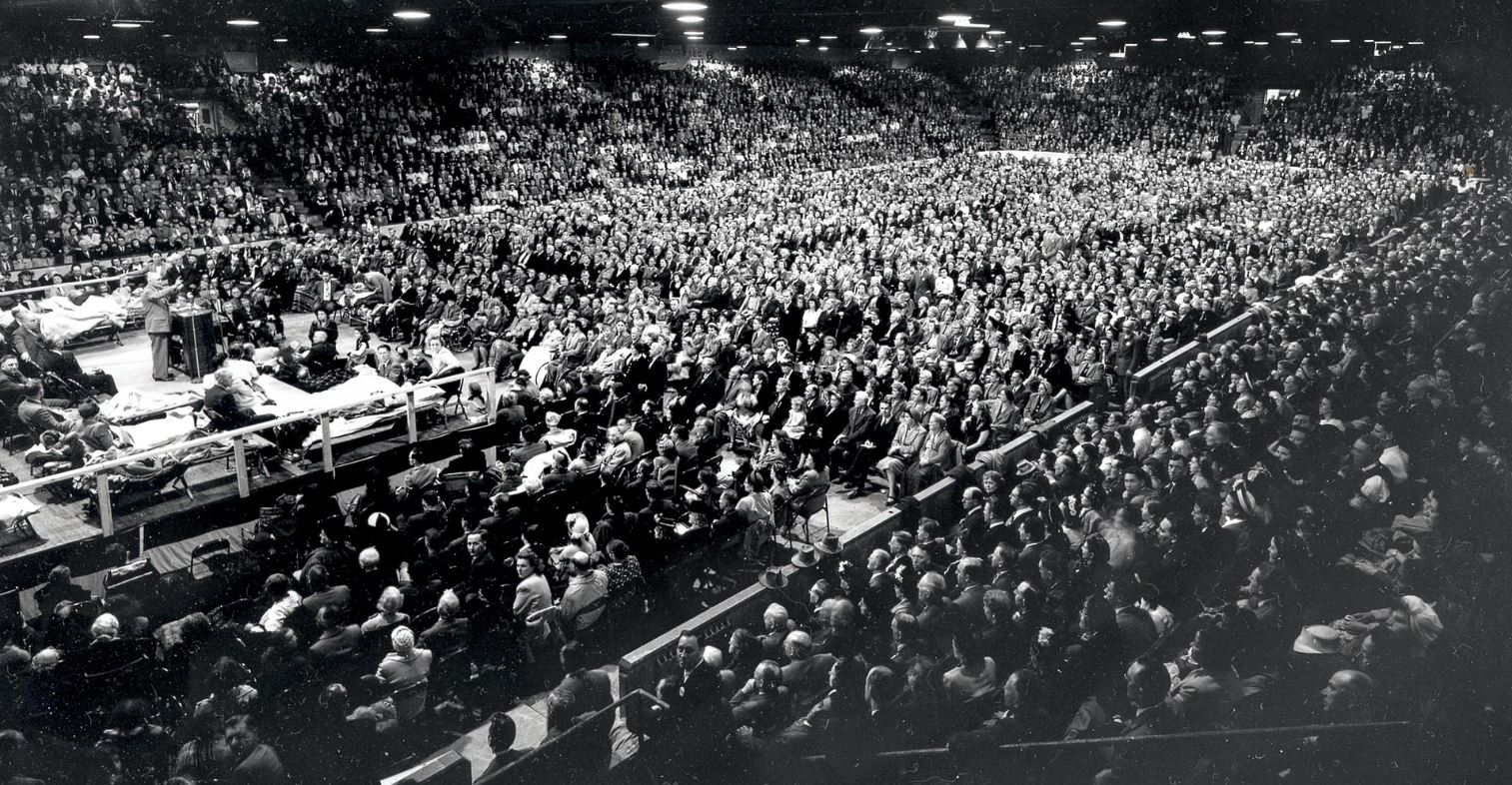
Pentecostalism, the kind Oral Roberts and William Branham embodied, was countercultural. American Pentecostalism, from its beginnings in Topeka, Kansas and Azusa Street in Los Angeles, recast Christianity as a religion of communication between the mortal and the divine. For all of the things left unsaid, inexpressable, forgotten, or unutterable, a believer need only pray in tongues. There was so much roiling beneath the surface of the American experience, even more beneath civil religion. It was not just war and race that was left unaddressed. The divide between High Church with its cerebral theology and Low Church with its embodied theology, beneath the class and economic divisions, the profound and wide theological differences between “fellow Christians” in America were also left unaddressed. Pentecostalism promised a pure language, the jerking and halting speech of “tongues” and heavenly language for all of this.
Raised in a small mining town buried in the Appalachians, my grandparents briefly dabbled in Pentecostalism. It allowed my grandmother to pray about the physical abuse she endured from her mother. It allowed my grandfather to mourn the death of his father to alcoholism. It allowed them to, years later, mourn the death of their first daughter when she was run over by a hauling truck.
Unlike Oral Roberts, who centered the miraculous optics of cattle stall “healing lines” interrupting human suffering, my grandparents sought a quiet religious experience with assurances. The heartbreak they had experienced was part of God’s plan. Continually anxious, when their third daughter was burned by a hot iron, they frantically drove her to a local witch for a healing remedy. Not their local Assemblies of God Church. My grandparents did not even seek out the prayers of their fellow church members, primarily because they were pastors of their church. They did not want to have to explain themselves, the way that trauma lived inside of them and compelled them to make decisions their religion forbade them from making. Like visiting a witch to heal their daughter. Some things, they felt, could not be spoken. Not even to God.
Jimmy Swaggart often recollected experiences from his own life where he came to the limits of his understanding, the limits of his ability to articulate what he was thinking and feeling. At such times, he was thankful for the gift of tongues. Pentecostalism emphasizes the secretiveness of tongues a great deal, the ways in which the human heart cries out to God in inexpressable ways, though in the aftermath of World War II much more was made of the verifiability of this magical, mystical expression of God’s Spirit in the life of the believer. This was an age of science and reason. The Assemblies of God especially began to insist that, though it may initially sound strange to the uncultivated ear, the “heavenly language” of the ecstatic utterances were recognized languages on Earth. Nameless “witnesses” (often the children of missionaries) and “experts” (who often taught Linguistics at Harvard, Yale, and Princeton) had studied the miraculous languages present in Pentecostal churches and claimed authoritatively that tongues were not so strange at all. God was the god of the miraculous and unexplained. But God was also the god of science and the reasonable, easily recognizable and always on the level. There were no magic tricks, sleight of hands, or chicanery within Pentecostalism’s claims. Speaking in a heavenly language, with the tongues of men or of angels, was as sure and reliable as the movement of atoms and the destruction of bombs.
It was the march toward legitimacy that began to bend Pentecostalism’s countercultural orientation. Many Pentecostals, like Oral Roberts, began to downplay their belief and practice of speaking, praying, and making prophetic utterances in tongues. Instead, they emphasized a holy life or “complete consecration” by which they both rejected the world and its alleged wickedness as well as defended their strange behaviors and rejection by American society. Writing in the Assemblies of God magazine The Pentecostal Evangel in 1934, then-editor Stanley Frodsham offered, “I sometimes wonder whether God is much interested in big movements. I know He is intensely interested in individual souls who are wholly consecrated to Him, and wholly devoted to His cause.”
The denomination revisited this comparatively quaint idea in 2021 with an article by Darrin J. Rodgers, the director of the Flower Pentecostal Heritage Center.
Early Pentecostal literature is overflowing with calls to full consecration — the insistence that Christians fully devote themselves to Christ and His mission. This call to full consecration — an essential part of the worldview of early Pentecostals — is now a faint echo in some quarters of the movement. Early Pentecostals offered profound insights concerning the need for a deeper spiritual life. A rediscovery of these insights — which focus on discipleship and mission — could reinvigorate the church by challenging believers to question the Western church’s accommodation of the materialism and selfishness of the surrounding culture.
What is “full consecration?” The term may be unfamiliar to many readers. Stanley Horton noted, in a 1980 Pentecostal Evangel article, “In the early days of this Pentecostal movement we heard a great deal about consecration.” Horton went on to explain that the Hebrew word, kadash, which means consecration, was later replaced in popular piety by similar words, such as dedication and commitment. He noted that kadash signified a “separation to the service of God,” calling for not merely a partial dedication, but for “a total consecration and a lifestyle different from the [surrounding] world.”
Pentecostalism emerged about 120 years ago among radical Holiness and evangelical Christians who aimed for full consecration. They were very uncomfortable with the gap between Scripture and what they saw in their own lives; between ought-ness and is-ness. They wanted to practice an authentic spirituality; a genuine Christianity, not just in confession, but in practice.
The de-emphasis on magical thinking for doctrinal purity and practical, individual holiness brought about other changes to the movement. A new generation of Pentecostals, the one SWaggart grew up in, tried to embrace the practical, rational, and logical. This was not because logical thinking illuminated their faith necessarily, but – on trend here – for more practical reasons. Pentecostals resisted unrestrained performance of the divine because, like other denominations before them, they saw that the fastest way to legitimacy was nationalism. At the end of this road was the luring mirage of power. As it had been in the 4th Century under Emperor Constantine, the access to power was too strong a temptation for the religious group to resist.
When the National Association of Evangelicals was formed in 1942, after serious debate and strong denunciations, the NAE decided to include both Holiness and Pentecostal denominations in their membership. The Free Methodist Church and the Assemblies of God were both charter members. By the time Swaggart set out with Frances and baby Donnie as an evangelist, Holiness and Pentecostal Christians were actively purging their ranks of “doctrinal error” and erecting higher barriers to credentialing their leaders. This would seem sensible, evidence that the movement was maturing, except that Pentecostals generally and the Assemblies of God specifically have consistently remained remedial. Their graduate programs, even now, are equitable to introductory courses at Boston College, Princeton Seminary, Fuller Seminary, and the Southern Baptist Theological Seminary in Louisville, Kentucky. The effort to “clean house” was an obvious effort to appease the NAE, but Pentecostals have never managed to embody the expectations of their various founders.
Rodgers continues,
Early Pentecostals were ahead of their time. It should be noted that they were not buying into modern political or social ideologies; their commitments arose from their devotional life. Some of their commitments — such as women in ministry and racial reconciliation — brought persecution 100 years ago, but the culture has shifted so that these stands are now considered respectable by many. This newfound respectability presents a challenge — it is possible to look like a Pentecostal by embracing historic Pentecostal themes that are now considered “cool,” without also seeking to be fully consecrated.
Living out and conveying authentic Christian spirituality from one generation to the next has often proven a difficult task. Carl Brumback, in his 1961 history of the Assemblies of God, expressed concern over the decline of the spiritual life within the Pentecostal movement. He wrote:
“It must be admitted that there is a general lessening of fervor and discipline in the Assemblies of God in America. This frank admission is not a wholly new sentiment, for down through the years in the pages of the Pentecostal Evangel and other periodicals correspondents have asked, ‘Is Pentecost the revival it was in the beginning?’ As early as five years after Azusa, they were longing for ‘the good old days’! Nevertheless, it is vital to any revival movement to reassess not too infrequently the state of its spiritual life.”
Instead of reading the failure of Pentecostals to rise to the expectations of their past or the demands of the present, it would be more accurate to reframe these events as corrosion. Pentecostals, despite their public denunciation of culture, acquire a little power and began to erode Evangelicalism from within. Instead of Pentecostals rising to the occasion and challenging themselves intellectually or adopting theological insights to better translate their unique teachings, they lowered the standards for their fellow Evangelicals altogether. A little leaven leavens the whole lump, according to the Apostle Paul in his letter to the Galatians, but in resisting Empire, God says one must be separate entirely “and eat unleavened bread” (Exodus 12:15). Still, Olson praises them. He points out that Pentecostals
have always remained, however, a distinct subset of Evangelicalism… Their influence on evangelical worship, spirituality, and doctrine has been noticeable… The legacy of the Holiness-Pentecostal movement to evangelical theology is an emphasis on higher spiritual life – especially second-blessing-type experiences subsequent to conversion – and interest in the gifts of the Holy Spirit. While many evangelical Christians have little or no use for emotional displays of spirituality, almost all have been affected by the renewal of the doctrine of the Holy Spirit and the Spirit’s work in the Christian life introduced by Holiness-Pentecostal revivalists. So-called contemporary worship (chorus singing with arms raised, hand clapping to energetic “praise and worship” choruses, informal worship) is an obvious extension of certain worship styles that were born in the Holiness-Pentecostal meetings of the turn of the century (81).
Tellingly, Olson also notes that
Another possible legacy of Holiness-Pentecostalism to the wider evangelical community is an active disinterest in rigorous biblical and theological study, doctrine, and evangelical intellectual creativity and participation in the wider culture (81-82).
Or as Pentecostal apologist Jonathan Ammon writes,
Some believers are anti-intellectual. They do not like apologetics [the practice of defending religious beliefs through reasoned argumentation], reasoning, philosophy, or higher learning. This is often true of Pentecostal and Charismatic cultures. (The Prophetic Apologetic: A Charismatic Approach to Christian Apologetics 4 [2020]).
Initially, Jimmy resisted a Pentecostalism that talked about “powers” and “gifts” without prioritizing the fundamental assumptions contained within scripture. He grew up in the tension of transition – in religion yes, but also culture and politics. As he saw it, what was the use of “participation in the wider culture” if it did not seek to change that culture? A product of the time, there were only two absolutes. One either rejected “the world”, as Jimmy struggled to do, or embraced it, as Jerry Lee had done. Christianity, if it meant anything at all, was a rejection of the quest for power, the seduction of culture, the ways of the world. But with the constant emphasis on personal, individualized experience, Jimmy recognized he wanted something more than the small town grease stains he lived in.
To his bones, Jimmy wanted nothing to do with perversions of the Gospel. Like Jerry Lee, he was terrified of God’s judgment, to be found wanting and lacking in the final estimation come Judgment Day. As his ministry expanded, Jimmy wanted to showcase a full gospel of transformation and hope, to articulate the ways in which God was calling believers away from worldliness and sin which could ensnare even someone as tender and pure-hearted as his own cousin. Jimmy did not want to preach a hollow Christianity like the one offered by Norman Vincent Peale in New York City, focusing on the goodness of humanity and the power of one’s own thoughts. He did not want to preach a dead gospel, like the one pronounced every Sunday from the pulpits of dead churches scattered across America. And he did not want to preach a false gospel, like his fellow Pentecostals who were increasingly becoming confused about what Jesus and Paul actually said and did.
Jesus was a humble servant from the backwoods of a nothing town. This was something Jimmy knew something about. Jesus refused the devil and so, in turn, would Jimmy. Gone were the days of consciously rejecting the life God had called him to. Jimmy had to resist the devil in all his ways and stand vigilant against compromise.
It was a narrative Jimmy had been repeating to himself before he had even accepted his call to ministry. He was just as talented as Jerry Lee, after all, only Jimmy had chosen God instead of riches. In a diner in Winnsboro, Jimmy heard his cousin singing from the jukebox, “Crazy arms that long to hold somebody new” and took comfort in knowing that Frances was waiting for him at home.
It wore on him though, Jerry Lee’s success.
My thoughts drifted back the times Jerry Lee and I had played piano together, the times we had talked about making lots of money, the times we had planned to leave Ferriday for the big time. Now it looked as if Jerry Lee had finally realized his part of the dream. But what about me. Here I was, dressed in greasy overalls, my face covered with grime. All I could do was serve and obey. I had no other choice. I had a different master. Dark, cloudy thoughts hung in my mind, “I’ll never do anything but preach in little backwoods churches… grease and grime is really my lot.” Yet deep inside I resolved if that’s what God wanted, that’s what I would do. I would work on the dragline and preach whenever I could until Jesus came (To Cross a River 87).
While he may have convinced himself that he had chosen the right path for his life, by Jimmy’s own account, the divide between he and his cousin continued to bother him. He felt entitled to something more than grease and grime. Jerry Lee had amassed an unfathomable fortune, asking for a king’s ransom to play local concerts and getting it. His deal with Sun Records, his tours with Elvis and Johnny Cash, on top of his records and honorariums created a contrast that Jimmy, no matter how pure his heart and intentions, could ignore.
Jerry Lee came to visit in December of 1957. Jimmy “continued working as a swamper and preaching on weekends whenever a church door would open… when Jerry Lee drove up in his Cadillac. He had reached the pinnacle of success. He had appeared on several national television programs. His picture was on the cover of many trade magazines. His latest recording, ‘Great Balls of Fire,’ was number one in the nation. But he didn’t seem to want to talk about all that” (To Cross a River 87 – 89). The toll of the road, the insecurity of childhood poverty, his revolving relationships, and the loneliness of watching his friends go their own way on their own tours had caused Jerry Lee to begin to ask existential questions. Fame had come on so quickly, he knew it might leave the same way. And this life he had found himself in, surrounded by hangers-on, alcohol, drugs. It all felt so empty. By then, Jimmy and Frances had a son, Donnie. It was a small life that the Swaggarts had, but it was stable and far more secure than the one Jerry Lee was living. God felt so eternally distant, their childhood in church a fading memory. Jerry Lee was convinced, quite entirely, that he was beyond redemption. He had made his pact with Satan for fame and money, and now he had to endure the terms of the bargain he had made.
Over breakfast, Jimmy told his cousin that he was about to go into full-time ministry. It made little sense, financially. God was calling him away from the oil and gas industry, which was taking off. There would be opportunities for him if he could stay the course and stick it out, but after discussing the matter with Frances, her father, and Sun, Jimmy wanted to break out of the depression and stagnation of the life he had built around himself. He wanted to take a risk, defy the odds, and put his trust in God to financially provide. To Jerry Lee, Jimmy’s news must have felt like a painful juxtaposition. Like Jerry Lee, Jimmy would go “on the road” and trust that a paycheck would be waiting for him at the other end of the drive.
At church, once Jimmy began to preach, the turmoil Jerry Lee was feeling began to tumble over his outward defense of light-hearted self-assurance. As Jimmy recalled,
[Jerry Lee] was deeply affected by the Holy Spirit. His face turned ashen. He gripped the pew in front of him so tightly his knuckles turned white, shaking it as he wept and sobbed. A number of people moved forward that morning to receive the Lord and repent of their sins, but Jerry Lee remained in his seat, sobbing. Finally, mama went over to pray with him and urge him to come forward. He always seemed to love her better than any of his aunts and uncles and he hugged her neck emotionally. Yet he would not yield to the Holy Spirit’s bidding (89).

Jerry Lee divorced his second wife, Jane Mitchum, that month. The following summer, he married for the third time. Myra Gale Brown, who was thirteen at the time of the marriage, was Jimmy and Jerry Lee’s cousin.
Jerry Lee’s wealth and fame played a part in the family silently assenting to what each of them, especially the women, knew would be ill-fated circumstance. The cycle of violence and sexual abuse within the family continued once again. Jimmy must have felt some smug self-assurance in witnessing his cousin break down that December. Even in the retelling, he continues to fixate on the musical success of his extended family, the story infused with resentment and questions about his own ability as a singer and minister.
Several times prior to leaving my job, people approached me about playing the piano in various places. Most of them were gospel quartets. The offers always looked glamorous and appealing. But I never felt free to accept them. I had been called to preach the gospel, not play the piano for someone else… The air waves were filled with the heavy rock-and-roll beat of Jerry Lee’s music. Mickey [Gilley] had just signed a contract with Dot Records and they were predicting big things for him. Another cousin, Carl McVoy, was with the Bill Black Combo and they had a song in the top forty… I was swamped with depression. Dark, gloomy thoughts roamed through my mind (91 – 92).
The following summer, Jimmy was preaching a revival in Spring Hill, Louisiana, when Jerry Lee returned from England. The tabloids had picked up the news of Jerry Lee marrying Myra and all hell broke loose. Venues broke their contracts, shows were canceled, radio stations refused to play Jerry Lee’s records. Despite it all, Jimmy called his cousin and invited him to church the next night. No matter how awful Jerry Lee may have been, how sinful, Jimmy loved Jerry Lee and remained loyal. He also knew Jerry Lee, even as a pariah, was a hot ticket.
The response was as I expected. People jammed into the tiny church building like sardines. Some couldn’t find seats and had to stand in the front door or attempt to peer through the raised windows. I don’t think anybody heard a word I said that night. They were all looking at Jerry Lee and Myra, whose recent photos in the papers made them seem even larger than life itself. Afterwards, we went out to a restaurant. Once again, people jammed the place trying to get a picture or an autograph from Jerry Lee. Finally, the owner ushered everybody out and locked the doors (118 – 119).
Jimmy wanted more. This was beyond the pale, what he was witnessing. Jerry Lee had become notorious for his wildness. He could break the law. He could marry his cousin, a child. He could do anything he wanted. Even then, he could still pack a church and get a free meal out of it. At the restaurant, Myra convinced Jerry Lee to buy Jimmy a new car – an answer to prayer – and write it off on his taxes as a charitable donation. Jerry Lee was above the law. He was beyond sin. He was, in Jimmy’s estimation, untouchable. If only there were some way to bring Jerry Lee on the road with him, to restore him to his proper place as a minister. Instead, Jimmy began to use Jerry Lee’s infamy. One way or another, Jimmy would do what even God couldn’t.
In the late 1950s I wanted to get as many people into our meetings as possible so in many places I let it be known that I was Jerry Lee Lewis’s preacher cousin. I would also have special nights in the meetings when I preached a youth message and talked about my experiences with Jerry Lee. On those nights, people would flock into the services. We had scores of people who came to hear about Jerry Lee and wound up accepting Jesus Christ as their Saviour. That was the real purpose anyway.
Using Jerry Lee’s name in my revival meetings proved successful in attracting people to the services. But it worked against me in other avenues, especially when I applied for ordination in the spring of 1959. I was refused.
By then, Jimmy and Frances had been on the road for a year. At a district council meeting of the Assemblies of God in Lake Charles, Louisiana, candidates for ordination were called into a room individually and examined by a committee of preachers. Despite knowing the men in the room and having preached at their churches, men who he thought of as friends if not already co-laborers in the work of the Gospel, Jimmy was rebuffed.
It was a shock.
The committee ordained men who were not in full-time ministry, men who hadn’t committed themselves to ministry like Jimmy had. The previous year felt like a waste. Everyone at the district council knew how eager Jimmy was. It was expected that he would emerge ordained; if the committee held to their decision, the shame of refusal would raise questions. Still, they denied him.
“Well, Jimmy,” the superintendent intoned, “we are aware that you’ve been on the field for a year but we think there’s more to ordination than time. There are other factors.”
There was something about the tone of the man’s voice that seemed to suggest I was not responsible enough to be ordained. Yet the committee’s answer had been so vague and evasive I could read almost anything into it, but nothing concrete…
James Allen, one of the preachers on the committee, interrupted me. “I can’t see how anyone could object to a spirit like this. This man is showing a beautiful spirit and I, for one, would like to go ahead and resolve the situation now.”
The district superintendent overruled Brother Allen. “I’m sorry,” he said firmly, “we’ve already voted not to ordain Jimmy Swaggart at this time. He’ll have to request ordination at next year’s meeting.”
But nobody would tell me why. I walked out of the meeting totally crushed. We had already had such a struggle getting meetings. Now with this hanging over our heads, the situation seemed almost hopeless. There had always been a lot of rumors circulated about me. Being Jerry Lee’s cousin, I guess that was normal. But I knew that being refused for ordination all boiled down to being his cousin. That bothered a lot of people. Others didn’t like my piano playing and singing. They thought it wasn’t churchy sounding enough. There seemed to be more rhythm in it than they thought the four walls of the church could stand. Daddy and mama were both deeply hurt when I told them about being refused. I was the only preacher denied ordination that day. Frances and I… felt like we had been kicked in the stomach by an Arkansas mule.
This is an interesting descriptor, considering who was in the room. At that same annual meeting, Marvin Gorman was named the Louisiana District Youth Director. Gorman, a fellow traveling minister, was well known to Jimmy Swaggart and may have been the last person Jimmy’s mother, Minnie Bell, talked to shortly before her death in 1960. Gorman, of course, was born and raised in Arkansas. He could be stubborn at times, like a mule. And when he and Swaggart went to court, decades later, his “kick” was strong enough to take Swaggart’s breath away.
 Theology & the City
One thought on “Biography: Jimmy Swaggart, Chapter 10”