by Randall S. Frederick
Visiting the Grand Canyon was a humbling experience. Recognizing the smallness of life in comparison to the expanse of the Canyon’s eroded depth, I cannot fathom how anyone would feel otherwise. But was it divine? Inspiring? Creative? Not for me. I’ve traveled through the Chihuanan and Mojave Deserts. I visited the Middle East in the summer months. But I wouldn’t say I spoke to, heard from, saw, or even glimpsed God in those places. Awe-inspiring experiences? Without reservation, I would say absolutely. But spiritually uplifting? In ways that compelled me to feel connected to the divine? I don’t know about that. I felt more in touch with the Earth and nature, the centuries and centuries of humans who had traversed these places, the immensity of time and space and place. I did not feel that I was in communion with God or the Great Spirit, whatever we want to call that all-knowing, fully aligned All-Father or All-Mother whose palace is just above our line of sight.
The divine has more often appeared much closer to my daily life, through the mundane and ordinary. In the New Testament, the conversion of the apostle Paul is often held up as the prime example of a spiritual experience. On his way to kill the first Christians, Paul claims that he saw the face of a recently deceased and then-triumphant Jesus Christ. Supposedly, Jesus has ascended to Heaven. Paul will later claim that after Jesus died, he went to Heaven and sat on the right hand of God Almighty, a place of power and administration. But before Paul irons out his theology, he claims Jesus leaves Heaven to gently rebuke him. Paul is so struck by the vision of Jesus in all of his celestial glory interrupting his daily life that he falls off his horse. He is blinded by the glory and power of this visit. Literally. Paul is unable to see or speak for several weeks after this moment. This is the kind of experience that Christians celebrate and hold up as not only a possibility for the common individual, but a normal experience. Paul, collecting his wits, a healthy set of eyes, and a renewed ability to speak, immediately flees his responsibility as persecutor and executioner of the Christian community. He leaves for the Arabian Desert to reflect on his life and the teachings with which he had previously ordered his life. Again, this is the kind of experience that Christians celebrate and hold up as not only a possibility for the common individual, but a normal experience. When Paul returns to Israel, he begins to heal people of sicknesses, remove demons from people’s bodies, and restore sight for the blind — basically, Paul does all of the things Jesus did but he does it more frequently, publicly, unapologetically, and internationally. Paul sails, rides, and walks through Israel as well as the lands of the Roman Empire. This too is celebrated and normalized.
Except this is not the case. These activities are neither normal nor especially celebrated.
The small group of followers who traveled with Jesus the Messiah did not have experiences like these. They made no claims to replace or exceed Jesus. Nor did they try to normalize such instances. Curiously, the person appointed to lead the Christian community in Jerusalem is not one of these people, but Jesus’ brother James. James insists that Christian spirituality is best embodied, most evident, when Christians share their food with those who cannot afford it, their homes with those who are homeless, and help those who need help like widows and orphans. In fact, the obligation of believers to the needy was the first issue that the Early Church had to resolve. For James, spirituality is not miracles and public travel tours but simple care for fellow humans. It is grounded and simple.
In my experience with religious communities, I have never witnessed or heard about the Pauline Damascus Road Experience (great name for a band, by the way). The people who have claimed to have witnessed the toothless receive “gold teeth!” and the disabled “levitate above their wheelchairs!” have never been able to provide a name or even an address for these experiences. When pressed, they admit they weren’t witnesses themselves but know someone who was. Here too, the trail goes cold. Though they know this now-revealed source, the names do not appear in phonebooks or databases. Unlike Paul, I have never had a hole open in space and time in front of me. I haven’t even fallen off a horse, though I’ve taken horseback riding lessons and come close.
Like James, like the apostles and close inner circle of Jesus, I have more often found myself arguing with fellow believers. I have been tasked with administrative responsibilities. I have fed the hungry, clothed the naked, and housed those who were homeless. Like the apostles, I have argued with the divine and even after three years of close proximity, still managed to be confused, deny that I ever knew them, and have even forgotten what I experienced over time. I am, unlike Paul, an unreliable source primarily because I am so reluctant to promote myself and have never to my knowledge insisted — as Paul did — that I speak for God, except perhaps to satirize those who make such claims.
Nevertheless, I maintain a rather unpopular and unconventional claim here. I am not a spiritual person, at least not conventionally or in the ways that Evangelicals would acknowledge. I am a very spiritual person in practice though, just not the kind Evangelicals recognize as authentic. When I set myself aside, the challenge is no longer insisting to you that I am better, holier, pray more, and deserving of your admiration and respect. In admitting my failures, I prefer to help you acknowledge your successes. I do not, as Jesus warned against, pray publicly to get attention. Rather, as Jesus encouraged, I pray privately and quietly.
So how do I speak about the ineffable in practical terms? Where do I even begin? These outer workings of the inner life? Am I supposed to speak about manifesting and crystals and the aligning of chakras because these are so very popular in the self-transformation section of the bookstore?
For what I intend to do, I suppose it is best to frame things like I would a house. Room by room.

The Porch
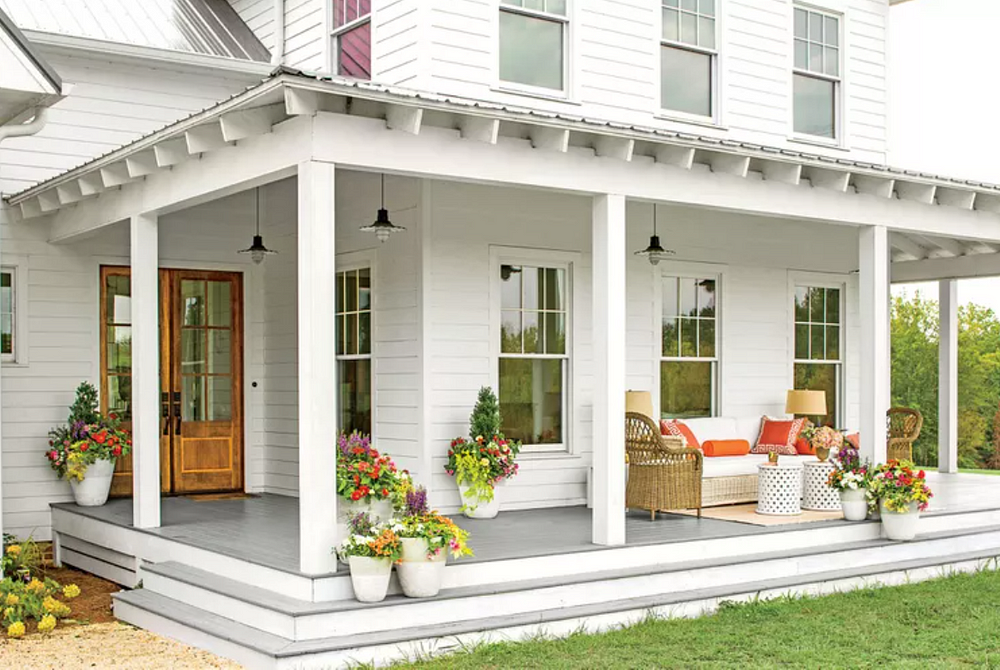
I grew up in the South, where porches were once a way of life. A friend of mine in California and I would often talk about how much we missed the porches we grew up with in Texas and Louisiana. Porches have slowly become a cosmetic feature, an accessory of showmanship to display one’s wealth, but the porch wasn’t an accessory to our grandparents. It was a hosting space. Porches hold furniture that welcomes conversation, typically decked with swings, benches, tables, or rocking chairs. My father has each of these on his wraparound porch. My mother has a grill and table on hers.
No one uses porches anymore, at least not in the ways that our grandparents used to use them. Porches were once a “third place” of daily life. Apart from work and the home itself, porches allowed you to meet with neighbors in a non-confrontational way. After all, you were close enough to your neighbor’s home to exchange light conversation, but if necessary, you could make a quick exit. Politicians would sometimes knock on the porch boards or support beams rather than intrude on your porch. After all, even if you were part of the community and they were eager for your vote, they knew to respect that invisible line between the curb and a potential voter’s porch. The political knock, or more accurately the knock from someone who wasn’t a neighbor, would communicate a sense of respect. “Hi, I’m here at a distance to allow you to look out and determine whether you actually want to talk to me. If not, no offense taken.” From the window, you had a choice whether to respond and, if you didn’t answer, the porch knocker knew there must be a good reason. You weren’t entertaining strangers.
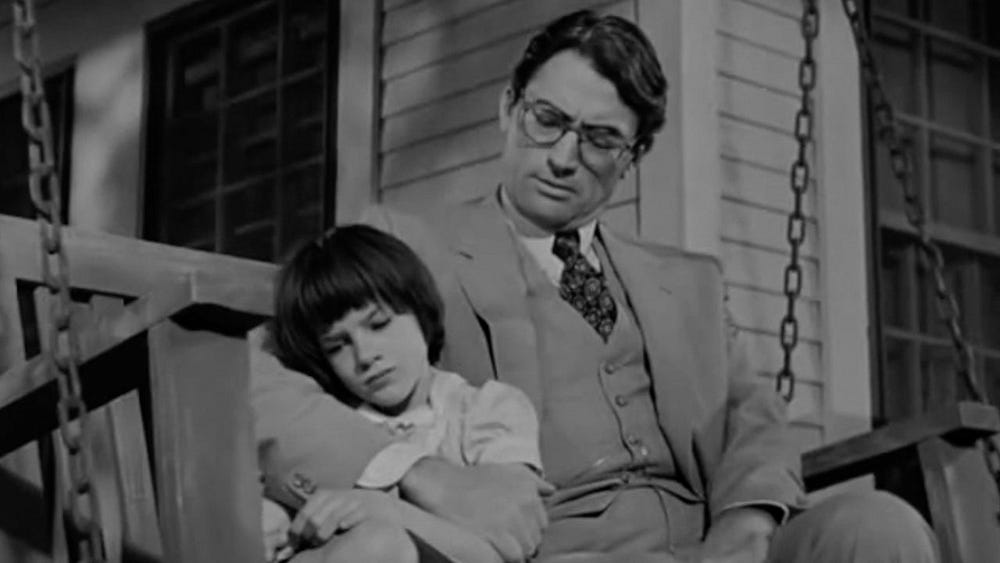
In Harper Lee’s To Kill a Mockingbird, the porch functions as a school of sorts for Scout Finch, her brother Jem, and their neighbor Dill. Atticus Finch, Scout and Jem’s father, does his best to explain the way of the world to his children from their porch and explain to them the importance of doing what is right even when it is unpopular or comes with consequences. Because of the role the porch once played in American life, the porch also becomes a battleground of sorts for the Finch family. When Atticus defends a black man in court, many people in the community begin to look down on him, feeling that he has betrayed them. Insults and threats made against the Finch family become more offensive, more personal because their neighbors choose to make them at the foot of the Finch’s porch.
As Rachel Watson, an American literature professor at Howard University and somebody who has written about both the book and film versions of To Kill a Mockingbird explains,
“The porch gets emphasized in the film in this way where public space and private space can kind of merge, so that you can imagine somebody’s point of view without actually inhabiting their shoes. So, that’s like the explicit moral of the film.”
Besides being frequently visible throughout the movie, porches help us to understand how the characters view the issue of class, and at times, how they’re divided by it, too.
Harper Lee’s friend Truman Capote, who Dill was based on, does something similar in his own short stories. Capote and Lee grew up together in the South and remained friends for decades. In Capote’s novella, Breakfast at Tiffany’s, the fire escape walkup of a New York apartment serves the same function as a porch. It is a liminal space in-between home and the outside world. Revealing conversations are had there, made all the more intimate because the fire escape, or the modern porch, is where the revelations into who people are, how they see themselves, and how they see the world.
By the time I was a child, porches had become a little more intimate. You had to actually know someone to step foot on their porch without fear of harm. Porches were no longer a liminal space, but part of the home itself. America had begun to withdraw, had become more private. You probably didn’t knock on the porch itself anymore, because to even get that close meant you either had a key already (so knocking was superfluous) or you had a warrant and reinforcements behind you. Politicians? They kept their distance entirely. No more need to do door-to-door politicking if a flyer in their mailbox with contact information was provided. If they wanted to know more, they could come to a rally. The best way to get someone’s vote was to respect their privacy and stay far away at a safe distance. The less interaction, the less conversation, the better.
By the time I was a teenager, there were gated communities, neighborhood patrols, then armed patrols, doorbells and knockers to alert home owners, then motion sensors and alarms, then camera doorbells. All of these were meant to create a sense of social distance under the pretext of security and safety. By then, neighbors were sometimes even more than strangers. Neighbors were a threat.
With inflation and the stripping of the American economy by Boomers, particularly after the Reagan Era when suburbia exploded, landowners tried to maximize revenue by minimizing square footage. Many people are now unable to buy even modest homes with yards. Most are unable to buy homes at all. Porches are a luxury, both in terms of space and with the assumption that you have a social circle necessitating the porch at all. Those who owned apartment buildings tried to maximize their selling points by making hallways smaller, thinner, less navigable. Homeowners-turned-landlords, seeking to maxmize profit, removed porches. Some claim their decision to do so has been for insurance purposes. After all, porches are notoriously dangerous. But I’m convinced the disappearance of porches is a product of a shift in attitudes here in America. Withdrawing from one another into the privacy of our own space, the rhetoric of a home being your “castle” and “fortress”, all of this has led to a decline in communities. We no longer know one another. We’ve become a fragmented, compartmentalized society. So it’s no wonder when study after study says Americans feel lonely, depressed, and isolated.
Don’t misunderstand. I’m not saying the removal of porches led to the downfall of America. I’m not alarmist as that. I am saying the disappearance of porches it is a symptom, though. It is a symptom of paranoia, distrust, and isolation in the same ways that depression, suicide, divorce, police brutality, the rise of Fascism, and false news are symptoms of larger issues. It’s pretty obvious that when you cram people into a box, remove yards and porches, undermine the curated communities our predecessors built for themselves, and run a series of marketing campaigns and news pieces meant to create fear of one’s neighbor, agitate it, and weaponize it, then we’re on a trajectory from which we may never return. You’ve convinced neighbor to turn against neighbor, disrupting solidarity at a local level. Porches are the last, closest space for neighbors to shake hands, heads, and talk things out. When developers take that away, they’ve taken away more than twenty square feet facing the nearest street. When landlords paint windows shut, they’ve done more than remove access to a fresh air. They’ve built a coffin and called it “home.”
It’s not a new tactic. Barons and Titans of the Gilded Age did this too, breaking up labor unions and solidarity movements over the last century before they began targeting neighborhoods. Might we see the dictatorial Homeowners Association, conveniently led by the wealthiest and most privileged retirees, as extensions of corporations? To say nothing of the real estate moguls, predatory poachers who want to expand their fiefdoms with rules and regulations that disinhibit young families.
The porch, while not the central or even most significant part of a plot of land, certainly shapes how we orient and navigate ourselves, our communities, and our sense of self. “Ah,” you protest. “But I don’t have a porch, so come off it. I can’t relate to any of this.” That’s the point and you missed it, neighbor. Isolation and compartmentalization of the self, the kind that this nation celebrates, is often presented as a convenience to your own customizable expression of rugged individualism. Friends and neighbors are accessories to your own vision of the self. Small apartments keep things simple, so you’re not weighed down by the complications of knowing people. People — other people — are complex and confusing, a threat to the simplicity you have curated (on your own) so carefully.
I don’t know. I’m not fully convinced this is the way any of us truly want to live. Deprived of public spaces, ghettoized, we begin to see a two bedroom with no yard, no porch, and no space for growth as a status symbol, as though we have finally achieved the American Dream of having an extra room — for a baby? For a home office? For guests? — where we might do more than merely sleep before returning to the grind. We have a landing before we get to our apartment? How classy!
The outside world, that other place outside your home, is often exhausting. This doesn’t mean we want to avoid it, though. Whenever we step outside of our boxed-in living spaces, we find that we need a third space which is neither work nor our home, but still close enough for convenience. We need coffeeshops and restaurants and parks, places to sit and have conversations with people we know or occasionally recognize without being charged for it. I’m unconvinced that working all week only to pay to rent a chair in a coffeeshop is a “good” life, something to be celebrated. Porches were these spaces a generation ago, a place where we could socialize at a comfortable distance and not be charged for the experience. We need to talk to people. We need fresh air. To see and hear and move through nature, to cook out and sit down without expectation.
Before we can even begin the inner work, we must acknowledge the ways that the external world lingers and encloses. What is happening inside our homes and lives is affected by the outside world that — we are told, at least — wants to intrude and harm and steal and corrupt. Whether we have a porch or fire escape or even a mat outside our apartment, there is something here that needs to be considered. What impact, if any, has the outside world had upon your inner life? Is there a sense of community in your neighborhood and, if so, who is “on your porch”? Who are you sitting with or unable to sit with, what news smacks against your door, and if a stranger comes knocking, are you able to see them at a polite distance or are you so boxed in, so at home in the coffin you call home, that they feel like an unwelcome threat to your existence?
Watson continues to note that Harper Lee used the Southern porch in ways that stage directors and even the movie clued in on. The porch, as Lee framed it, was a “stage to establish sort of public identity” and “hierarchy between people so that it doesn’t just happen between blacks and whites, it happens between whites of different classes. When we first meet Walter Cunningham (a white character) in the beginning of the movie, when he is bringing his entailment payment to Atticus Finch, Atticus is on their back porch receiving the payment. And Atticus and Scout are kind of above Walter Cunningham.” This scene illustrates Scout’s emerging awareness and understanding of the difference, economically and spatially, between the Finches and the lynch mob of poor white farmers who are ready to kill a black man. In the stage production, Scout’s father Atticus finally explodes the anger he has calmly kept within the privacy of his own mind. To the audience, Atticus’ estimation of his neighbors has been evident all along. He finally screams that yes, yes indeed, he is above the pathetic and pitiful lives of his racist neighbors. He looks down on them because they are beneath him. But his awareness of class is not so clearly defined by this moment.
Lee didn’t just use porches as a backdrop, but as dynamic spaces that reveal thoughts about the characters and how they see one another. When her work was adapted to film, the original screenplay referenced porches nearly 60 times. Scout’s lessons on empathy and class difference come into play again on the porch when she confronts a lynch mob, led by Walter Cunningham, on its way to attack Atticus’ client, Tom Robinson, a Black man who has been accused of committing a heinous crime.
“It’s a kind of spatial alignment, where we have Atticus on the porch protecting Tom and then Walter Cunningham and the lynch mob is kind of below him. And again, Scout is on the porch with Atticus, able to make eye contact with Walter Cunningham.”
The American porch has, in its time as an American cultural symbol, represented the cultural ideals of our nation. The most striking cultural significance of the front porch is its connection to nature and the land surrounding it. Throughout the history of our nation, Americans have idealized nature and land. The first writers of our country, such as Crevecour and Jefferson, praised the young agrarian nation, whose natural conditions provided for a better life.

From the Transcendentalists to Frederick Jackson Turner, Americans have always been aware of the special attributes land and nature gave their nation. For a majority of our nation’s history, America did exist as an agrarian nation, and it praised its “purple mountain majesties” and endless forests. Yet along with the idealization of nature came an ideal to control it. Americans “manifest destiny” induced them to conquer nature, by building towns and cities, clearing forests, and otherwise civilizing the land. The front porch provided a compromise for these two opposing American ideals and connected human control, in the form of the house, to nature and the wilderness outside it.
In essence, Reynolds Price writes in his Out on the Porch (1992), the porch “served as a vital transition between the uncontrollable out-of-doors and the cherished interior of the home.” Thus, the American front porch demonstrated Americans’ simultaneous ideals of nature and its control.
In many ways, the front porch represented the American ideal of family. The porch, in essence, was an outdoor living room, where the family could retire after the activities of a long day. In the evenings, as the outdoor air provided a cool alternative to the stuffy indoor temperatures, the entire family would move to the front porch. The children might play in the front yard or the friendly confines of the neighborhood, while the parents rocked in their chairs, dismissing the arduous labors and tasks of the day into relaxation and comfort. Stories might be told, advice garnered, or songs sung. Whatever the traditions and manners of the family might be could be offered in this setting as “a place for family and friends to pass the time.” What the family room or T.V. room of post-World War II America would become, existed first as the front porch, and so this is where we have had to begin our understanding of the outworkings of the inner life.
The American front porch represented the ideal of community in America. It was a buffer between the civilized and wild spaces of daily life. The porch also existed as a zone between the public and private, an area that could be shared between the sanctity of the home and the community outside. It was an area where interaction with the community could take place, for
“the master’s farm business, the mistress’s selections of goods and produce, the home craftsmen’s sales, and sundry negotiations of the cooler sort (with the hired man, the foreman, the slave or house servant, the distressed or disgruntled neighbor, even with the unpredictable stranger from the muddy road) could all be conducted in the civil atmosphere offered by the shade of a prominent porch, apart from the sleeping and feeding quarters and without serious risk to the family’s physical and psychic core.”
The porch further fostered a sense of community and neighborliness. In the evenings, as people moved outdoors, the porch served to connect individuals. The neighbors from next door might stop by one’s house, to sit on the porch and discuss both personal and community issues. The couple walking down the street might offer a passing “hello,” as they passed house after house whose inhabitants rested outdoors. The porch brought the neighborhood and community together, by forcing interaction and an acute awareness of others. Indeed, the front porch and the ideal of community in America had developed into a congruous union.
Between the rise of the front porch in the middle nineteenth century and its decline in the post-World War II era, the front porch developed a cultural significance. It represented the cultural ideals of family, community, and nature. As these ideals would decline in importance in American culture, so would the porch.
In the period immediately before and after World War II, the American front porch became a relic of the past, an architectural feature and cultural symbol no longer important to Americans. The technological and social forces that initiated and spurred this developing abandonment of the front porch was the proliferation of the American automobile. The growing number of automobiles in America, their availability to different classes, and their growing use as a means of transportation flooded the American streets and roadways with vehicles. As a result, “the front porch was no longer an idyllic setting where one could relax and commune with nature,” for the “exhaust fumes and the noise of a steady stream of cars and trucks had rendered it inhospitable and unhealthy”, according to Renee Kahn and Ellen Meagher in their Preserving Porches (1990).
The automobile further created a new enclave and setting of towns and cities: suburbia. Automobiles allowed for Americans to move further distances from their workplace to build homes on less expensive property. The “automobile-dependent suburbs” did not feature front porches, due to the omnipresence of the automobile. Thus, as technology had helped to develop the front porch, by the mid-twentieth century, it was leading to its decline.
The new technological development of air conditioning further aided in the decline of the front porch. Providing a cool environment indoors, the front porch was no longer needed as a cool shaded area during the day or as a place to enjoy the cool night air. Families remained indoors comfortably, and a primary use of the front porch was no longer needed. Air conditioning, in a sense, also contributed to another technological development that would affect the front porch: the television.
The television, which could exist only inside, provided endless hours of entertainment indoors. As a result, family life shifted from the porch to a family room or T.V. room, where families could watch the evening news, sporting events, or the early sitcoms, all while enjoying the newly invented “T.V. dinner.” No longer would families relax outside on the front porch.
It has been heretofore suggested that a change in cultural ideals further aided in the decline of the front porch. Many of these cultural changes were the result of the technological changes outlined in this section. Certainly, Americans declining ideal with nature was a result of new technological developments such as the automobile. Yet, culture had changed on its own as well, aside from technological developments, further contributing to the decline of the front porch. The American ideal of community had certainly declined during this period. The specific reasons for such change must be left to more experienced anthropologists or sociologists, yet it is uncontested that America became overtly more individualistic and less community-oriented. This change helped to eliminate porches, and the elimination of porches further accelerated this trend. At the same time, the traditional American importance given to the family had declined. Familial structure and relations had changed, lending to less family interaction and family time. While this connection to the decline of the front porch is a stretch, it certainly may have played a role.
By the 1960s, the front porch had disappeared in the new architectural forms and houses sweeping the country. Technological and cultural forces had pushed porches to the back or side yard, or had eliminated them altogether. American society had changed, and with this change, the front porch no longer stood as an American cultural symbol. Few Americans noticed this change, and the front porch disappeared into the realm of American memory. Not until the late 1980’s and 1990’s would the front porch be missed.
 Theology & the City